

News Kazakhstan31.05.2024
QazaqGreenFest: Unification of western power zone with Kazakhstan's Unified Power System to commence this year


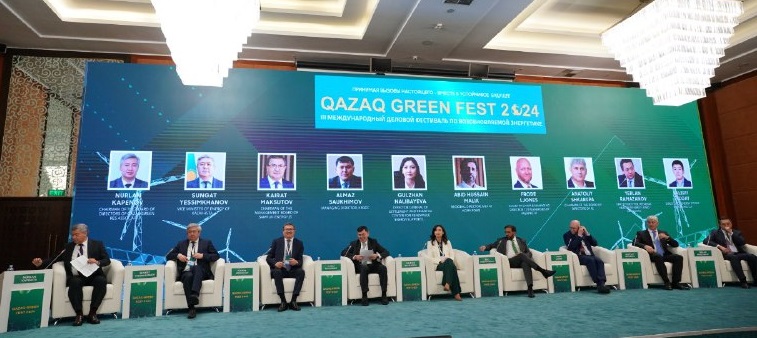
QAZAQ GREEN. A project to unify the Western Kazakhstan power system with the nationwide system will be launched this year. This will allow the transmission of power flows from the West to the Center and increase the reliability of supply. This was announced today by Almaz Saukhimov, Managing Director for Development of the Unified Power System (UPS) of KEGOC JSC, during a panel session of the international business festival Qazaq Green Fest, reports Kapital.kz.
He listed major projects that take into account the general development of Kazakhstan's power system until 2035. It includes increased load, introduction of flexible generation, including coal, gas and RES.
"Of our major projects, we are currently implementing the reinforcement of the South Zone power grid. This project is being implemented, it was started last year. This year, a project will be launched to unify the Western Kazakhstan power system with the Unified Energy System (UES) of the country. This, as you know, is also a very ambitious project that will allow us to unite our two power systems," he said.
The Managing Director noted that today the Western power zone operates separately from the UES of Kazakhstan, and such unification will allow, firstly, to transmit power flows from the West to the Central part, and from the Central part to the Western part to regulate imbalances and increase the reliability of the Atyrau, Mangystau and West Kazakhstan regions.
"We at KEGOC understand that it is necessary to have time to modernize the existing power lines that are part of our power system. If we do not pay attention to this, then soon they will also come into disrepair, and this will not be good for the power system. One of our most ambitious projects is the project to build DC lines from North to South," he explained.
The North-South project will allow for greater integration of renewable energy sources, as the DC line has certain flexibility properties due to semiconductor systems.
"This allows us to quickly regulate voltage and current. And this significantly increases the reliability and stability of the power system. In addition, the reinforcement of the external power supply scheme of Astana is planned. The capital has a very high load growth due to population growth," Almaz Saukhimov noted.
He explained that in Astana there is the TsGPP (Central Main Step-Down Substation) substation, which is 100% loaded.
"With this project, we want to strengthen the overall power supply of Astana by looping it. This will also allow us to strengthen reliability and integrate more RES sources, because additional transmission capacities will be created for the exchange of electricity," said Almaz Saukhimov.
In addition, it is planned to build a line from the Karaganda substation to the new Astana substation.
"Karaganda and the Karaganda energy hub are deficit regions, there is a large load. Understanding this, we are now laying down in our vision that a new substation should appear there soon, this is a power transmission line from Astana to Karaganda, and from Karaganda to Zhezkazgan. They will strengthen the power supply of the Ulytau region," he stressed.
In addition, a 500 kV line will be laid from Zhezkazgan to Kyzylorda, and then from Kyzylorda to Shymkent.
"In Kyzylorda, it is planned to build a new combined cycle plant with a capacity of 1144 MW, the next stages are the construction of a 500 kV line "Karabatan" in the village of Beineu, Mangystau region. And the final stage of unification is the construction of the 500 kV Beineu-Shalkar-Kyzylorda line. Thus, we will loop our power system, and this will allow us to maneuver and manage the electrical mode," concluded Almaz Saukhimov.
Azerbaijan to raise renewables share to 34% by end-2027
Solar power helped Europe weather the energy crisis, but growth is slowing
Nepra tightens wheeling rules, mandates battery storage for solar, wind projects
Women in Bangladesh turn EV battery swapping into a new source of income
Sydney CBD solar farm to cut carbon emissions by 2,000 tonnes a year
IEA: Türkiye needs faster investment in grids and storage as energy demand rises
Kazakhstan holds auction for selection of hydroelectric power plant construction projects
Equinor brings its largest US battery storage project online
Norway launches project to integrate wind propulsion into commercial shipping
China's photovoltaic power capacity overtakes coal-fired power for first time
Germany moves to cut the cost of offshore wind
UN presents Climate Report: 1.5°C threshold will be breached without urgent action
Europe on track for a record year in wind power
Rosatom plans wind turbine component plant in Russia’s Amur region
EBRD backs Tajikistan’s plans for solar power auctions
Solar power helps Europe avoid €30 billion in gas imports
Kazakh scientists test energy storage device with more than 750,000-cycle lifespa
Agrivoltaics cut worker heat stress and saved 22% of water, new model shows
Uzbekistan commissions 300 MW solar plant with 150 MW ESS
SolarWindow unveils ultra-thin solar film for curved surfaces