


News Kazakhstan19.11.2026
How Kostanay region is tackling its power shortage with green energy


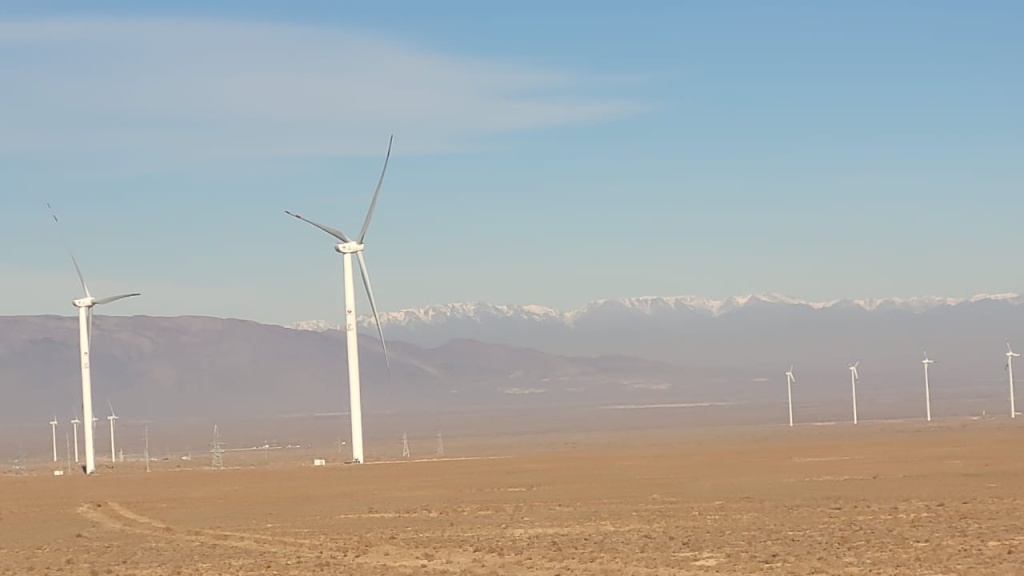
QAZAQ GREEN. Kostanay region consumes four times more electricity than it generates. As a result, around 60% of its power has to be bought from neighboring countries, according to official statistics from the regional akimat, Baq.kz reports.
In recent years, the energy deficit has become so severe that construction of high-rise buildings has slowed and the commissioning of new housing has stalled. This has become a serious threat not only to the region’s energy security but also to construction and other businesses. Looking for a solution, the regional authorities considered several options, from developing coal mines to building new combined heat and power (CHP) plants. In the end, they chose a cleaner and more promising path – building wind farms. And it seems to have paid off. The region recently opened its fifth wind farm, and next year’s plans promise to outshine everything that came before.
Power shortages hit construction and other businesses
The lack of power capacity holding back construction and other businesses in Kostanay region has been discussed for about 20 years. But the problem has now become so acute that local power companies have started refusing to issue technical specifications for connecting new homes. According to the Kostanay city akimat, the region’s power capacity deficit is currently estimated at about 40 MW. City officials are seriously concerned.
“An entrepreneur came to us wanting to start producing New Year trees to supply local markets and even CIS countries. He needs only about 1 MW, but even that is impossible to provide,” Kostanay city akim Marat Zhundubayev said at a recent meeting.
The acute shortage was confirmed by Zhaslan Klyshev, chief engineer of EPK-forfait LLP, which operates Kostanay’s city power grid.
“We can increase capacity locally on the city grid, but there is none left at the substations. For that, new substations must be built, and all projects have to be approved by MRET LLP and KEGOC JSC,” the chief engineer said.
MRET LLP and KEGOC JSC are Kostanay’s two power transmission companies, and for the past several years all construction companies have been required to agree technical specifications with them. Many, however, are simply turned down, which is hurting the construction business.
“For several years now we have been saying that housing construction has slowed because of the power shortage. MRET has stopped issuing technical specifications to developers for grid connection. There have been cases where developers had to guard a new building at their own expense because they could not commission it without electricity,” the Kostanay Region Builders Association said.
At least four substations needed
According to the transmission company, the city currently has only two substations, and their capacity is fully exhausted.
“To obtain technical specifications for connecting buildings to the grid, new developers must first prepare a detailed planning project and have it reviewed. The project must state how much power the construction company expects to need, but developers do not follow this procedure,” said MRET chief engineer Viktor Kiriy.
According to him, developers simply cut corners. To start construction, they obtain so-called “lower-level technical specifications” issued by the city grid company. But these cover reserves of no more than 10 kW. Building homes requires far more electricity, and only MRET can approve that. Developers simply do not approach MRET, knowing they would not get a construction permit. As a result, having started building with only the “lower-level specifications,” they end up facing an energy collapse, and by the time residents move in, the buildings are still not connected to the grid.
“Nobody controls this process. Everyone knows the substations lack capacity, but construction goes on anyway,” the chief engineer said.
He sees the solution in building the new substations that have been discussed for several years. The city needs at least four of them in different parts of Kostanay.
The Ortalyk substation is planned for the city center, Barys for the southwest and Vostochnaya for the southeast. The latter is to be built on the site of the Narimanovsky market, which was demolished last year amid a major scandal.
But all of them will be small, as there is no room left for large substations. These three will be 110 kV substations. Only the Yug substation in the south of the city, which will also serve the new Kunai neighborhood, is planned at 220 kV.
But these are only plans. Even the exact locations of the substations are still unknown, let alone whether the budget will have enough money to build them.
According to preliminary estimates, each will require a substantial sum – around 10–15 billion tenge. Sites must be chosen so that cables can be laid to connect them to consumers. All of this involves endless approvals and sign-offs, and sometimes even buying land from private owners, which delays substations that are urgently needed right now.
Under the city’s master plan, all four substations are due no earlier than 2030, with two more 110 kV substations – Uzkokoleinaya and Sukhoi Port – to follow by 2040.
However, given the construction boom and the rapid growth of other businesses, these timelines are far too long.
The first wind farm, then four more
That is why the authorities have bet on renewable energy. It is faster and greener than building substations, though not cheaper. And compared with long-drawn-out plans based on non-renewable sources, wind farms have far greater prospects.
Kostanay region currently has five wind farms with a combined capacity of 248 MW.
They are spread across different parts of the region. They include the 50 MW Ybyray wind farm in Kostanay district, launched in 2022, and a 48 MW station in Arkalyk, opened in 2023.
Another 50 MW wind farm, owned by Aspan Energo LLP, began operating in summer 2026.
Most recently, Universal Energy opened a new wind farm in Maikol rural district of Kostanay district, near the village of Shiminovka. At 100 MW, it has twice the capacity of any of the previous ones. Another small station was also opened in Arkalyk.
Ybyray, the region’s very first wind farm, began operating only four years ago. Since then, the number of facilities has grown, if not rapidly. And next year, the region expects a major project with 165 wind turbines.
When Ybyray first opened, there was more skepticism and doubt than hope.
Several years were spent just assessing wind speeds and gusts and choosing the site for the future turbine blades. In 2018, the region began measuring wind potential in Kostanay district, where the first generator was to be built. The UN Development Programme, commissioned by Kazakhstan’s Ministry of Energy, created a wind atlas, and an anemometer mast was installed in the district.
It took two years to collect data on wind strength and air humidity. Next came the design and cost estimate documentation, which the region had never had before. Construction took another couple of years, and in 2022 the region got its first long-awaited renewable energy sources.
“Every station has what is called a capacity factor. Our station has 16 turbines, and its capacity factor is above average. The station’s average annual load is about 50%,” said Timur Shukutbayev, deputy head of the first wind farm in Kostanay district.
According to him, some of the turbines often run in curtailed mode because, under the project terms, the station may not generate more than 50 MW.
The first experience of harnessing wind power inspired other investors, and over four years Kostanay region gained four more wind farms.
Investment and capacity keep growing
The fifth wind farm opened recently, in mid-October. Its capacity of 100 MW allows even more clean energy to be generated.
“We plan annual generation of 360 million kWh. If we were burning fuel to produce that much electricity, it would result in about 300,000 tonnes of emissions a year. But wind is a renewable source, which makes it beneficial both economically and environmentally,” said Tamerlan Razbekov, a representative of the investor.
Almost 40 billion tenge was invested in the new wind farm, currently the most powerful in Kostanay region. The investment is expected to pay off within 8–10 years.
“Technology keeps advancing. Our previous facilities used 3.25 MW turbines, while the new one in Kostanay district has 6.25 MW turbines. The Ybyray turbines operate at wind speeds from 3 to 25 meters per second and reach maximum output at 8 meters per second. Our installation will deliver maximum output at wind speeds of 7–10 meters per second,” the expert said.
All the energy produced by the region’s new wind farm will go into the country’s unified power system. Its design capacity of 100 MW could fully cover Kostanay’s needs, but the project aims to redistribute energy across the country and even supply neighboring regions and countries.
“This doesn’t mean we won’t get anything. It’s just that some regions need wind energy more, and we will soon have another, even more powerful project,” the regional energy and housing and utilities department said reassuringly.
A ninefold increase in power generation
The north’s most powerful wind farm to appear in two years
Recently, major investor Turan Wind Energy LLP signed an agreement with the country’s Prime Minister to build another large wind farm in Kostanay region. It will be the most powerful in the northern region.
“The construction project has been approved. The site has been determined. Work will begin in spring 2027 and be completed in 2029,” the regional akimat said briefly.
According to official data, the project includes 165 wind turbines with a total capacity of 1,000 MW – ten times the capacity of the wind farm opened this October. Another feature is that the wind farm will be able to keep up to 300 MW in reserve thanks to an energy storage system, helping to balance generation and distribute electricity.
The 165 turbines will be located in three districts of the region – Kostanay, Fedorov and Beimbet Mailin. Total investment exceeds that of all previous projects combined, at more than 380 billion tenge. The project will create over 750 new jobs.
The regional authorities see new renewable capacity as key not only to ending the region’s energy deficit but also to giving a strong boost to industrial development. Local carmakers and a number of other manufacturers are interested in green energy.
Just as importantly, green energy could help Kostanay region make a breakthrough in diversifying its economy beyond its industrial and agricultural focus.
“Today our region is energy-dependent. We consume about 0.45 GW of electricity, while generation is only 0.12 GW. In other words, we produce four times less than we consume,” said Kostanay Region Akim Kumar Aksakalov.
According to him, in addition to the next wind farm, the region plans to build its first solar power plant and then a gas piston power plant.
The regional finance department has also assessed the purely economic effect of wind farms and concluded that renewable energy is much cheaper than non-renewable energy. Another advantage is the high average wind speed in many parts of the region.
“All these factors make the region attractive for wind farm construction. Developing renewables in Kostanay region can bring significant economic, environmental and social benefits. A mega-project, the first in northern Kazakhstan, is now planned in the region. Once it is completed, we will be able to increase power generation in the region ninefold, which will fully cover our needs,” the head of the region said, describing the impact of wind farms for the region and the country.
Cleaner air and water, preserved land
Experts also point to a strong environmental effect. Kazakhstan’s power system has historically relied on burning coal, which accounts for more than 70% of electricity generation. Developing wind power directly addresses the main environmental problems.
First of all, it reduces greenhouse gas emissions. Wind farms do not emit carbon dioxide when generating electricity, which helps the country meet its decarbonization commitments.
Wind turbines do not release the sulfur and nitrogen oxides, heavy metals or fine particulate matter produced by coal-fired CHP plants. This helps improve air and water quality. Unlike open-pit coal mining, wind farms do not destroy the landscape and preserve farmland. Once turbines are installed, the surrounding land remains suitable for agriculture.
Large wind farm projects are currently under way in four regions of the country.
In addition to Kostanay region, construction has begun on the large-scale Mirny wind farm in Moiynkum district of Zhambyl region, with the same capacity as the Kostanay project – 1 GW (1,000 MW). Its integrated energy storage system, however, will be twice as large – 600 MW. Commissioning is scheduled for the end of 2028.
In Pavlodar region, another 1 GW (1,000 MW) wind farm project has been launched with support from Chinese investors. In Mangystau region, a green hydrogen production project is being implemented using vast wind and solar capacity. Its cost is estimated at 40–50 billion US dollars.
EU Council and Parliament agree to speed up permits for renewables and grids
How Kostanay region is tackling its power shortage with green energy
Google to buy 50 MW of superhot geothermal power in Oregon
Amazon plans to invest additional $7 billion in renewable energy in India
U.S. energy storage installations surpass 200 GWh
Garmin patents smartwatch with solar panel under the cover glass
Lebanese government approves electricity plan focused on gas and renewables
Remote communities in Turkmenistan to get up to 10 solar mini-plants
Türkiye and China sign renewable energy MoU envisaging about $15 billion in investment
Construction begins on 251.9 MW solar-plus-storage project in Greece
Acwa to commission two solar plants in Türkiye in 2029
Arman Shaikhanov appointed Chairman of the Management Board of KOREM
RWE and KKR commit £12 billion to UK offshore wind
Guterres urges climate justice compact at COP31
Agreements to build two wind farms in Kazakhstan signed at COP31
Kazakhstan and Germany discuss development of renewables and green hydrogen
Sergey Aleyev appointed Head of Financial Settlement Center for Renewable Energy Sources
Yerlan Akkenzhenov presents amendments on developing alternative energy sources to the Kurultai
Russia’s Omsk region plans to build its first wind farm
Кazakhstan’s renewable power output grows more than 16-fold in ten years