

Education and science20.12.2020
Nazarbayev university develops RES polygon


Aidar Zhakupov, NURIS CEO
NURIS Nazarbayev University
Risk-taking Inspiration Synergy
Recently, Nazarbayev University has celebrated its tenth anniversary, and one of its most important achievements so far is the creation of an innovative cluster by Nazarbayev University
Research and Innovation System (NURIS). Among the most important parts of the Cluster's infrastructure is the RE Polygon. Aidar Zhakupov, NURIS CEO, told QazaqSolar about the contribution that the Polygon makes to scientific research, the dissemination of knowledge and the development of competencies of industry specialists.
- Aidar Beksultanovich, QazaqSolar editorial team joins in congratulations on the NU tenth anniversary and wishes the university staff all success in set goals. Please tell us about the history of the RE Polygon, created on the basis of the Nazarbayev University campus.
- Thank you very much for congratulations. Yes, looking back we firstly should remember the creation of the Center for Energy Research at the dawn of Nazarbayev University, which was later reorganized into the Nazarbayev University Research and Innovation System. I would also like to note that renewable energy has been identified as one of the priority areas for
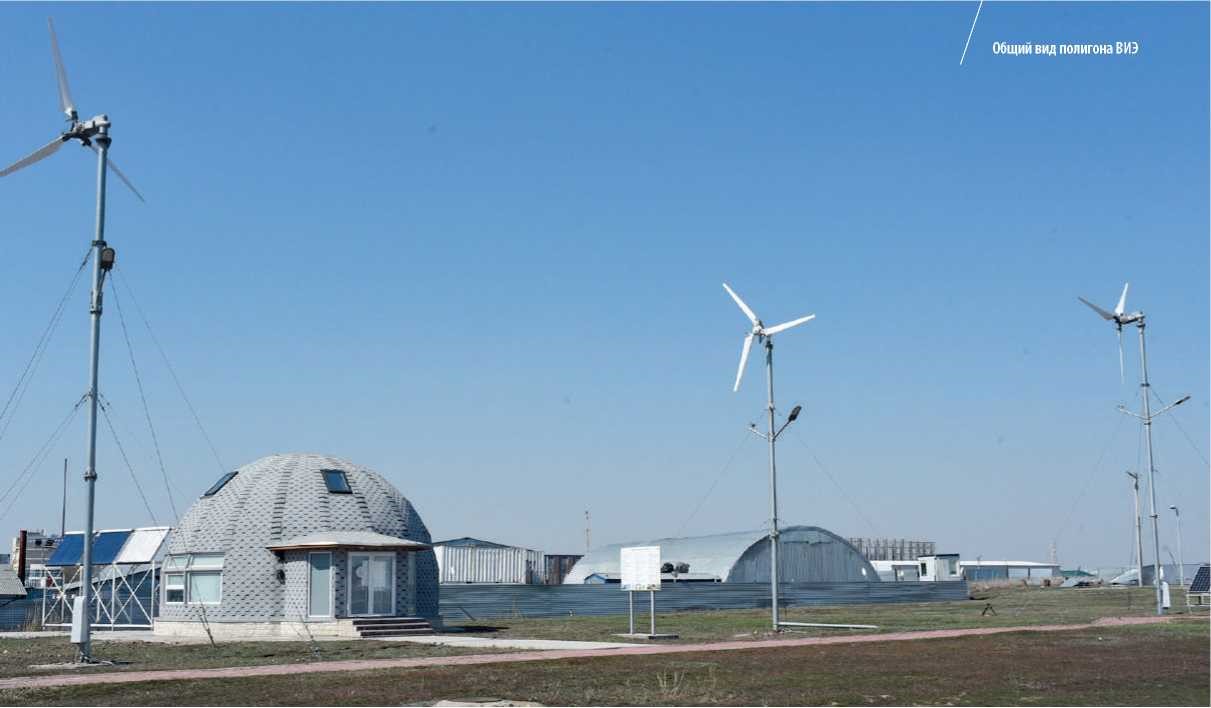
the development of newly created scientific laboratories. In addition to test stands and laboratory facilities, it was important to create real wind turbines, solar panels and solar systems operating in real climatic and operating conditions. That is why, it was decided to create the RE Polygon. During 2012-2016, at the expense of the Ministry of Education and Science of the Republic of Kazakhstan, pilot wind/solar hybrid installations were created. Thanks to a grant from TOTAL, the SunPowerOasis C-7 solar power plant was designed and built. In addition, a wind pumped storage system was set up (a grant from Shevron). In 2017, thanks to a grant from BG Kazakhstan (Shell), a prototype of an energy-efficient Shell-Yurt was designed and built. It is equipped with autonomous heat and electricity systems based on renewable energy sources (geothermal heat pumps, solar power systems), as well as an inflow and exhaust ventilation system with heat recovery. During 2018-2020, the Shell-Yurt control system was modernized and improved, and the Smart Grid system of the RE Polygon is being finalized. In 2020, a set of laboratory works on the RE Polygon was developed.
- Indeed, the NURIS RE Polygon is a great place for research and development. At the same time, we noticed that the infrastructure is composed of mostly small-scale autonomous renewable energy systems to supply energy to buildings. What is the reason for developing mostly this kind of RE technologies?
- Effective state policy in the field of «green» economy and support for renewable energy sources led to a rapid growth in renewable energy facilities (wind and solar) integrated into the grid. This is, undoubtedly, an area of great interest for international and large Kazakhstani businesses. However, an increase in the number of commissioned facilities (despite positive global environmental trends) has not led to an improvement in the environmental conditions of cities and towns, especially in the north of Kazakhstan, where coal is still used for heating houses. One of the ways to reduce environmental pollution in cities is to switch to autonomous renewable power supply of buildings. In RE legislation, there is a net consumer concept, under which it is possible to offset the value of electricity produced by small-scale power plants (installed at home) and exported to the grid against future electricity bills. However, we still have a relatively small number of net consumers in the country.
Another important issue is the energy supply of agro-industrial complex and rural facilities. Often a business that wants to design and construct grain storage facilities, vegetable storage facilities, greenhouses, etc., simply cannot get the technical conditions for connecting to power grids due to a lack of capacity.
Comparatively high costs for the installation of power lines and significant energy losses are also among constraining factors for the development of RE in rural areas.
For this reason, we focused on creating a demonstration site to display the use of small-scale renewable energy facilities for autonomous power supply of building. Since solar power systems and heat pumps are low-grade heat sources, it is first of all necessary to improve energy efficiency of the enclosing structures to reduce heat losses. Therefore, at the RE Polygon, we implemented a number of solutions to improve energy efficiency of RE facilities for electricity and heat supply.
- Aidar Beksultanovich, could you please elaborate on the existing Polygon's infrastructure.
- The infrastructure is composed of a complex of energy systems and renewable energy facilities, powered by solar, wind energy and low-potential surface heat energy. Let's look at each renewable energy system separately:
THE FIRST one is on-grid solar panels of 10, 15 and 25 kW.
These systems are intended to supply energy to buildings and facilities by direct conversion of solar energy into electrical energy and direct integration of the generated electricity into a three-phase grid. With a total capacity of 50 kW, the system covers up to 25% of power supply to the Technopark building.
The second one - off-grid wind/solar hybrid power systems of 2,5 and 10 kW.
THE SECOND type is autonomous hybrid power supply system (include photovoltaic modules and wind generators) which accumulates the generated electrical energy in batteries. These systems have the ability to automatically switch the power supply system to the reserve one.
THE THIRD is Shell Yurt, an energy efficient laboratory building with autonomous heat supply sources.
Shell Yurt is a unique energy efficient dome home equipped with RE-based microclimate solutions. This equipment includes solar thermal collectors, a heat pump, an inflow and exhaust ventilation system with heat recovery in cold weather and cooling in hot weather. Shell Yurt autonomously satisfies its own heat and electricity needs.
THE FOURTH one is a digital system for monitoring and visualizing thermal and electrical parameters of the Shell Yurt building and the wind/solar hybrid power plant, as well as weather data.
Scientific research requires numerical data on thermal and electrical parameters both for generation and consumption, as well on the impact of external meteorological factors, temperature, wind speed, and the level of solar radiation. Moreover, the listed parameters should be linked to each other, since a change in one parameter, for example, temperature, leads to a change in the operating mode of equipment, for example, a heat pump.
For this reason, it was necessary to create a unified digital information and measurement system for monitoring and visualizing thermal, electrical, meteorological, and even economic data.
The system is capable to perform the following tasks:
- measurement of thermal and electrical parameters: coolant flow rate and temperature; voltage and current; consumed electrical power and energy;
- software processing and calculation of technical and economic indicators: the value of thermal energy from various sources, the cost of thermal and electrical energy;
- visualization of meteorological data: air temperature, level of solar radiation, wind speed, atmospheric pressure, humidity;
- data archiving in the DBMS;
- display and visualization as mnemonic diagrams and time-based graphs (minutes; hours; days; week; month; year).
- In one of his interviews, Nurlan Kapenov, Chairman of the Board of Directors of SPAQ and the founder of our magazine, pointed out the problems of staff shortages in the field of renewable energy in the light of its rapid development. How can the RE Polygon be used to develop competencies, improve qualifications and disseminate knowledge in the field?
- Indeed, the rapid development of renewable energy and the creation of a large number of new jobs in the field requires a significant improvement in personnel training and retraining. The lack of qualified personnel to develop, design, finance, build, operate and maintain renewable energy projects is one of the biggest obstacles to a further development of renewable energy technologies. At present, 31 universities and 21 colleges are training specialists in electric power engineering, 26 universities and 16 colleges - in heat power engineering. However, only the Almaty University of Power Engineering and Telecommunications offers a minor in RE and has trained 61 RE specialists so far. In the course of an independent assessment of Kazakhstani universities carried out in cooperation with the Ministry of Education and Science of the Republic of Kazakhstan, it was revealed that 73% of educational programs do not meet employers' requirements. Also, within the framework of the UNDP / GEF Project “Roadmap for organizing a system of advanced training and improvement of the educational process in the field of renewable energy”, several seminars were held to improve qualifications and training in the field. At the same time, to further develop the area, it is necessary to significantly expand activities to disseminate knowledge and practical skills, improve qualifications and retrain personnel. In addition, one of the obstacles to the development of RE in the agro-industrial complex and housing and communal services is the low awareness of RE both among officials who make decisions on the development of infrastructure projects, as well as farmers and housing and communal services workers.
Therefore, we propose to create RE Competence Development Center on the basis of the Polygon. In addition to advanced training and retraining of personnel, this project will allow creating a system for the dissemination of knowledge and practical skills about the advantages of using renewable energy technologies in various economic sectors, especially in agriculture and housing and communal services. We are currently working on defining the organizational forms of the NURIS-based Center.
It is assumed that the project's target audience can be engineers, college and university students, university professors, representatives of agricultural enterprises (farmers), employees of construction companies and housing and communal services, NGO representatives and government officials.
We invite interested organizations and individuals to cooperate and ensure that this project, necessary for the development of RE field, is implemented.
Bishkek hosts first round of talks on Kambarata HPP-1 сonstruction
UNICEF brings solar power to rural health clinic in Turkmenistan
World's first solar-powered ambulance to hit the road in 2026
Uzbekistan launches clean hydrogen initiative for energy transition
Four clean energy technologies now cheaper than fossil fuels, EU research finds
Russia to commission around 1 GW of renewables in 2026
TotalEnergies and Masdar to form $2.2 bn JV to accelerate renewable energy growth in Asia
Renewables cover over 50% of German electricity consumption in Q1
New process turns CO₂ and sunlight into aviation fuel
IRENA: world adds record 692 GW of renewable power in 2025
Vietnam sets 10% solar target for homes and government offices
Abu Dhabi villa owners get green light to generate and store solar power
Euronews: Europeans rush to buy solar, heat pumps and EVs
Kyrgyzstan to increase renewable energy generation to 1.5 bn kWh
UN actively supports preparations for Regional Ecological Summit in Kazakhstan
Astana to host Central Asia's RES EXPO-2026
Spain and China build a solar storage giant in Chile's desert
EBRD backs Lithuania's push into large-scale battery energy storage
Sun beats coal: why the energy crisis will speed up Asia's shift to renewables
SPIC and Kazakhstan break ground on 1 GW wind farm near Ekibastuz