

World News15.04.2024
90-GWh thermal energy storage facility could heat a city for a year


QAZAQ GREEN. An energy supplier in Finland has announced the upcoming construction of an underground seasonal thermal energy storage facility about the size of two Madison Square Gardens that could meet the heating demands of a medium-sized city for up to a year, New Atlas reports.
Though renewable energy systems play an important part in the supply matrix, the wind doesn't always blow and long days of sunshine are not guaranteed. We've seen a number of energy storage solutions being proposed to deal with the intermittent nature of such setups over the years, including a hibernating battery, rechargeable aluminum, and an industrial-scale sand battery.
"The world is undergoing a huge energy transition," said Vantaan Energia's CEO, Jukka Toivonen. "Wind and solar power have become vital technologies in the transition from fossil fuels to clean energy. The biggest challenge of the energy transition so far has been the inability to store these intermittent forms of energy for later use. "Unfortunately, small-scale storage solutions, such as batteries or accumulators, are not sufficient; large, industrial-scale storage solutions are needed."
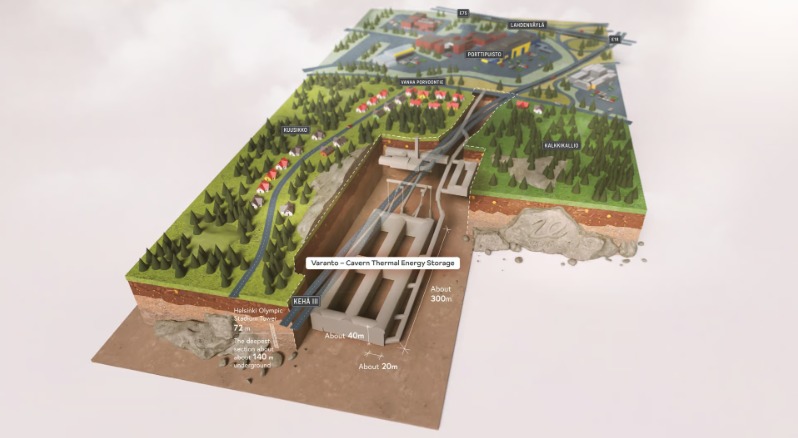
The company's solution for the city of Vantaa in the south of Finland is to construct huge underground caverns to store thermal energy, which can then be pumped to homes and business via an existing district heating network when needed.
The project has a total volume of 1.1 million cubic meters (38.85 million cubic feet), including processing facilities, and will be built into the city's bedrock at around 100 m (330 ft) below ground – though the deepest parts of the setup could go down as far as 140 m. Three caverns will be created, each measuring 300 m (984.25 ft) in length, 40 m (131.2 ft) in height and 20 m (65.6 ft) in width.
These will be filled with hot water by a pair of 60-MW electric boilers, powered by renewables when it's cheap to do so. Pressure within the space allows for temperatures to get as high as 140 °C (284 °F) without the water boiling over or steaming away. Waste heat from industry will also feed the setup, with a smart control system balancing energy sources.
The Varanto facility is reported to have a total thermal capacity of 90 GWh when "fully charged" – enough to meet the year-round domestic heating needs of a "medium-sized Finnish city."
The seasonal thermal energy storage facility underneath Vantaa in southern Finland is reported to have the equivalent energy capacity of 1.3 million electric car batteries
The majority of the homes in Finland's fourth most populated municipality are hooked up to the city's 600-km-plus (373-mile) underground district heating network, where hot water is pumped through a closed two-pipe system and into heat exchangers at each building. Once the heat transfer has taken place, the cooled water is then piped back to the production plant and reheated so the cycle can begin again.
The Nordic country is reported to be the largest producer of district heating in the region – in relation to population – and generated some 37.3 terawatt-hours in 2023, with more than half sourced from renewables and 14% coming from waste heat.
In Vantaa, a waste-to-energy plant that burns a mix of non-recyclable domestic and commercial/industrial waste, plus the wood-fueled Martinlaasko Power Plant, are responsible for providing the heat for the local network at the moment. A high-temperature incineration plant that can take in hazardous waste will come online next year.
The Varanto seasonal thermal energy storage facility is expected to enter the mix from 2028, with construction of the entrance due to start in a few months from now. Though reported to enable "cost-effective storage of renewable energy and waste heat on an industrial scale," actual figures or estimates are yet to be revealed.
Vantaan Energia estimates the build cost to come in at 200 million euros, with the Finnish Ministry of Economic Affairs and Employment already topping up the project pot with a grant of €19 million. The video below gives a brief overview.
Kazakhstan and World Bank discuss energy integration in Central Asia
Construction of 500 MW wind power plant begins in Karaganda region
50 MW solar power plant auction winner determined in Kazakhstan's Southern Grid Zone
Rooftop solar panels: Kyrgyzstan prepares rules for households and businesses
Europe’s rising heat: Can renewables provide the solution?
Winner announced for 100 MW solar auction in Kazakhstan
Chinese company ready to invest $1 billion in solar and wind generation in Kyrgyzstan
Meta to invest in space solar energy and ultra-long-duration energy storage
Tokyo pushing plan for world’s biggest floating wind power farm
Kazakhstan cancels 50 MW solar auction due to lack of participants
Tokayev ratifies Green Energy Corridor Agreement with Azerbaijan and Uzbekistan
China raises RES share to 60% of total installed capacity
Batys Kaspiy Energo wins auction for 250 MW wind farm in Atyrau region
Ember: Renewables overtake coal in global power generation for the first time
Kazakhstan continues accepting applications for May RES auctions
Water-energy balance of the region discussed by ministers of four Central Asian countries
Just transition: leaving no one behind in the energy transformation
CAREC and Central Asian universities sign new memoranda on green skills development
Kazakhstan and UNECE discuss energy resilience and low-carbon technologies
100,000 jobs and a skills gap: how Central Asia is preparing for the renewables boom