

World News23.04.2024
Production of a solar energy storage battery has started in Vilnius


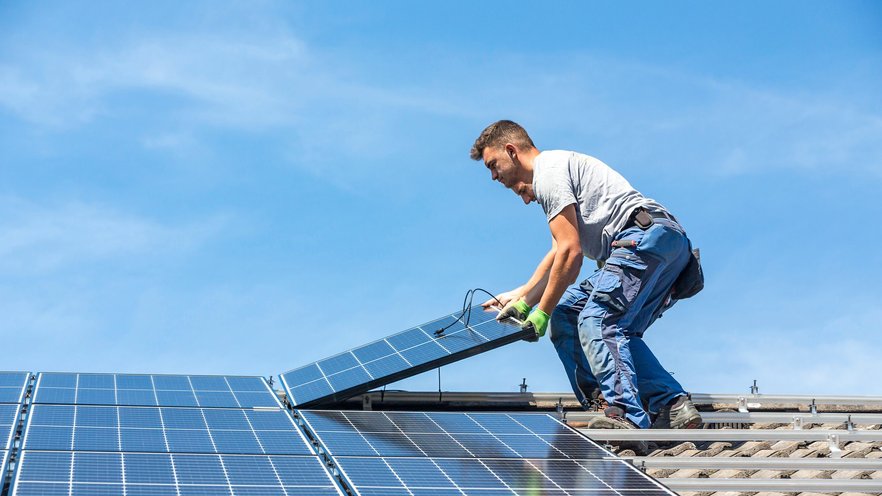
QAZAQ GREEN. The first Lithuanian smart battery "Nova" that stores electricity produced from the sun has been introduced, which can already be purchased by producing household consumers and small businesses, according to Made in Vilnius.
The smart battery was manufactured by SoliTek, a company belonging to the BOD Group.
The new battery production line was presented on Friday at the "Business and Innovation Center" opened in the capital. According to the head of BOD Group, Vidmantas Janulevičius, this is a "zero emission" building, self-sufficient in heat, and therefore the only one in the city not connected to central heating.
SoliTek started producing the Nova battery in 2023, according to SoliTek CEO Julius Sakalauskas, having been developing it for about three years before that.
"The investment in production equipment alone is about 1,5 million. euros. There is still all the development and certification of the product. We are talking about six-figure sums (in total - ELTA), he told Elta.
According to the head of the company, there are no specialists in Lithuania capable of developing such technology, so the company worked with partners in Belgium and Turkey when developing the battery.
The company sells 5-40 kwh (kilowatt-hour) electricity storage batteries to household consumers and small businesses. According to SoliTek manager Julius Sakalauskas, average batteries with a capacity of 10 kwh price - about 8 thousand euros, the price depends on the battery capacity. APVA support can be obtained for its installation.
"The payback of the battery should be about 6-7 years after using the support provided by the state. I would say it is a good investment (…) After installing the battery, you can get support, partially (the state - ELTA) finances it. As with solar power plants, an analogous system," he explained.
According to J. Sakalauskas, this battery is intended for those who want to store unused energy produced by the solar power plant, it also acts as an additional source of electricity in the event of a power outage at home, and can temporarily increase the power of the home's electrical network.
“The battery has three-phase backup in case of power failure. For example, if the electricity goes out completely, the battery will fully serve your house, even three-phase appliances", said J. Sakalauskas to Eltai.
According to him, a battery with a higher capacity can supply the house with electricity for several days. Also, according to J. Sakalauskas, the artificial intelligence (AI) installed in the battery ensures that unused electrical energy is stored as efficiently as possible.
"The battery is smart in that it predicts the generation of the solar plant. It takes tomorrow's weather forecast, looks at it, predicts how much electricity it should generate tomorrow. It also takes electricity prices from the (Nordpool electricity - ELTA) exchange tomorrow and estimates the consumption of how much electricity you normally use at what time of day. Based on this, the algorithm calculates the optimal mode to minimize your electricity bill, when it will be cheapest to charge," explained the head of SoliTek.
"It (battery technology - ELTA) is lithium-ion iron phosphate technology, which is the safest technology on the market right now for exactly these (renewable electricity - ELTA) solutions," said the SoliTek CEO.
Also, according to him, although this technology is widespread in the world, this battery made in Lithuania differs "in its intelligence and management optimization".
"Other batteries just act like a battery. You charged, you discharged. This charges by optimizing your electricity bill," he emphasized.
According to J. Sakalauskas, the lithium used to make this electric battery is bought mainly from Asia, mostly from China.
"Lithium is enough for now. Perhaps there is a misconception here that it is getting so low that it is about to run out. As new deposits of lithium are discovered, lithium itself is not a big problem. The problem is that it is not available in Europe. Our goal (…) is to import as much of this material as possible into the European Union, from which it is forbidden to export lithium batteries for recycling. As a result, we accumulate and in the future we will be able (…) to recycle the same batteries and use the recycled raw material again for the production of batteries", said J. Sakalauskas.
According to him, there are no specialists in Lithuania capable of developing such technology, so the company worked with partners in Belgium and Turkey when developing the battery.
SoliTek is the largest manufacturer of solar modules and energy storage systems in Lithuania and throughout Northern Europe. The company was founded in 2009 and belongs to the group of high-tech companies "BOD Group".
CAREC and Central Asian universities sign new memoranda on green skills development
100,000 jobs and a skills gap: how Central Asia is preparing for the renewables boom
No transition without transmission: How Central Asia is building its energy future
ADB to invest $5.5bn across 15 projects in Kazakhstan
17 agreements worth over $2.3 billion signed at the opening of RES 2026 EXPO in Astana
World Bank to invest $1bn in Central Asia's energy integration
Kazakhstan and China to launch a 500 MW wind farm in Karaganda region
Kazakhstan and Tajikistan move toward clean power deal over Rogun HPP
Regional Ecological Summit 2026 opens in Astana
Solar pumps and drip irrigation help Kyrgyz farmers cut costs amid rising energy prices
Hormuz closure failed to trigger coal comeback as solar and wind filled the gap
Astana set to launch RES 2026 EXPO and ink key international deals
Central Asian countries to discuss energy transition at RES 2026 in Astana
Moldova surpassed 1 GW of installed renewable energy capacity
China begins building US$1 billion hydropower station in Cambodia
Thousands protest in Germany urging faster green shift
Scientists from Russia and Uzbekistan improved the stability of green energy systems by 24%
Kazakh startup ranks in GCIP global top 3 in Vienna
Kazakhstan poultry farm produces 15 million kWh of energy from waste
China, Spain expand partnership in solar and wind power