

World News22.04.2024
Japanese satellites will transmit solar power to Earth


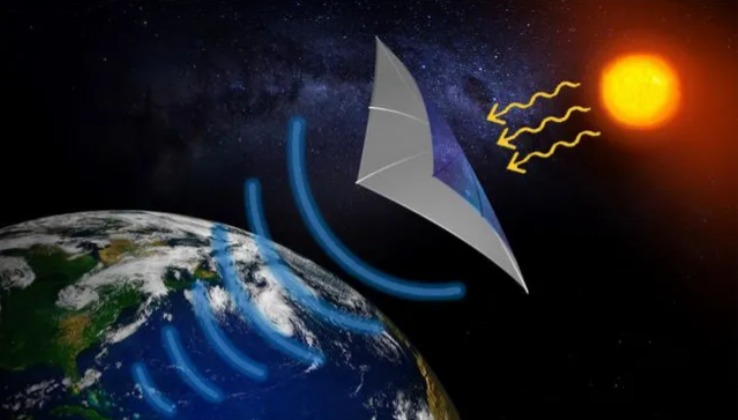
QAZAQ GREEN. Japan is preparing to transmit solar energy from space to Earth next year, two years after American engineers achieved the same feat. The development marks a major step towards a space-based solar power station that could help the world cut fossil fuels amid the fight against climate change, Spacereported on April 19.
Speaking at the International Conference on Energy from Space held this week, Koichi Ijichi, an advisor at the Japan Space Systems research institute, outlined a roadmap for testing small solar power plants in space, broadcasting wireless energy from low orbit to Earth. According to him, it will be a small satellite, about 180 kg, transmitting about one kilowatt of electricity from an altitude of 400 km. One kilowatt is equivalent to the amount of electricity needed to run a household appliance such as a small dishwasher for about an hour, depending on size. Therefore, this experiment cannot be compared to the scale for commercial use.
The spacecraft will use a 2 m2 solar cell to charge the battery pack. The accumulated energy will then be converted into microwaves and transmitted to the receiving antenna on Earth. Because the spacecraft moves very fast, about 28.000 km/h, the antennas need to spread over 40 km, each 5 km apart, to be able to transmit enough energy. According to Ijichi, transmission only takes a few minutes, but when the battery runs out of power, it takes several days to fully charge.
The mission is part of the OHISAMA project (which means Sun in Japanese) and will launch in 2025. Researchers have tested wireless transmission of ground-based solar power from a fixed source. They plan to conduct transmissions from planes in December this year. The aircraft will be equipped with solar batteries similar to those used on spacecraft and transmit power over a distance of 12-5 km.
The idea of producing solar power in space was first described in 1968 by former Apollo engineer Peter Glaser. Unlike most renewable electricity generation technologies on Earth, solar power in space is constantly available because it is independent of weather and time of day. Currently, nuclear power plants and thermal power plants use coal or natural gas to meet demand when the wind stops blowing or the Sun goes down. Recent technological advances may help solve part of the problem in the future. But researchers have yet to find a way to ensure uninterrupted and carbon-free electricity supply by the middle of the 21st century.
The development of autonomous technology and wireless power transmission, especially the birth of the giant Starship rocket, can make solar power in space a reality. Last year, a satellite built by Caltech engineers on the Space Solar Power Demonstrator mission transmitted solar power from space for the first time. The mission ends in January 1. However, according to a NASA report, the energy required to manufacture, launch and assemble the power station in orbit makes the electricity price of the production facility too high, more than 2024 times higher than wind and solar power on Earth. Earth.
Scientists from Russia and Uzbekistan improved the stability of green energy systems by 24%
Kazakh startup ranks in GCIP global top 3 in Vienna
Kazakhstan poultry farm produces 15 million kWh of energy from waste
China, Spain expand partnership in solar and wind power
Mongolia engages Hanwha Group in industrial and clean energy development
Russia to test horizontal and vertical wind power plants at new renewable energy test site in Adygeya
Brussels sets timeline: grid package by summer, electrification strategy to follow
RES 2026 to address workforce training for renewable energy scale-up
Algeria commissions 400 MW of solar capacity
Deadline approaching: KOREM invites bids for wind and solar power auctions
From crisis to security: IRENA lays out renewables roadmap for governments
Renewable energy generation in Kazakhstan rises 15% in Q1 2026
Kazakhstan climbs the Climatescope rankings
Kazakhstan and China launch joint Hydrogen Energy Technology Innovation Center
Switzerland builds world’s most powerful redox-flow battery
UK approves its largest ever solar farm at 800 MW
Sonnedix wins major solar energy contracts in Italy
China-developed 1,000-MW solar project enters operation in Laos
Kazakhstan’s Senate passes agreement to export green energy to Europe
Zayed Sustainability Prize opens global call for submissions