

World News10.05.2024
Drilling into magma: Risky plan takes geothermal to supercritical extremes


QAZAQ GREEN. The Krafla Magma Testbed (KMT) "has the potential to be for geoscientists what the Large Hadron Collider has been for particle physicists." So say researchers working on the project to drill straight into a magma chamber to explore massive geothermal power, New Atlas reports.
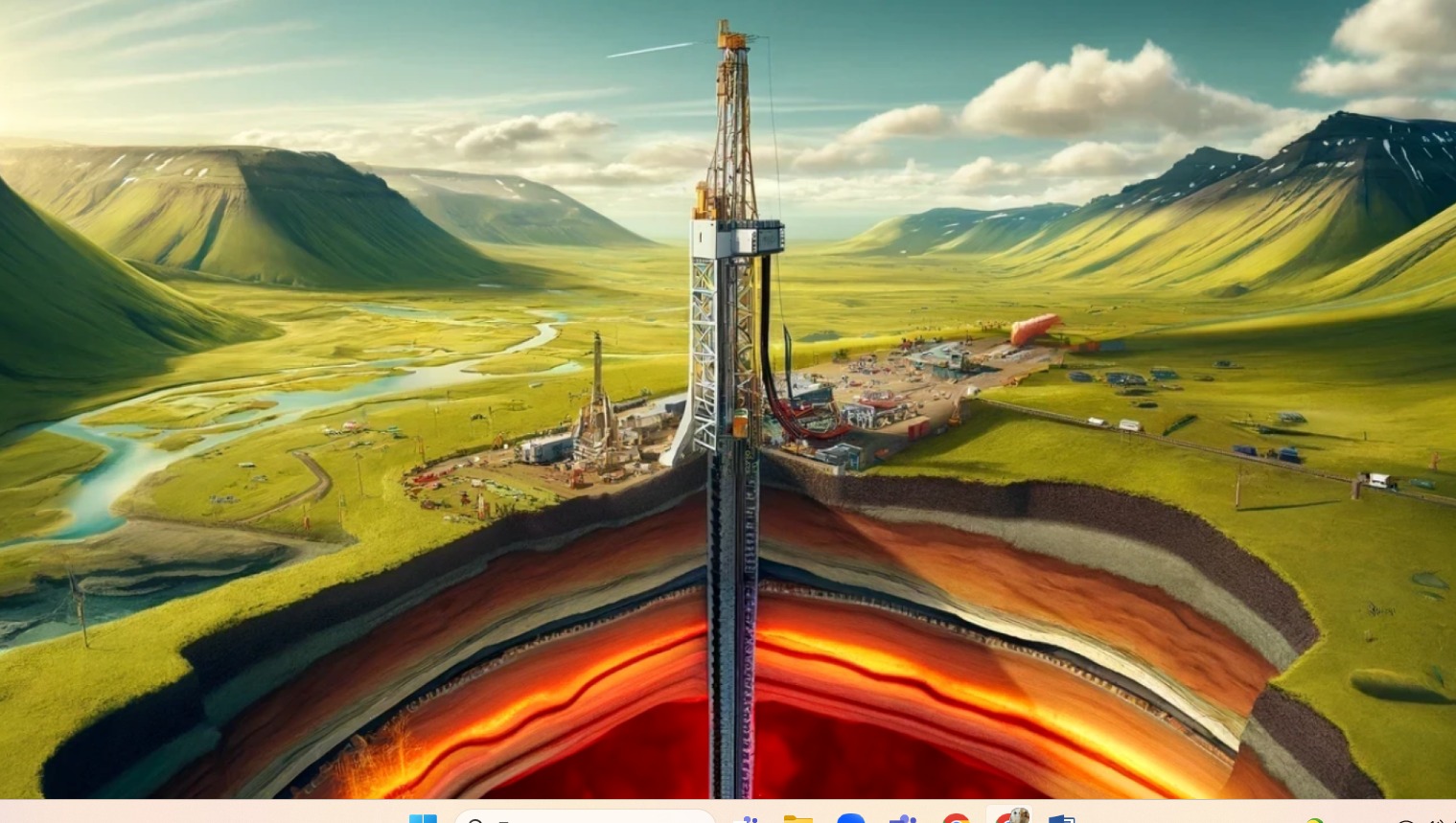
In 2009, researchers in Iceland drilled straight into the ground atop a known volcano. The original plan was to drill to a depth of 4.5 km (about 2.8 miles) to just above a known magma chamber. However, as you might imagine when it comes to messing with magma, things didn't go entirely to plan. At a depth of just 2 km (about 1.2 miles), the equipment penetrated an unknown upper part of the chamber where the scalding hot magma plugged up the hole, damaged the drill, and released a stream of noxious gas into the air.
A similar project was undertaken in 2014 with the same results. The drill hit an unexpected magma chamber and the equipment was destroyed by acidic gasses.
Not a people who are easily intimidated, the Icelanders took these two projects as a good sign. That's because they found magma much closer to the surface than anticipated, which means it can be more easily studied and, potentially, have its heat harnessed for massively more efficient geothermal power plants.
So they have decided to continue to poke their drills into more magma chambers as part of the KMT, which is to be the world's first magma observatory. Supported by over 40 research institutes and companies from 11 different countries, the goal of the project is threefold. First it will study magma itself and the way in which it interacts with the surrounding rock and transfers its heat out of the Earth's crust. Second, it will allow the direct observation of a volcanic system which, the team hopes, will lead to better ways to monitor, predict, and alert people to new eruptions.
Finally, and perhaps most dramatically, the KMT will explore using the tremendous heat energy contained in magma to dramatically improve the production of geothermal energy. Because the project will be deployed near the existing geothermal Krafla Power Station, there will be plenty of opportunity to experiment with actual power production.
"KMT will be the first international infrastructure, a field observatory, built to directly study magma and its coupling to the hydrothermal system above it," said the project team in the comments on the project's original profile video below. "This is analogous to a particle accelerator for physics or telescope array for astronomy but is focused on understanding processes occurring under the most extreme conditions in Earth’s crust."
The reason why magma is such an appealing add-on to geothermal energy production is that it has the thermal power to heat the water that turns the turbines into a supercritical state. This type of water forms when it is heated above 373 °C (about 703 °F) under 220 bars of pressure and it turns into a state of matter that is neither gas nor liquid. In this condition, the water can hold up to 10 times more energy than normal water or steam. Because of this, supercritical water is a kind of Holy Grail for geothermal energy advancement. Its use could dramatically improve the efficiency of the energy production process, making it an even more viable form of clean, available power, especially when coupled with other advances in the geothermal field.
Two-phased deployment
While originally slated to deploy this year, in a recent interview with Think Geoenergy, KMT's Björn Þór Guðmundsson said that the start of the project will take place in two phases: one in 2026 and the other in 2028.
The first well to be drilled will be the volcanic research well, and the second will be used for energy research.
"What is different about KMT is that we aim to recover a core from the base of the hydrothermal system to magma and monitor temperature through that interval in parallel," Guðmundsson told Think Geoenergy. "This will be the first time scientists will actually get samples of this. Our aim is to place temperature and pressure sensors into the magma for direct measurements on magma behavior. We are collaborating with the sensor community to develop new temperature sensor and temperature-resilient technologies to monitor pressure directly in the magma."
KMT also says that all of the equipment used this time around will be able to handle the harsh conditions that were unleashed during the previous drilling projects. And, of course the fact that the previous two efforts didn't trigger an accidental volcano leads the team to feel confident that the future projects will be relatively safe efforts.
Sunlight instead of filters: Chinese researchers develop solar catalyst to reduce waste odours
20 MW solar power plant commissioned in Shieli
India approves grid development scheme to integrate 135 GW of renewable energy
A major wind farm worth KZT380 billion be built in Kostanay region
Kazakhstan Development Bank secures up to $200 million for renewable energy projects
Exus acquires four US solar projects totalling 715 MWp
AIP acquires two Swedish wind farms totalling 312 MW
Zayed Sustainability Prize 2027 finalists include Astana school
Germany awards 480 MW of solar-plus-storage projects
Scientists develop method to convert end-of-life solar panels into silicon carbide
Hyperborea 150 MW wind farm reaches full design capacity
European ports test renewable energy and clean energy solutions
Australia grants first licence under new offshore infrastructure regime
Samruk-Kazyna and Chinese companies agree to jointly develop up to 1 GW wind power project
Kazakhstan completes final auction for 50 MW solar power project
Australia approves 1.4 GW Wongalee wind project
Kazakhstan and China agree on 450 MW wind power projects in Akmola region
Almaty to host Kazakhstan-China Investment Forum on September 25
Third round of trilateral talks on Kambarata HPP-1 project held in Almaty
Yerzhan Yertayev appointed Vice Minister of Energy of Kazakhstan