

World News20.02.2025
Sheffield scientists develop flexible, cost-effective solar cells without rare earth metals


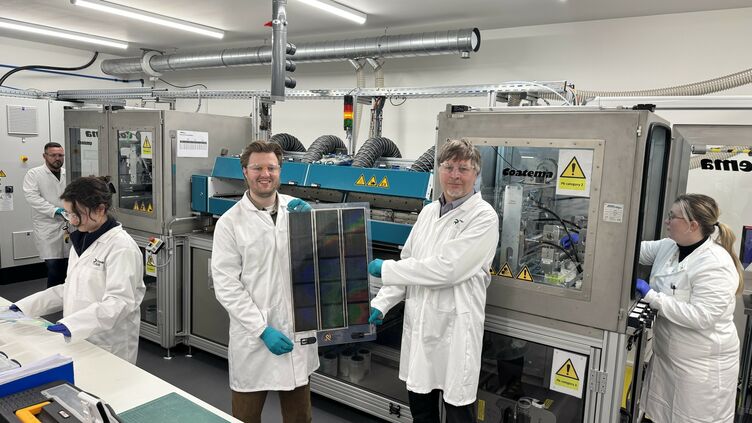
QAZAQ GREEN. Researchers at the University of Sheffield have unveiled a groundbreaking new technology that could revolutionize solar energy production. By using a novel back-contact solar cell design, incorporating perovskite materials and microgrooves embossed into plastic film, they have developed an innovative, scalable, and low-cost method of solar cell manufacturing.
This cutting-edge approach eliminates the need for expensive and scarce materials such as indium, making the technology both sustainable and economically viable. The resulting lightweight, flexible solar films can be installed on a variety of surfaces, including rooftops and non-traditional areas that cannot support the weight of conventional solar panels. This advancement has the potential to significantly expand solar energy accessibility, particularly in developing nations.
The research, conducted in collaboration with UK-based company Power Roll Ltd., was published in ACS Applied Energy Materials. Unlike conventional solar panels that rely on multiple layered structures, these new back-contact cells consolidate all electrical contacts onto the device’s rear side. This design simplifies production, lowers costs, and enhances efficiency.
To validate their findings, scientists used a Hard X-ray nanoprobe microscope at Diamond Light Source in Oxfordshire, allowing them to capture highly detailed images of the new solar cells. These analyses provided critical insights into the material’s structural integrity, revealing previously undetectable defects such as empty spaces and crystal boundaries. This marks the first instance of such advanced imaging being applied to this type of solar technology.
Professor David Lidzey, co-author of the study from the University of Sheffield’s School of Mathematical and Physical Sciences, emphasized the potential impact of these flexible solar films:
“One major advantage of these lightweight solar panels is their adaptability. In the UK, many warehouse roofs are not designed to support the heavy load of traditional solar panels, but with this flexible solar technology, installation becomes far more feasible. This could be a game-changer, especially for low- and middle-income countries where access to solar energy is limited.”
The University of Sheffield, a global leader in sustainability and advanced manufacturing, has been working closely with Power Roll Ltd. for over a decade, combining expertise in material science and imaging technology with industrial manufacturing. This successful collaboration has paved the way for new, innovative solutions in renewable energy.
As perovskite solar cell technology continues to evolve, ongoing research remains crucial for refining and optimizing performance. The next phase of this project will focus on expanding the use of X-ray microscopy to further analyze the stability and efficiency of these materials. New experiments are already scheduled at Diamond Light Source this summer, aiming to enhance understanding of key operational aspects.
With continuous innovation and collaboration, these flexible perovskite-based solar films could soon become a widely adopted, cost-effective solution for clean energy production, accelerating the global shift away from fossil fuels.
UK approves its largest ever solar farm at 800 MW
Sonnedix wins major solar energy contracts in Italy
China-developed 1,000-MW solar project enters operation in Laos
Kazakhstan’s Senate passes agreement to export green energy to Europe
Zayed Sustainability Prize opens global call for submissions
Daily share of ‘green energy’ in Azerbaijan exceeds 29%
Tajikistan to build a 250 MW solar power station
China's Xizang starts work on record-breaking solar plant
Investors in renewable energy required to install energy storage systems in Kyrgyzstan
TNO develops world’s first perovskite solar roof tile
CFE Calificados adds 900 MW of solar and 450 MW of storage to its portfolio in Mexico
Just energy transition: Kazakhstan sets the investment direction for Central Asia
Dubai to install 600 EV charging stations across parks and beaches
Japan’s Shimizu unveils Luna Ring concept for lunar solar power generation
E-invoicing timelines revised for electricity sector in Kazakhstan
Solar panels of Progress MS-34 cargo spacecraft pass testing at Baikonur
WWEA report: China installed 77% of all new wind capacity in 2025
Maximo completes 100 MW of robotic solar installation at a single site
Bishkek hosts first round of talks on Kambarata HPP-1 сonstruction
UNICEF brings solar power to rural health clinic in Turkmenistan