

World News17.06.2026
Canadian researchers test foam-based floating solar system built to survive winter ice


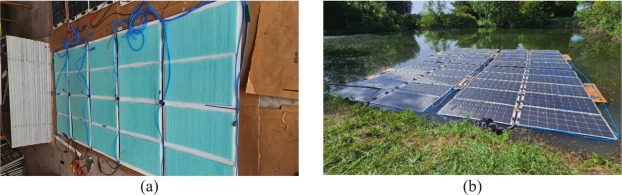
QAZAQ GREEN. A team of Canadian researchers has published the results of a year-long trial of a 7 kW floating solar power system designed to operate through harsh winters without sustaining ice damage. The work appears in a study published in the journal Applied Energy.
Floating photovoltaics (FPV) have already proven their value in warm climates: water cools the panels and boosts output, while shading the surface reduces evaporation and algae growth. Until now, however, such systems had barely been tested in cold climates, where ice poses a serious threat to floating structures.
The experimental array was deployed on a pond in Ontario. Its key feature is the use of foam floats instead of conventional pontoons — the panels are bonded directly to blocks of closed-cell polyethylene foam, making the design cheaper and easier to assemble. To prevent ice formation, the researchers installed an air-bubbling system that draws warmer water from the pond's depths up to the surface.
The results showed that the bubbler system kept the area around the array completely ice-free throughout the winter, while the additional energy needed to run it was minimal — ranging from just 0.02% to, in the most energy-intensive scenario, around 14.5% of annual output, depending on the pump operating mode. The system itself generated 7.7 MWh of electricity over the year, about 2.7% more than predicted by existing models for floating solar systems.
Beyond power output, the project also demonstrated a water-saving effect: shading from the panels reduced pond evaporation in proportion to surface coverage. Calculations showed that covering half the pond's surface with panels could save up to 927 cubic meters of water annually — a benefit particularly relevant for drought-prone agricultural regions.
Economic analysis found that under high electricity prices, such as those typical of remote communities relying on diesel generation, the system pays for itself in roughly four years. The authors note that the main barrier to wider economic viability remains the high cost of flexible solar modules, which could fall as production volumes increase.
Among the practical challenges encountered were algae buildup on the panels in summer and a risk of snow damage in winter, since the flat, untilted design left the modules without a way to shed accumulation. The researchers plan to test larger systems next and refine the design to address these issues.
Turkmenistan and ADB explore the country's wind potential for renewable energy development
BMW and SOLARWATT unveil home energy integration solution for Neue Klasse electric vehicles
China completes its largest integrated solar-hydrogen-storage project
Canadian researchers test foam-based floating solar system built to survive winter ice
Aktobe regional administration and Plenitude Kazakhstan discuss construction of 100 MW wind farm
Masdar to acquire 49.99% stake in Repsol's €849m Spanish renewables portfolio
Solar power plant construction discussed in Dushanbe
Solar power in Moldova: more pros than cons?
World Bank to allocate $59m for green finance development in Kyrgyzstan
Global offshore wind capacity forecast to quadruple by 2035
Kyrgyzstan launches largest solar plant with Vietnamese investment
Coal, gas or renewables: what powers Kazakhstan's energy mix?
Ember: Energy crisis accelerates Europe's strategic break from fossil fuel dependency
Cuban tobacco company turns to solar power after blackouts ruin millions of cigars
Central Asian countries discuss reliable operation of power systems
Kazakhstan courts investors in EV charging infrastructure at Automechanika Astana 2026
Uzbekistan green energy output surges 28% in 2026
Spain’s breakthrough in energy storage for year-round green steel production
Kazakhstan and South Korea chart course for deeper energy partnership
Over 600 renewable energy projects from Central Asia and Azerbaijan submitted to IAEA