

Industry News02.09.2024
UNDP presented the results of the project on de-risking investments in the green energy sector in Kazakhstan


The United Nations Development Programme (UNDP) in Kazakhstan has presented the results of the project to reduce the risks of investing in renewable energy technologies. At the final event of the project, which was implemented by UNDP in partnership with the Ministry of Energy of the Republic of Kazakhstan and with financial support from the Global Environment Facility (GEF), experts discussed the future prospects for the renewable energy sector. They also made recommendations for the further implementation of financial and non-financial support mechanisms and identified new strategies to be applied in the future.
As part of Kazakhstan's Strategy to achieve carbon neutrality, which prioritizes the gradual transition of Kazakhstan’s electricity sector to alternative and renewable energy sources by 2060, the introduction of renewable energy technologies is essential for both large-scale plants and small and medium-sized enterprises. There are currently 148 large-scale renewable energy plants in Kazakhstan with a total capacity of 2,900megawatts. The share of renewable energy in total electricity generation has reached 6.5 percent.
UNDP with the support of the GEF applied De-risking Renewable Energy Investment (DREI) methodology to test and implement new support instruments. The aim of this methodology is to target interventions and create a "risk-return" profile that encourages private investment to provide reliable, environmentally friendly, and affordable energy solutions in the country. The methodology incorporates a range of publicly available techniques, financial instruments, modelling, and key information sources. During the implementation of the project, it was adopted specifically for Kazakhstan.
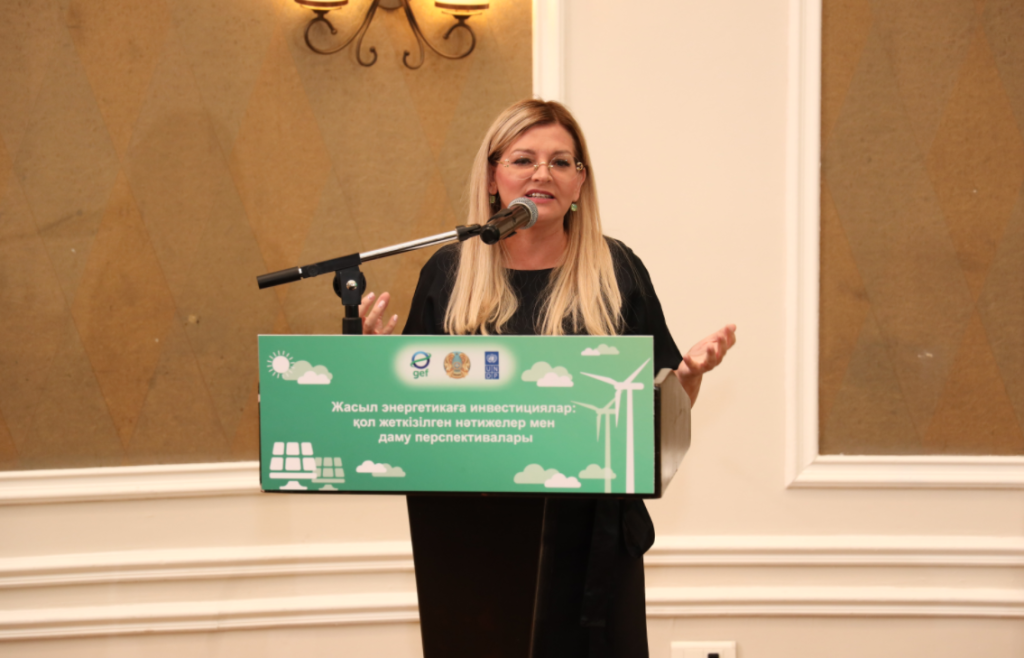
“Decarbonizing the economy is our primary responsibility and reflects our commitment to future generations. Phasing out fossil fuels and transitioning to renewable energy sources are no longer just ambitious goals, but commitments that countries around the world have made. The approach proposed by UNDP helps governments to effectively promote and increase private investment in renewable energy through improved legislation. By supporting “green” initiatives, we are confidently moving towards a low-carbon future for people and planet,” emphasized Katarzyna Wawiernia, UNDP Resident Representative in Kazakhstan.
One of the most important achievements of cooperation with the Ministry of Energy of the Republic of Kazakhstan was the amendments and additions to the Law "On Supporting the Use of Renewable Energy Sources". In particular, the term "small-scale renewable energy facility" was introduced, the maximum capacity for such installations was increased to 200 kilowatts and individuals who are net consumers were exempted from the obligation to register as legal entities. In addition, the obligation for electricity transmission companies to ensure free access and connection of grid consumers to the electricity grid has been introduced. According to experts, these changes will help to promote the growth of private investment in the renewable energy sector.
"The Ministry is actively working to increase the share of renewable energy sources in the country's energy balance. This will not only reduce greenhouse gas emissions, but also strengthen energy security. Once the Action Plan for the Development of the Electricity Industry is successfully implemented, the structure of installed capacity by fuel type by 2035 will be as follows: renewables – 24,4 percent; hydropower – 10,8 percent; gas – 25,8 percent; coal – 34,3 percent," said Sungat Yessimkhanov, Vice Minister of Energy of the Republic of Kazakhstan.
In addition, as part of the joint project with the Ministry of Energy, financial instruments were developed and implemented to increase the accessibility of "green" financing. For example, an innovative mechanism — auctions with ready documentation or site-specific RE auction — was introduced in Kazakhstan in 2019. The success of this type of auction led to an influx of foreign direct investment and the application of this mechanism to other types of auctions. In 2020, Kazakhstan issued its first green bonds with the support of the Astana International Financial Centre. UNDP partner, the "Damu" Entrepreneurship Development Fund JSC, raised funds to finance renewable energy projects through second-tier banks by issuing and placing green bonds. These funds were then used to finance small and medium-sized enterprises implementing renewable energy projects.
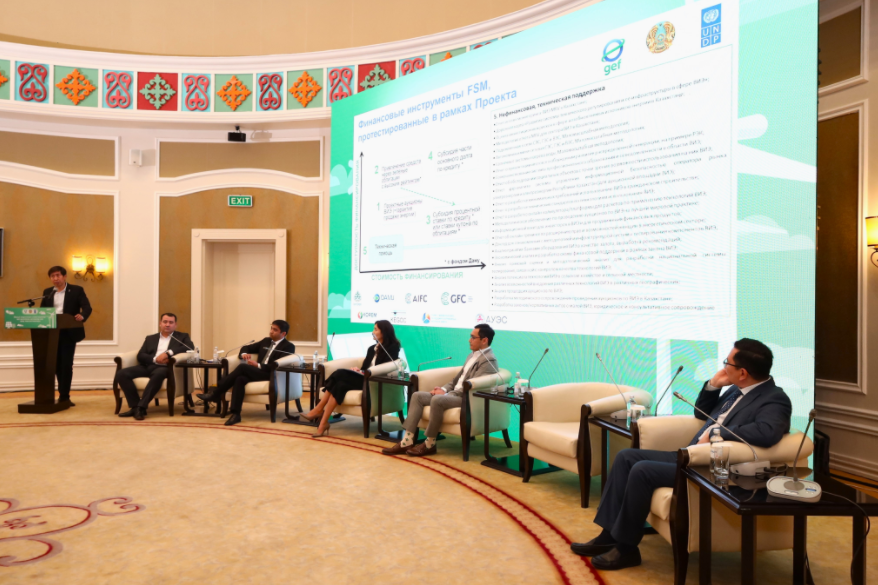
It is important to highlight that the financial instruments developed under the joint UNDP-GEF projects have significantly improved access to “green” financing for more than 60 projects of small and medium-sized enterprises with a total investment of 3,9 billion tenge dedicated to the implementation of green technologies. These projects have been successfully implemented in the regions of Aktobe, Almaty, East Kazakhstan, Karaganda, Mangystau, North Kazakhstan and Turkistan, as well as in the cities of Almaty and Shymkent. The most frequently used technologies include solar power plants and biomass boilers for heating.
Scientists from Russia and Uzbekistan improved the stability of green energy systems by 24%
Kazakh startup ranks in GCIP global top 3 in Vienna
Kazakhstan poultry farm produces 15 million kWh of energy from waste
China, Spain expand partnership in solar and wind power
Mongolia engages Hanwha Group in industrial and clean energy development
Russia to test horizontal and vertical wind power plants at new renewable energy test site in Adygeya
Brussels sets timeline: grid package by summer, electrification strategy to follow
RES 2026 to address workforce training for renewable energy scale-up
Algeria commissions 400 MW of solar capacity
Deadline approaching: KOREM invites bids for wind and solar power auctions
From crisis to security: IRENA lays out renewables roadmap for governments
Renewable energy generation in Kazakhstan rises 15% in Q1 2026
Kazakhstan climbs the Climatescope rankings
Kazakhstan and China launch joint Hydrogen Energy Technology Innovation Center
Switzerland builds world’s most powerful redox-flow battery
UK approves its largest ever solar farm at 800 MW
Sonnedix wins major solar energy contracts in Italy
China-developed 1,000-MW solar project enters operation in Laos
Kazakhstan’s Senate passes agreement to export green energy to Europe
Zayed Sustainability Prize opens global call for submissions