

News Kazakhstan21.06.2022
Carbon Neutrality by 2060: WEF recommendations and Kazakhstan's new strategy


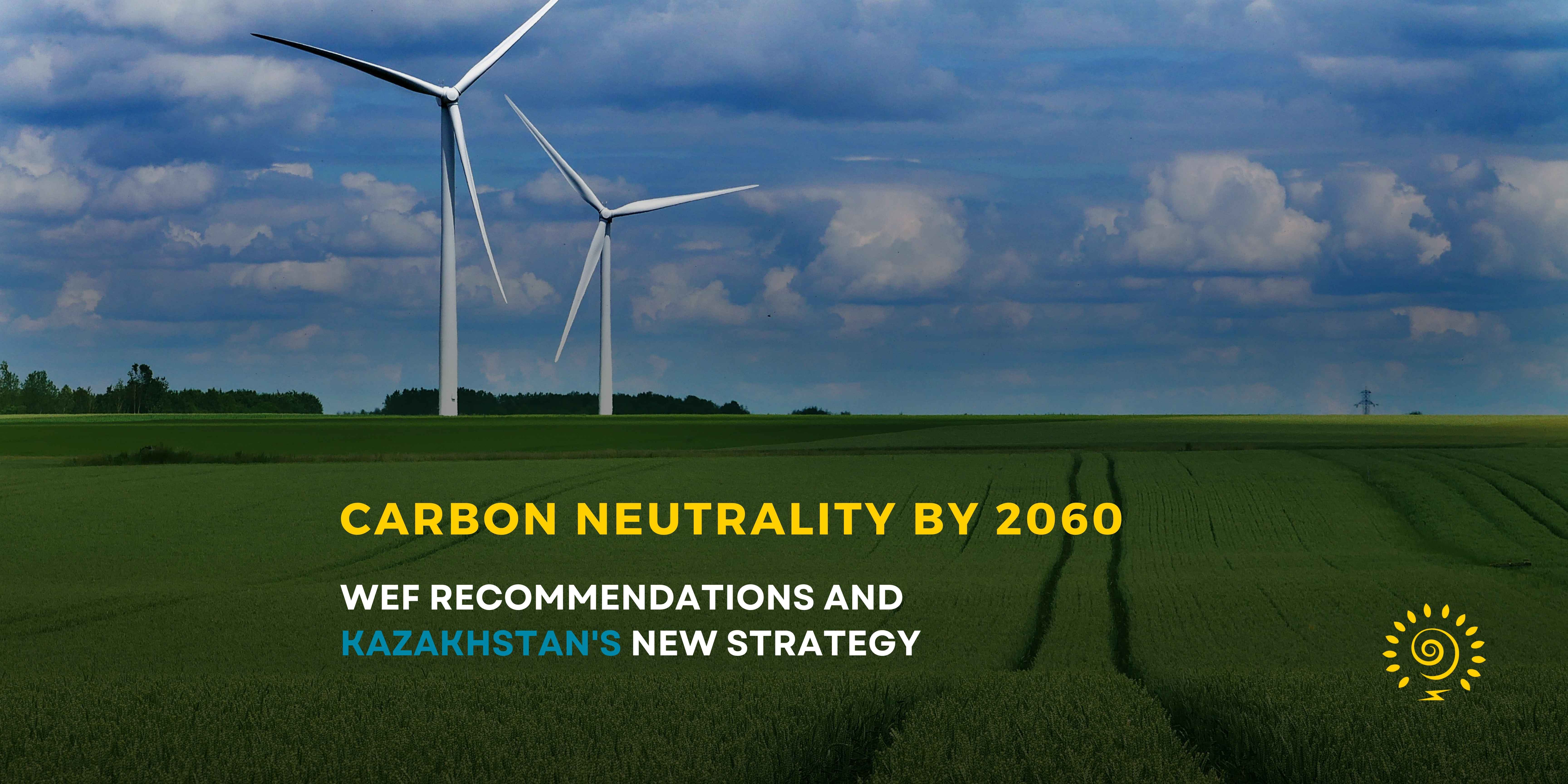
QAZAQ GREEN. Bakhyt Yesekina, member of the Green Economy Council under the President of Kazakhstan and director of the Scientific and Educational Center "Green Academy", informed Qazaq Green about the WEF recommendations on the strategy to achieve carbon neutrality outlined during the Davos Forum and the forthcoming provisions of the Kazakhstan’s Strategy.
The problem of global energy transition based on the principles of decarbonisation, technological modernisation and integration of ESG processes of national economy management remains at the top of the global development agenda, despite the new challenges of our time associated with local wars and the food crisis.
During the U.N. Climate Summit in December 2020, Kazakh President Tokayev pledged that Kazakhstan will reach carbon neutrality by 2060. International experience shows that the basic element of the transition to carbon neutrality is the introduction of an effective system of carbon regulation stimulating decarbonisation.
Kazakhstan should fundamentally improve its carbon management system
The current carbon regulation system in Kazakhstan does not meet the country's commitments on greenhouse gas emissions reduction and requires radical improvement.
Emissions trading does not have an adequate incentive effect either. According to CCX (CaspyCommodityExchange), a Kazakh company that trades in carbon credits on a par with ETS and ModernTradingSolution, in 2021 the price of carbon units in trading was at 1-1.2 USD, while in the EU the price of carbon exceeds 70 USD per ton of CO2. The updated Nationally Determined Contribution of Kazakhstan for 2021-2025 developed by The Ministry of Ecology, Geology and Natural Resources of the Republic of Kazakhstan under the Paris Agreement commitments, envisages an increase in the price of carbon unit to $16.9 in 2023-2025 and to $50.8 in 2026-2030. In order to achieve such a price for greenhouse gas emissions, urgent action is needed to improve the effectiveness of the carbon regulatory system, stimulate emission reductions and introduce green technologies.
In this regard, the Strategy for Achieving Low-Carbon Neutrality in Kazakhstan (hereinafter, the Strategy), currently being developed by the Ministry of National Economy with the participation of national experts, should provide systematic measures to stimulate the development and implementation of low-carbon technologies.
Unfortunately, the required technological solutions, including production of hydrogen, bioethanol, geothermal energy with almost zero carbon content, have not yet become commercially competitive. In this regard, the Government needs to adopt a programme of technological modernization of the industry and, above all, its basic industries.
Equitable transition and job creation should be the next important focus of the low-carbon transition according to Davos participants - areas which are already facing a difficult situation, particularly in relation to the technological changes taking place. A fair transition to carbon neutrality requires complementary legislative, policy and economic measures that distribute the burdens and benefits of climate action fairly and equitably across different social groups, creating new opportunities in industries and regions affected by decarbonisation and climate change adaptation policies.
There is no doubt that the transition to carbon neutrality will transform the country's economic structure, with the main challenges expected in the energy sector due to the decline in coal production and coal-fired power generation, which now accounts for over 60% of the country's energy mix. According to preliminary expert estimates of the Ministry of Energy, the abandonment of coal and other actions to decarbonize the economy will lead to the release of 27,000 jobs in coal mining, energy production, and, taking into account employees in other related areas, about 35,000.
In this context, fossil fuel workers vulnerable to job loss in the process of energy transformation should be protected through social protection measures, retraining and retraining programmes, and creation of new jobs in low-emission sectors. Programmes offering alternative employment and retraining for new green jobs should be developed for this category of people.
Summarising the WEF recommendations for climate and low-carbon transition, it should be noted that Kazakhstan, like other countries that continue to use fossil fuels intensively, will struggle to achieve carbon neutrality by 2060. According to the IEA, in order to achieve this, countries need to increase the share of energy costs in global GDP from 8% to 25% by 2035. To achieve the target in our country, according to McKinsey research, the share of investment in decarbonisation would need to increase to 15% of GDP against a global average of 7.5%.
WEF recommendations for achieving carbon neutrality:
- International climate goals should be legally secured in domestic policies.
- Energy security planning should move from 'just-in-time' planning to 'just-in-case' planning, requiring the maintenance of sufficient reserve capacity and storage infrastructure, using market mechanisms to incentivise investment in these solutions. Energy efficiency and energy conservation have additional benefits and a role to play in energy security.
- Reducing the risk of clean energy investments is important to maintain capital inflows.
- Equity and fairness should be central to the energy transition.
Over recent decades, due to the relative inelasticity of energy demand, high energy prices have contributed to high consumer price inflation. Vulnerable populations and small businesses have been particularly affected, highlighting issues of equity and fairness in the energy transition. Maintaining energy affordability is important not only for economic growth and social well-being, but also to support climate change policies. Long-term systemic solutions are therefore needed to ensure equitable access for vulnerable groups and small businesses.
The World Economic Forum (WEF) was held from 23-26 May 2022 in Davos and brought together more than two thousand participants: prominent politicians, businessmen and experts in the field of global development.
UNICEF brings solar power to rural health clinic in Turkmenistan
World's first solar-powered ambulance to hit the road in 2026
Uzbekistan launches clean hydrogen initiative for energy transition
Four clean energy technologies now cheaper than fossil fuels, EU research finds
Russia to commission around 1 GW of renewables in 2026
TotalEnergies and Masdar to form $2.2 bn JV to accelerate renewable energy growth in Asia
Renewables cover over 50% of German electricity consumption in Q1
New process turns CO₂ and sunlight into aviation fuel
IRENA: world adds record 692 GW of renewable power in 2025
Vietnam sets 10% solar target for homes and government offices
Abu Dhabi villa owners get green light to generate and store solar power
Euronews: Europeans rush to buy solar, heat pumps and EVs
Kyrgyzstan to increase renewable energy generation to 1.5 bn kWh
UN actively supports preparations for Regional Ecological Summit in Kazakhstan
Astana to host Central Asia's RES EXPO-2026
Spain and China build a solar storage giant in Chile's desert
EBRD backs Lithuania's push into large-scale battery energy storage
Sun beats coal: why the energy crisis will speed up Asia's shift to renewables
SPIC and Kazakhstan break ground on 1 GW wind farm near Ekibastuz
Germany launches wind farm with new turbine technology