


World News26.03.2024
Winged cargo ship saves three tonnes of fuel per day on first voyage


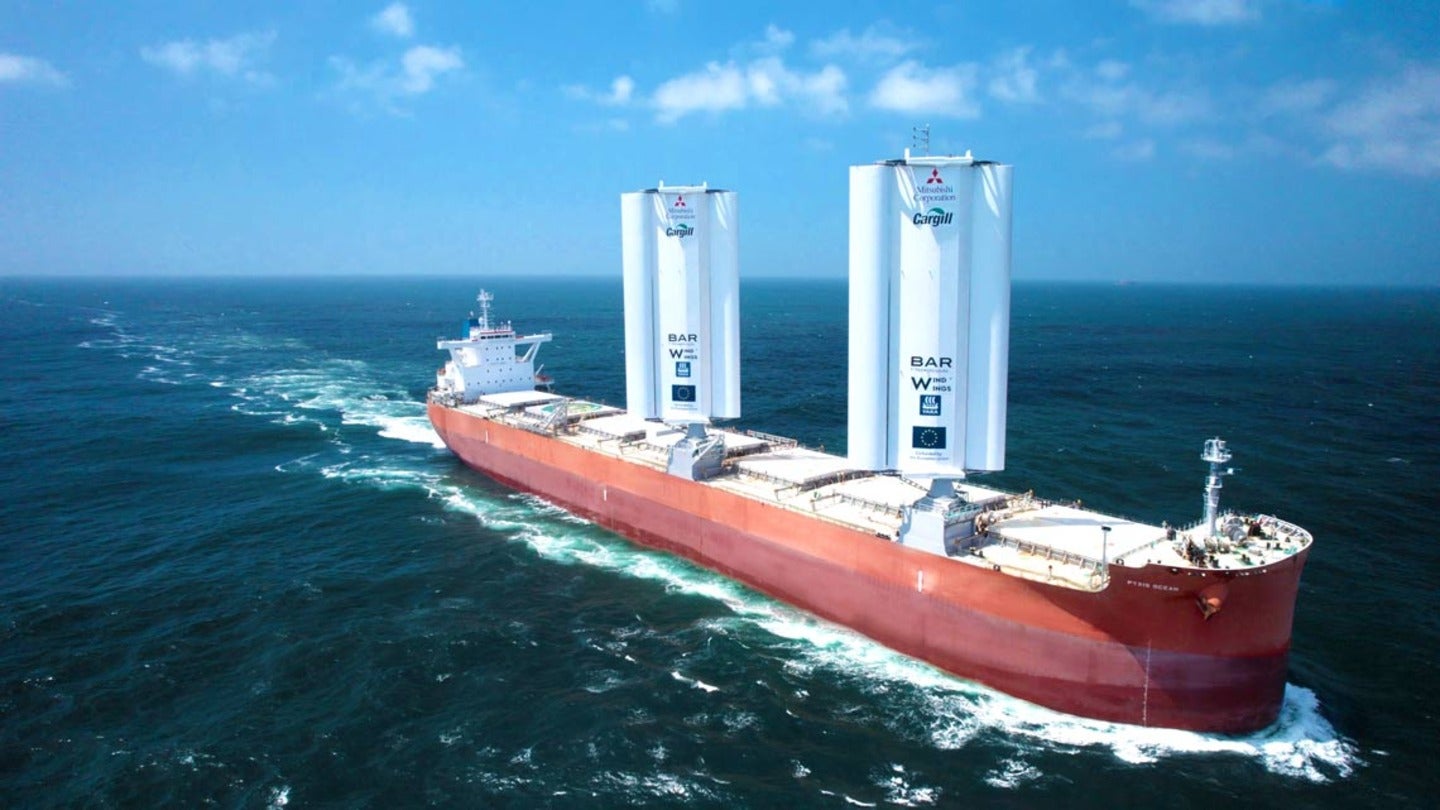
QAZAQ GREEN. An age of greener, more efficient shipping may be in the offing as a specially modified 43,000-tonne bulk freighter completes a six-month sea trial using a combination of diesel engines and a set of high-tech automatic sails to catch the wind, New Atlas reports.
Mixing sail and power isn't a new thing. In fact, it goes back to the very first steamships when shipmasters weren't particularly keen to rely on a cranky, half-experimental portable steam engine to cross the ocean. Even today, all but the smallest sailing boats have some sort of auxiliary power for maneuvering in close quarters or making passages when the wind isn't blowing.
As engines improved, ships became the behemoths we know today, and shipping schedules became as tight as my budget, sails gradually disappeared from commercial ocean traffic, but the wind propulsion never disappeared entirely. Sails may never come back as the primary means of propelling a ship, but the promise of a way of supplementing power with wind as a way to cut fuel consumption and reduce toxic emissions has always been attractive, so long as it doesn't rely on acres of canvas and huge crews of sailors hauling on sheers.
Operated by MC Shipping Kamsarmax and chartered by Cargill, Singapore-flagged Pyxis Ocean was retrofitted with two WindWings developed by BAR Technologies and carried out an extended six-month sea trial beginning in August 2023. During this time, it sailed across the Indian Ocean, Pacific Ocean, North and South Atlantic, and passed Cape Horn and the Cape of Good Hope.
The WindWings aren't the sort of canvas sails that you see on old pictures of the Cutty Sark. Instead, they are solid, foldable sails made of steel and glass fibers and stand 37.5-m (123-ft) tall. Their purpose isn't to replace the conventional diesel engines, but to provide supplemental propulsion as the ship sails into areas with favorable winds and currents.
They also don't require much of any minding. A simple red/green traffic system on the bridge tells the crew when to activate or inactivate the WindWings. Once online, they respond automatically to changes in the wind and trim themselves for optimum speed. This allows the diesels to be throttled back without the ship slowing down.
According to Cargill, this allowed the Pyxis Ocean to save the equivalent of three tonnes of fuel per day with a reduction in carbon dioxide emissions of 11.2 tonnes (the equivalent of removing 480 cars from the road for the extent of the voyage) and a general savings of 14%.
The next step is to make sure that such large-scale sail-equipped ships are compatible with 250 global shipping ports
"The results of the Pyxis Ocean’s first voyage with WindWings installed clearly demonstrate that wind assisted propulsion can secure significant fuel savings and emissions reduction," said John Cooper, BAR Technologies CEO. "For example, in near optimum sailing conditions, during an open sea voyage, the Pyxis Ocean achieved fuel savings of 11 tonnes per day. And while the Pyxis Ocean has two WindWings, we anticipate the majority of Kamsarmax vessels will carry three wings, further increasing the fuel savings and emissions reductions by a factor of 1.5. With Cargill are now able to validate our performance predictions and modeling in real-world conditions, it’s an exciting time as we begin to roll out WindWings production globally."
Bishkek hosts first round of talks on Kambarata HPP-1 сonstruction
UNICEF brings solar power to rural health clinic in Turkmenistan
World's first solar-powered ambulance to hit the road in 2026
Uzbekistan launches clean hydrogen initiative for energy transition
Four clean energy technologies now cheaper than fossil fuels, EU research finds
Russia to commission around 1 GW of renewables in 2026
TotalEnergies and Masdar to form $2.2 bn JV to accelerate renewable energy growth in Asia
Renewables cover over 50% of German electricity consumption in Q1
New process turns CO₂ and sunlight into aviation fuel
IRENA: world adds record 692 GW of renewable power in 2025
Vietnam sets 10% solar target for homes and government offices
Abu Dhabi villa owners get green light to generate and store solar power
Euronews: Europeans rush to buy solar, heat pumps and EVs
Kyrgyzstan to increase renewable energy generation to 1.5 bn kWh
UN actively supports preparations for Regional Ecological Summit in Kazakhstan
Astana to host Central Asia's RES EXPO-2026
Spain and China build a solar storage giant in Chile's desert
EBRD backs Lithuania's push into large-scale battery energy storage
Sun beats coal: why the energy crisis will speed up Asia's shift to renewables
SPIC and Kazakhstan break ground on 1 GW wind farm near Ekibastuz