

Industry News26.05.2025
Application of battery energy storage systems (BESS) in the Unified Energy System of The Republic of Kazakhstan



Inna Kim, Deputy Director of Energy System Researches LLP
1. The relevance of Battery Energy Storage Systems (BESS) for Kazakhstan
International experience demonstrates a wide range of applications for BESS, with the key ones being peak load shaving, uninterrupted power supply, frequency regulation, voltage fluctuation smoothing, deferral of grid upgrades, maximization of existing grid capacity, and more. At the same time, to assess the feasibility, implementation potential in various scenarios, and effective use of BESS in Kazakhstan, it is essential to consider the following specific characteristics of the energy system.
Structure of Traditional Generation by Zone and Type
In the structure of installed capacity at power plants in Kazakhstan by electricity generation technology, thermal power plants accounted for 19.46 GW in 2022, making up 79.4% of the total installed capacity. This includes: condensation power plants - 9.6 GW (39.2%), combined heat and power plants (CHP) - 7.8 GW (31.7%), gas turbine power plants - 2.06 GW (8.4%).
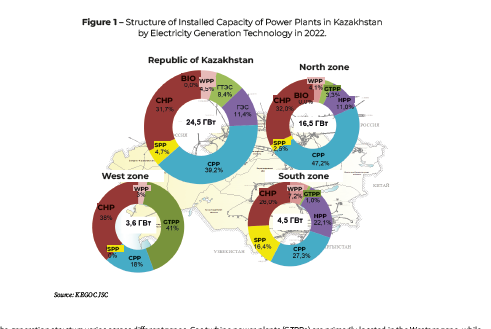
The generation structure varies across different zones. Gas turbine power plants (GTPPs) are primarily located in the Western zone, while large hydropower plants (HPPs) are concentrated in the Northern and Southern zones.
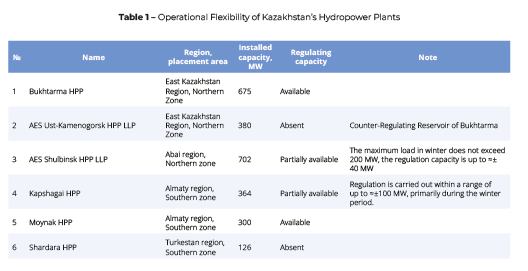
Due to their technological characteristics, GTPPs and HPPs have the best capability to rapidly adjust generation, allowing for quick ramp-up and ramp-down. However, it is important to note that in Kazakhstan, only four out of six large HPPs participate in grid regulation.
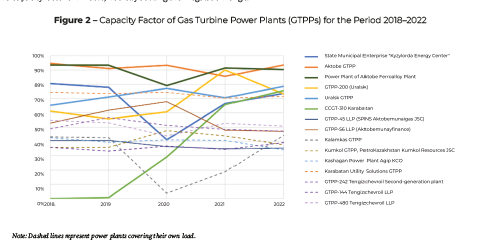
An analysis of the reported capacity factor values of gas turbine power plants (GTPPs) shows that, with the exception of power plants in the oil and gas sector, which cover their own load with a nearly proportional reserve, the main GTPPs operated primarily in a baseload mode with a capacity factor of 74-90%, not fully utilizing their regulation range.
Plans for the Development of Renewable Energy Generation by Zone and Type
The renewable energy development targets are outlined in the following documents:
• Forecast Energy Balance of the Republic of Kazakhstan until 2035 (Order of the Ministry of Energy of the Republic of Kazakhstan No. 44 dated January 30, 2023);
• Auction Schedule for 2024-2027 (Order of the Ministry of Energy No. 187 dated May 23, 2023);
• Action Plan for the Development of the Electric Power Industry until 2035 (Order of the Ministry of Energy No. 71 dated February 20, 2024).
According to the planned indicators for 2035, a total of 15.8 GW of renewable energy capacity is expected to be commissioned, including 12 GW of wind power (WPPs), 2.3 GW of small hydropower (SHPPs), and 1.6 GW of solar power (SPPs).
The distribution of planned renewable energy capacity by zone and type is shown in the figure below.
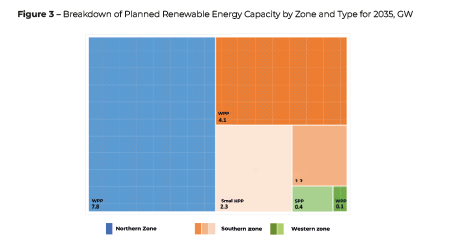
An analysis of the projected renewable energy capacity additions for 2035 indicates that the majority of the increase in installed renewable energy capacity is expected in the Northern (49%) and Southern (48%) zones of Kazakhstan's power system. In the Northern zone, development will rely exclusively on wind power (WPPs), while in the Southern zone, capacity additions will include wind (WPPs), solar (SPPs), and small hydropower plants (small HPPs).
Load Profile
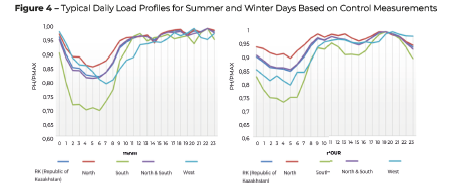
The Southern zone has the least uniform and densest load schedule due to the significant share of residential and commercial consumption. All analyzed daily load curves exhibit peak demand periods during the daytime (10+12 hours) and nighttime (19+23 hours).
Power Grid Infrastructure
The total length of transmission lines and substations within Kazakhstan's National Power Grid (Overhead power lines and substations), owned by KEGOC JSC as of December 31, 2022, is outlined below.
1,150 kV (including 500 kV) - 1,421 km
500 kV - 8,282 km
330 kV (including 220 kV) - 1,863 km
220 kV -14,890 KM
Limited Transmission Capacity of the North-South Transit.
The transmission capacity of the North-South transit in its current state, at the limiting section (Agadyr - South Kuzbass Power Station), is estimated at approximately 2100 MW in the north-to-south direction and 2400 MW in the south-to-north direction.
Parallel Operation with the Power Systems of Russia and Central Asia (Kyrgyzstan and Uzbekistan).
An analysis of the hourly balances across Kazakhstan's power system showed that for 97% of the time, imbalances remained within the range of ±1000 MW and were compensated through power exchange flows with neighboring power systems. However, the existing contractual obligations for cross-border electricity flows stipulate that exchange flows must be maintained within ±150 MW with the Russian power system and ±50 MW with the Central Asian power system.
Lack of an Up-to-Date Reliability Standard for Power System Operation.
The regulatory volume of primary and secondary capacity reserves is defined by Kazakhstan's Power Grid Rules: primary reserve - 2.5% of the available generation capacity, secondary reserve - 8% of the peak load, but no less than the installed capacity of the largest generating unit.
However, as the share of renewable energy increases, this standard requires revision, as renewables introduce significant uncertainty into the overall generation balance. This, in turn, increases the uncertainty of the "net" load profile, which must be covered by conventional power plants .
Mechanisms for Investment Returns
Kazakhstan currently operates a capacity market, a wholesale electricity market, and a balancing market, along with additional payments for power plants participating in the centralized Automatic Frequency and Power Regulation System (AFPRS).
Subject to a positive techno-economic assessment, BESS deployment in Kazakhstan is possible both as an independent business (arbitrage) and in combination with other technologies (renewable energy generation, system services, etc.).
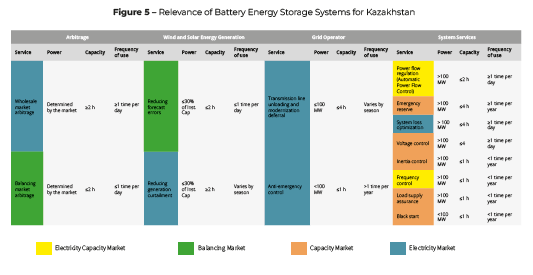
Arbitrage - the purchase of electricity during off-peak hours on the wholesale or balancing market and its sale during peak hours.
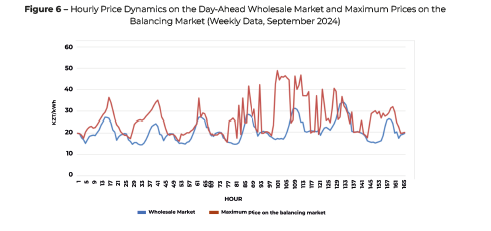
According to KOREM JSC, in September 2024, the minimum and maximum imbalance prices on the balancing market ranged from 0.01 to 63.21 KZT/kWh. Meanwhile, on the day-ahead wholesale market, data from SFC LLP indicates that electricity prices varied between 12.62 and 35.6 KZT/kWh depending on the hour. At the same time, the wholesale market exhibits relatively clear price trends with lower uncertainty, whereas the balancing market is characterized by high volatility and significant uncertainty.
Wind and Solar Power Generation
The most promising application of BESS in combination with renewable energy generation—as part of hybrid groups or qualified conditional consumers—includes the following objectives:
Reducing forecast errors - charging or discharging BESS to ensure compliance with the declared dispatch schedule.
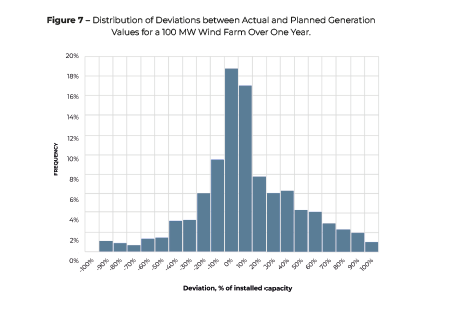
For example, an analysis of annual data on compliance with the planned hourly generation schedule for a 100 MW wind farm commissioned in 2022 showed that 90% of actual deviations from planned values fell within the range of ±60%. At the same time, international experience demonstrates the “learning curve” effect in renewable energy forecasting, meaning that forecast accuracy tends to improve over time as more data is collected.
Reducing Renewable Energy Curtailment
Preliminary modeling of Kazakhstan's energy system for 2030 suggests that substantial curtailment of renewable generation may be necessary to prevent electricity surpluses and ensure grid stability. BESS can help by storing excess energy and releasing it during peak demand or power shortages.
Power Grids
• Transmission Line Unloading and Upgrade Deferral. BESS can reduce the load on transmission lines during peak demand or
generation periods, thereby extending the lifespan of existing infrastructure and enhancing grid reliability.
• Emergency Management. BESS enables rapid response to power imbalances, helping to prevent system failures. It also facilitates
and accelerates grid restoration in case of emergencies.
Grid Support Services
Thanks to its high responsiveness, scalability, and flexibility, BESS can be considered for providing grid support services, including:
• Power Flow Management. Kazakhstan's power system operates an Automatic Frequency and Power Regulation system (AFPRS), which continuously monitors the generation-consumption balance and power flows across key National Power Grid sections (including the North-South transit) and interconnections with neighboring systems. BESS can be deployed to correct power imbalances and adjust cross-border power exchanges at the request of the System Operator, ensuring compliance with established limits.
• Emergency reserve - BESS supplying temporary reserves to compensate for energy deficits or excesses.
• Inertia and frequency regulation - traditionally, large synchronous generators at thermal and hydroelectric power plants serve as sources of inertia. However, as the share of renewables grows in Kazakhstan, there is an increasing need for new approaches to maintaining inertia. Grid-forming BESS, utilizing synthetic inertia control algorithms, can adjust power output in response to frequency changes, providing an inertial response similar to that of traditional generators.
• Voltage regulation and network loss optimization - BESS can function as both a source and consumer of reactive power, enabling voltage regulation in both normal and post-fault conditions without the need for additional equipment;
• Reliability enhancement (system adequacy) - BESS can help minimize the risk of power shortages and supply disruptions.
• Black start capability - Kazakhstan's power system spans vast areas with remote regions and an extensive transmission network. In the event of system-wide failures causing mass disconnections of consumers and generation, grid-forming BESS can enable rapid power restoration, minimizing economic losses and social impact.
2. The System Operator's Vision for the Development of Battery Energy Storage Systems (BESS) in the Republic of Kazakhstan
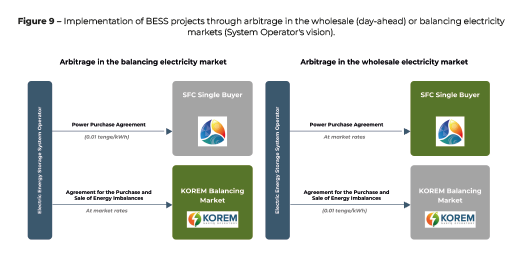
The System Operator proposes the implementation of BESS projects through capacity market auctions and/or arbitrage on the day- ahead and balancing electricity markets.
Investment returns through capacity market auctions offer the following advantages and disadvantages:
Advantages:
• For the investor - Guaranteed return on investment if selected.
• For the system operator - Free use of BESS for providing system services.
Disadvantages:
• Lack of motivation to improve the efficiency of BESS utilization.
• Limited profit potential.
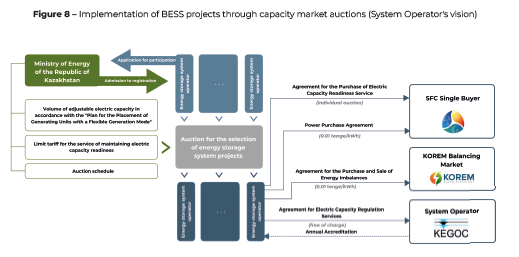
Investment return through arbitrage on the day-ahead or balancing markets has the following advantages and disadvantages: Advantages:
• The responsibility for improving BESS efficiency lies with the owner;
• The ability to use BESS to reduce both local and system-wide constraints. Disadvantages:
• Lack of investment return guarantees, dependence on market conditions and forecasting quality;
• The need for clear separation of BESS power and capacity for participation in the wholesale and balancing electricity markets. Inability to sell a day ahead on the wholesale market while simultaneously participating in the balancing market.
2.2. Battery Energy Storage Systems (BESS) in the Context of Modeling the Development of the Unified Energy System of the Republic of Kazakhstan (Forecast Balance).
The modeling of BESS operation was carried out based on the following initial positions: Planned Energy Development for 2030 in Accordance with:
• The Forecast Energy Balance of the Republic of Kazakhstan until 2035 (Order of the Ministry of Energy of the Republic of Kazakhstan No. 44 dated January 30, 2023);
• The Auction Schedule for 2024-2027 (Order of the Ministry of Energy No. 187 dated May 23, 2023);
• The Action Plan for the Development of the Electric Power Industry of the Republic of Kazakhstan until 2035 (Order of the Ministry of Energy No. 71 dated February 20, 2024).
Modeling of Power Plant Dispatching in Accordance with:
• For Thermal Power Plants (TPP): Technical minimum/maximum, ramp-up/ramp-down rates.
• For RES - generation profile.
The prospective hourly load was obtained by scaling the reported load profile to the forecasted peak load levels;
Given the existing contractual obligations on permissible ranges of cross-border power flows, the export/import range for the Unified Energy System of Kazakhstan is set at ±150 MW for the forecast period.
BESS under consideration:
• 300 MW / 600 MWh Total Wind Farm;
• 300 MW / 600 MWh ACWA Power Wind Farm;
• 300 MW / 600 MWh Masdar Wind Farm;
• 300 MW / 600 MWh Shelek Wind Farm;
• 300 MW / 600 MWh China Power Wind Farm.
The principle of BESS operation involves participation in the AFPRS of Kazakhstan's Unified Power System, including regulating power flows through the North-South transit and intergovernmental connections.
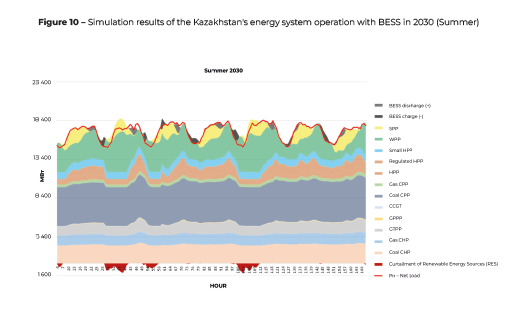

The analysis of the planned energy development for 2030 has shown that the Unified Energy System (UES) of Kazakhstan is expected to face a shortage of flexible generation (ramp down capability), which may lead to increased curtailment of renewable energy sources (RES). Reasons for RES curtailment in the model are the following:
1) Overall generation surplus in the power system when the load of conventional power plants is reduced to the technological minimum (shutdown of power plants was not considered). RES curtailment is applied to balance the power system while maintaining contractual levels of cross-border power flows.
2) Overload of the North-South transmission corridor. If an overload occurs in the northward direction, restrictions are applied to RES in the Southern zone, while in the southward direction, restrictions are applied to power plants in the Northern zone.
Resolving the issue of excessive generation expansion in the future will enhance the effectiveness of BESS in reducing RES curtailment.
3. Key Issues and Concerns
• The effective use of BESS requires consideration of the specific characteristics and operational features of Kazakhstan to determine the feasibility and potential for implementation in various scenarios;
• Under the existing market conditions, BESS can be utilized both as a standalone solution and as part of projects in electricity generation, transmission, and consumption;
• The system operator is considering the implementation of energy storage systems through competitive selection in the capacity market or by utilizing arbitrage strategies in the day-ahead wholesale and balancing electricity markets, as well as in the ancillary services market.
• Given the planned generation expansion by 2030, a shortage of downward capacity reserves is expected, leading to increased curtailment of renewable energy sources.
• Resolving the issue of excessive generation expansion in the future will enhance the effectiveness of BESS in reducing RES curtailment.
Scientists from Russia and Uzbekistan improved the stability of green energy systems by 24%
Kazakh startup ranks in GCIP global top 3 in Vienna
Kazakhstan poultry farm produces 15 million kWh of energy from waste
China, Spain expand partnership in solar and wind power
Mongolia engages Hanwha Group in industrial and clean energy development
Russia to test horizontal and vertical wind power plants at new renewable energy test site in Adygeya
Brussels sets timeline: grid package by summer, electrification strategy to follow
RES 2026 to address workforce training for renewable energy scale-up
Algeria commissions 400 MW of solar capacity
Deadline approaching: KOREM invites bids for wind and solar power auctions
From crisis to security: IRENA lays out renewables roadmap for governments
Renewable energy generation in Kazakhstan rises 15% in Q1 2026
Kazakhstan climbs the Climatescope rankings
Kazakhstan and China launch joint Hydrogen Energy Technology Innovation Center
Switzerland builds world’s most powerful redox-flow battery
UK approves its largest ever solar farm at 800 MW
Sonnedix wins major solar energy contracts in Italy
China-developed 1,000-MW solar project enters operation in Laos
Kazakhstan’s Senate passes agreement to export green energy to Europe
Zayed Sustainability Prize opens global call for submissions