

Industry News08.12.2025
Hi-MO X10 and HPBC Technology: Setting a New Benchmark for Solar Module Efficiency from LONGi in Kazakhstan



Asset Ongarbayev, Regional Head, Kazakhstan, LONGi Solar
As Central Asia’s largest economy, Kazakhstan plays a key role as a regional leader and a vital bridge between China and Europe. As a strategic Belt and Road Initiative partner, the country actively attracts investment to develop green infrastructure. Abundant solar potential gives Kazakhstan significant potential for renewable energy growth.
Industrial and commercial expansion is expected to accelerate in the coming years. A balanced foreign policy and favourable investment climate will drive growth in oil refining, mining, metallurgy, cement, and other industries.
The active development of these sectors will demand more energy, and solar power plants offer the fastest, most efficient solution to potential electricity shortages. To help Kazakhstan meet this challenge and advance its carbon neutrality goals, LONGi is ready to offer its most advanced photovoltaic technologies for projects in Kazakhstan.
Founded in 2000, LONGi is committed to being the most valuable solar technology company in the world.
Under the mission of "To make the best of solar energy to build a green world" with a brand positioning of "The most trusted, reliable solar company that blazes the trail for green technology". Focusing on scientific and technological innovation, LONGi operates across five business lines: monocrystalline silicon wafer production, solar modules, rooftop solar systems, ground-mounted power stations, and hydrogen energy equipment. LONGi’s development is guided by the principles of "Green Power + Green Hydrogen" advancing the global zero-carbon transition.
LONGi was the first Chinese company to join global initiatives such as RE100, EP100, EV100, and SBTi, actively contributing to the worldwide clean energy transition. LONGi’s Central Asia team works to introduce the most advanced technologies and provide full support for regional projects.
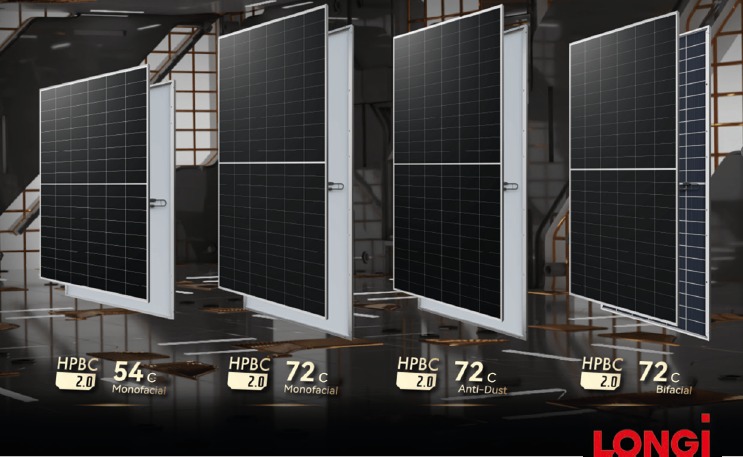
One of LONGi's most promising achievements in the field of photovoltaics is HPBC (Hybrid Passivated Back Contact) technology, built on TaiRay silicon wafers. This innovation significantly enhances thermal stability and conductivity, boosting the efficiency, reliability, and lifespan of solar panels.
Over the past two years, BC (Back Contact) technology has repeatedly set world records for monocrystalline cell efficiency, now reaching 27.81%. In mass production, BC cells outperform TOPCon by roughly 1.6%, and this advantage continues to grow. HJT (Heterojunction) technology lags behind BC in terms of efficiency and power generation, given the slow pace of industrialisation and current market supply of less than 5 GW.
Higher Efficiency
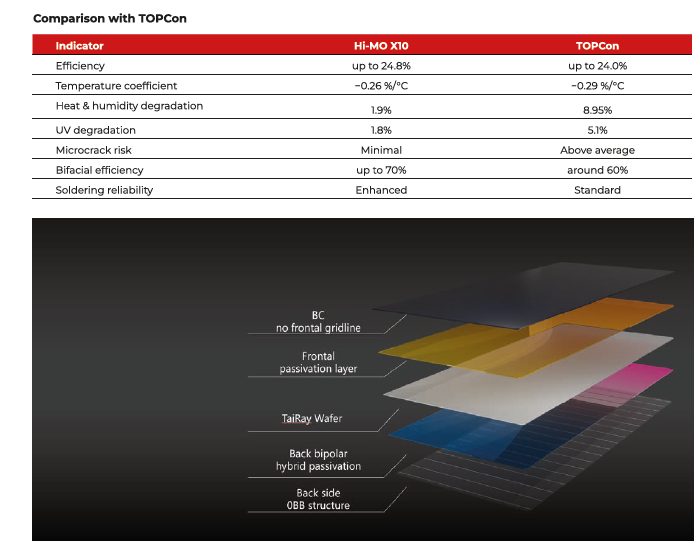
HPBC 2.0 is currently the most efficient solar technology in mass production. Cell efficiency exceeds 27%, while the Hi-MO X10 module achieves up to 24.8%, delivering over 5% higher energy generation per unit area compared with TOPCon.
Hi-MO X10 has gained global recognition for its adaptability to diverse distributed energy applications.
LONGi manufactures functional products with a precise understanding of customer needs: dust-resistant and anti-glare solar modules, various lighting designs and other solutions.
Extra Energy even in the morning and evening
Thanks to HPBC 2.0 and its unique surface structure, the Hi-MO X10 captures diffused light efficiently and continues generating in low light, adding up to half an hour of extra output daily.
Advanced technologies
The HPBC cell platform integrates three major innovations: TaiRay silicon wafers, bipolar hybrid passivation, and zero busbar (0BB) design. This system incorporates approximately 400 patented technologies, ensuring increased energy generation performance.
Hi-MO X10 provides 30 W more power than TOPCon modules of the same size. Power density per unit area is 5% higher – a key advantage for space-limited rooftops. As a result, each Hi-MO X10 module generates over 60 kWh of additional energy annually, providing additional income.
High Efficiency and Lower Losses in Hot Weather
The Hi-MO X10 module has a temperature coefficient of just −0.26%/°C, which is 0.03% better than TOPCon technology. This delivers up to 2.2% more power generation in hot weather, when panels from other manufacturers lose output.
Resistance to Overheating and Hot Spots
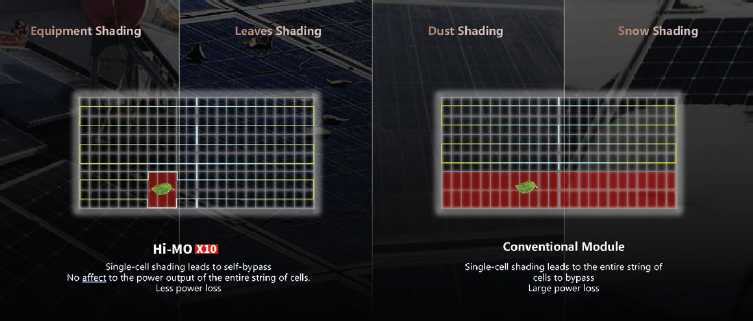
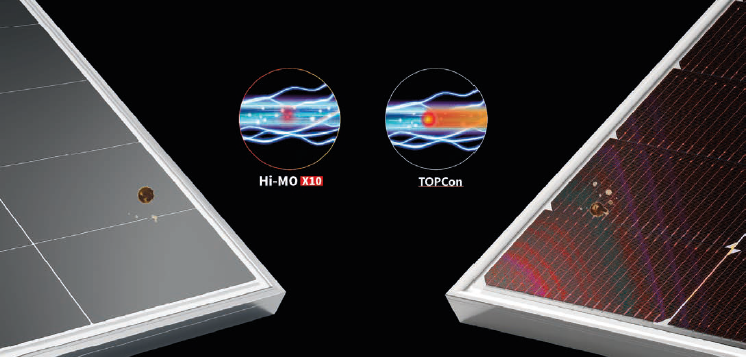
The Hi-MO X10 is protected against overheating: the temperature in shaded areas is 38°C lower than conventional panels, thanks to innovative Zero Busbar (0BB) technology that prevents localized hotspots and fire risk. This minimizes energy losses from shading and maximizes the effective use of the solar module installation area.
Reliability and Durability
Hi-MO X10 modules undergo rigorous durability tests for strength and resistance to external influences. In humidity and heat testing (DH3000), degradation was just 1.9% versus 8.95% for TOPCon. UV resistance was 1.8%, while TOPCon had a rating of 5.1%.
Every module is digitally monitored through MES, QMS, LIMS, and AI-based systems to ensure consistent quality and long-term reliability.
Conclusion
Hi-MO X10 outperforms TOPCon in all key indicators of efficiency, reliability and service life. This module is designed for those who value maximum output per square metre, durability and protection from external factors, reliability and predictability of investment. Hi-MO X10 is suitable for any facility, from private rooftops to large solar parks, and is an excellent choice for increasing the profitability of your projects.
ADB to invest $5.5bn across 15 projects in Kazakhstan
17 agreements worth over $2.3 billion signed at the opening of RES 2026 EXPO in Astana
World Bank to invest $1bn in Central Asia's energy integration
Kazakhstan and China to launch a 500 MW wind farm in Karaganda region
Kazakhstan and Tajikistan move toward clean power deal over Rogun HPP
Regional Ecological Summit 2026 opens in Astana
Solar pumps and drip irrigation help Kyrgyz farmers cut costs amid rising energy prices
Hormuz closure failed to trigger coal comeback as solar and wind filled the gap
Astana set to launch RES 2026 EXPO and ink key international deals
Central Asian countries to discuss energy transition at RES 2026 in Astana
Moldova surpassed 1 GW of installed renewable energy capacity
China begins building US$1 billion hydropower station in Cambodia
Thousands protest in Germany urging faster green shift
Scientists from Russia and Uzbekistan improved the stability of green energy systems by 24%
Kazakh startup ranks in GCIP global top 3 in Vienna
Kazakhstan poultry farm produces 15 million kWh of energy from waste
China, Spain expand partnership in solar and wind power
Mongolia engages Hanwha Group in industrial and clean energy development
Russia to test horizontal and vertical wind power plants at new renewable energy test site in Adygeya
Brussels sets timeline: grid package by summer, electrification strategy to follow