

World News21.04.2026
Hormuz closure failed to trigger coal comeback as solar and wind filled the gap


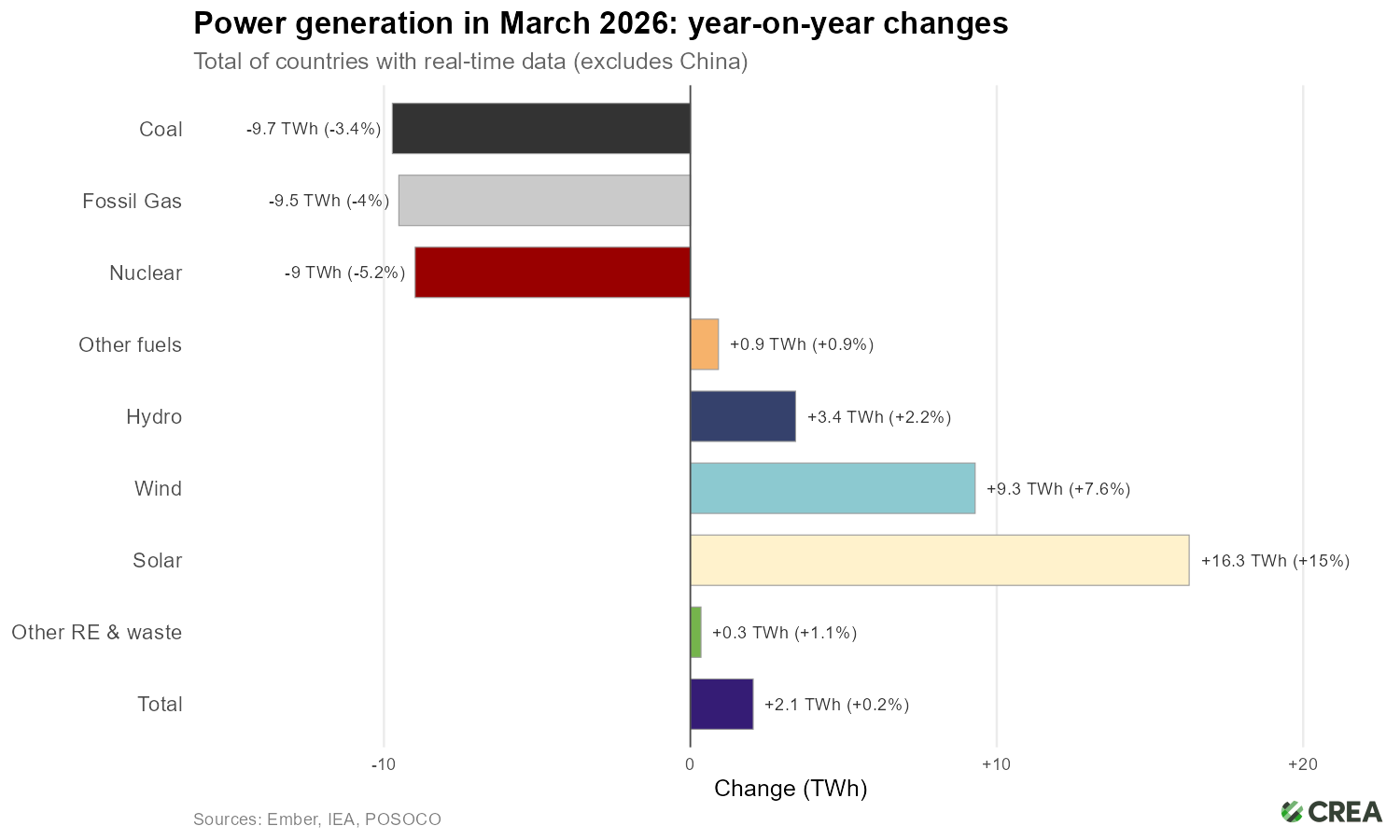
QAZAQ GREEN. Global power generation from fossil fuels declined in the first month following the closure of the Strait of Hormuz, with falling gas-fired generation offset by growth in solar and wind power rather than coal, according to analysis by the Centre for Research on Energy and Clean Air (CREA).
Across countries publishing near-real-time data — covering 87% of global coal generation and over 60% of gas-fired generation — total fossil fuel power output fell 1% year on year. Coal-fired generation was flat while gas dropped 4%. Outside China, the picture was sharper: coal fell 3.5% and gas 4%, while solar generation rose 14% and wind climbed 8%.
China was an exception, with coal generation up 2% in March as coastal plants switched from gas to coal amid high prices. Even so, output remained well below 2024 levels.
Seaborne coal transport volumes also fell — down 3% year on year to the lowest levels since 2021. Shipments to China and India dropped 9%, South Korea 4%, and Turkey and Vietnam by 25–27% respectively.
CREA analysts stress that the data offers little support for the widely circulated "coal comeback" narrative. Coal was already running at near-maximum capacity before the crisis, as its operating costs are lower than gas in all markets. No coal units were returned to service or delayed from retirement in any country during March.
The scale of clean energy deployment puts the crisis in perspective. Solar and wind capacity added in 2025 alone will generate roughly twice as much electricity as all the LNG that passed through the Strait of Hormuz before its closure — around 1,100 TWh per year versus approximately 590 TWh from Hormuz LNG.
The crisis is also accelerating clean energy commitments worldwide. France is preparing a plan to electrify key economic sectors, Turkey has pledged $80 billion in renewable investment by 2035, Indonesia is rolling out 13 GW of solar, and South Korea's president called for a rapid shift to renewables in direct response to the price shock.
Solar pumps and drip irrigation help Kyrgyz farmers cut costs amid rising energy prices
Hormuz closure failed to trigger coal comeback as solar and wind filled the gap
Astana set to launch RES 2026 EXPO and ink key international deals
Central Asian countries to discuss energy transition at RES 2026 in Astana
Moldova surpassed 1 GW of installed renewable energy capacity
China begins building US$1 billion hydropower station in Cambodia
Thousands protest in Germany urging faster green shift
Scientists from Russia and Uzbekistan improved the stability of green energy systems by 24%
Kazakh startup ranks in GCIP global top 3 in Vienna
Kazakhstan poultry farm produces 15 million kWh of energy from waste
China, Spain expand partnership in solar and wind power
Mongolia engages Hanwha Group in industrial and clean energy development
Russia to test horizontal and vertical wind power plants at new renewable energy test site in Adygeya
Brussels sets timeline: grid package by summer, electrification strategy to follow
RES 2026 to address workforce training for renewable energy scale-up
Algeria commissions 400 MW of solar capacity
Deadline approaching: KOREM invites bids for wind and solar power auctions
From crisis to security: IRENA lays out renewables roadmap for governments
Renewable energy generation in Kazakhstan rises 15% in Q1 2026
Kazakhstan climbs the Climatescope rankings