

International experience08.12.2025
Grid-forming technology can unlock Kazakhstan’s renewable energy potential


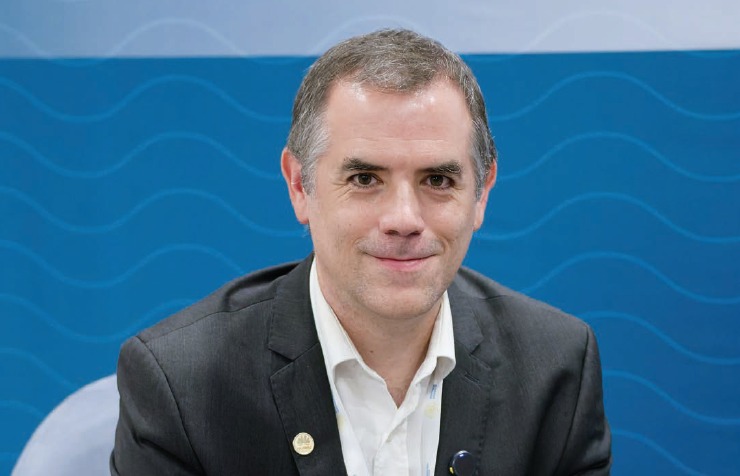
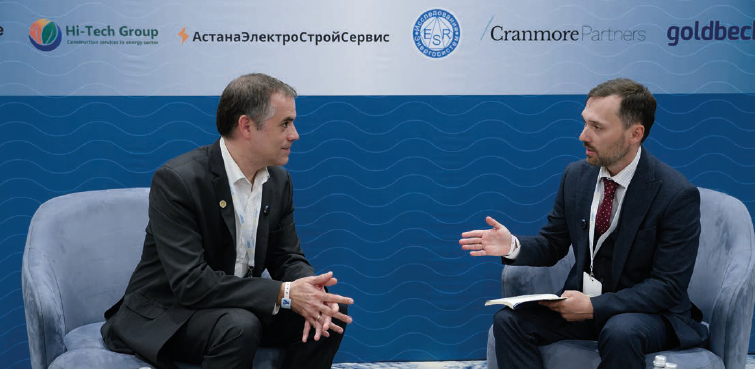
During the IV International Business Festival on Renewable Energy Qazaq Green Fest in Aktau, Timur Shalabayev, Executive Director of the Qazaq Green RES Association, interviewed Dr. Carlos Alvarez Ortega, Director for Grid Solutions at Huawei. Their discussion explored Kazakhstan's evolutionary approach to renewable energy development, the critical role of battery storage and grid-forming technologies in maintaining grid stability, and how global expertise can accelerate the country's transition toward a sustainable energy future.
- Dr. Ortega, you just took part in the session on green grid forming and grid stability. First of all, you know about development of renewables in Kazakhstan. How do you assess development of renewables? Are we going through revolutionary or evolutionary way?
- Evolutionary, but let me start by saying that your work here organizing this fantastic event has been outstanding. About the development of renewables in Kazakhstan, it's evolutionary. So, you need to achieve the autonomous behavior, the self-production of energy, you need to achieve that. So, based on that, I think you need renewables. But the challenge is how to manage this new technology into the grid. This is what we have been discussing in the previous session and I think it's a very challenging, very interesting topic and we can work together on that.
- Kazakhstan’s power system is still heavily dependent on fossil fuels, with about 70% of generation coming from coal plants. There is also a shortage of balancing capacities, and balancing often relies on energy purchases from neighbouring countries. This year, Qazaq Green and Huawei prepared a White Paper on battery energy storage systems (BESS) for Kazakhstan. Do we need BESS, and how should it be developed within our energy system?
- If you want to minimize the need for taking energy from neighboring countries, you need to rely on renewables like wind and PV. There is a huge project now, a wind power plant. But you cannot rely on the availability of that power. So, to make it flexible, you will need storage.
The good thing about fossil fuels is the availability. Even if you have some sources, so you need to compensate with neighboring countries. But the good thing is that from the electrical point of view, it's very reliable. The grid is stable and strong.
If we are moving to renewable sources, the problem is the stability of the grid. If you are based on wind turbines, PV inverters, power electronic-based generators, there will be an issue with the stability of the grid. This is something we have seen in many other countries that worked that way before Kazakhstan.
To do that, there are batteries to provide flexibility. And thinking about the stability of the grid, you will need batteries with grid-forming capabilities. So, there will be two changes here in Kazakhstan.
One very positive thing I'm seeing here is that the system operator, KEGOC, is considering that already. This is very positive for the stability of the grid of Kazakhstan and the development of the business.
- What solutions in energy storage can Huawei offer Kazakhstan? Could you share examples of real projects where your solutions have been implemented?
- Huawei is providing the storage. There's one main point of interest for Huawei. One main concern is that the system that we are deploying should be safe. This is one of the main drivers for Huawei’s storage products.
This is why, if you check the different products, the different options in the market, the storage capacity of Huawei products is always a little bit less. Because to provide a safe product is the most important thing for Huawei. That's why we are not going to 12 megawatt hours yet, because the process for testing the different cells takes a lot of time in Huawei.
About the storage capacity, we are a little behind the figures of other competitors. But this is a product we are providing. Super safe, reliable storage container.
The storage is direct current (DC). How to integrate that into the AC power with the PCS, power conversion system. It's the power electronics.
Huawei is also a specialist in that. Takes the DC power from the storage and converts it to AC for integrating into the system. That is the part where Huawei is implementing the grid forming capabilities.
Back to your question about the experience from other projects that we can apply here in Kazakhstan. We are working in Saudi with this grid forming technology. In China, also in Latin America, we have projects.
In the Philippines, we are deploying 4.5 gigawatt hours with grid forming technology. Also in Spain, we have projects. So it's not only some pilot projects in China. We have deployed commercial projects worldwide. And hopefully we will apply this in Kazakhstan.
- You mentioned grid-forming technologies. What is the difference between grid-forming and grid-following, and what solutions can Huawei provide for Kazakhstan in this field?
- It will be a little bit technical, but I hope it will be understandable that the grid following technology, like the traditional one in renewable energy, measures the voltage and then it injects current according to the voltage that has been measured already. So you connect.
First idea is that you need to connect to one grid that is already established. You measure the voltage and you inject current. The problem is if there is no voltage outside, what can you do? You need something else.
Or if the voltage is very weak, when you are putting current on it, you will distort the voltage. If you distort the voltage, the measuring of the voltage will be distorted. So the current will be distorted and finally the system will be unstable.
That's why if you are integrating a lot of renewables in one system, in one bus, at some point you will not be able to integrate more current source technology. So you need to change. To change to what? To change to the grid forming technology.
The main concept of the grid forming technology is that you will create the voltage. You will not measure anything, you will create the voltage. It's like a synchronous generator.
The synchronous generator is creating the voltage. That's how the grid forming technology is working inside. But grid forming technologies can work not only for microgrids.
They can also work together with connection to the grid as well. So in microgrids, in grids with no other generation, of course, should be a grid forming technology.
But it could be applied also in grids. It could be even strong grids. It's not so common, it makes no sense.
But in weak grids. So if there is one grid that is very weak already and you cannot install more renewable power, the traditional one, you can switch to grid forming in order to make it more stable, more strong. In that way, the grid forming technology will help the system operator to integrate more traditional renewable power.
Another point related to this is that the grid forming technology could be not 100%, just a percentage defined by the system operator and the rest could be the traditional one.
- Do you have examples of having such kind of grid forming technologies in microgrids or connected to the grid?
- In microgrids, we have in China, we have Saudi, the Red Sea project, that if you search on the internet, you will find very nice hotels. But we're not talking about pilots. It's real. This is totally real. You can enter the website and you can book a room, you can travel there. It's fully commercial. And the hotels are very nice. One marketing thing is that it's 100% green energy. The 100% is because it's isolated, working only with PV and storage.
In Latin America, there another one, islanded. But in China, we have the grid forming project connected to the grid. And also in Spain, we are building one connected to the grid. It's not operative right now, but it will be.
- Now, Kazakhstan has 7% of generation depending on renewables. And for our grid operator, it's headache already, even this 7%. But when we talk about the grid forming technologies, does it mean that such kind of technologies discovers the opportunity in the future to have 100% of renewables in the grid?
- Could be with the combination of the traditional one. But there is one point that is always controversial or make a little bit misunderstanding, is that in some countries, the renewable could be 20% of the total mix. I'm not thinking about the installed capacity. I'm thinking about the covering of the demand. Imagine it's 20%. But so full located in one bus, that then the system could be unstable. And I'm thinking about, for example, Kazakhstan, one gigawatt compared to the size of the country is not so big. But you need to check what is happening with one gigawatt in one specific location. So that's why the grid forming could be quite important, depending on the project you are considering. It's not about the size of the country and their percentage in the total energy mix. It's about the concentration of the renewable in one particular area. And that's why in some cases, the grid forming technology is relevant, but in others it could be not.
- Based on our experience working together on the White Paper, studying Kazakhstan's grid rules, energy system situation, and strategic renewable development goals including large capacity projects, what would you recommend? How can we build both a stable and sustainable green energy system?
- I think the role of the system operator is the key. And right now, they are considering the grid forming. So they have like long-term vision that is very good. So there was one discussion with the system operator in Spain a long time ago saying, we need right now some capabilities. We can talk later if we should activate or not. So this could be one way for Kazakhstan, and in my opinion, one of the best. So asking for certain capabilities, for example, grid forming is one. And when we are talking about grid forming, it's not just on and off. There are so many different things inside the grid forming, like inertia or what will happen when there is a jump in the phase of the voltage, what will happen with the voltage control. There are many things inside the grid forming. So we need to be able to provide those functions, but how to activate, when to activate, in which location, this is something that KEGOC needs to calculate and needs to tell the developer. So I'm thinking about the business, because you cannot change a rule once or it's better not to do for keeping a very safe environment for the business and attracting more investors. The grid forming capability should be required. And then how to activate the different functions will be something that KEGOC will tell in the future, because a grid today and the grid in the future will be different. So you will need different features. You will need different capabilities. So then it's better to have the product ready right now for tomorrow. And tomorrow KEGOC will say which functions you need to activate. And tomorrow is not in 25 years. It will be very soon, because we have seen that in other countries. And I don't know, we should talk about the, for example, the Spanish blackout that everyone knows, but this will be a big topic maybe for another day.
- Thank you for the interview.
- Thank you. It was a pleasure to be here.
ADB to invest $5.5bn across 15 projects in Kazakhstan
17 agreements worth over $2.3 billion signed at the opening of RES 2026 EXPO in Astana
World Bank to invest $1bn in Central Asia's energy integration
Kazakhstan and China to launch a 500 MW wind farm in Karaganda region
Kazakhstan and Tajikistan move toward clean power deal over Rogun HPP
Regional Ecological Summit 2026 opens in Astana
Solar pumps and drip irrigation help Kyrgyz farmers cut costs amid rising energy prices
Hormuz closure failed to trigger coal comeback as solar and wind filled the gap
Astana set to launch RES 2026 EXPO and ink key international deals
Central Asian countries to discuss energy transition at RES 2026 in Astana
Moldova surpassed 1 GW of installed renewable energy capacity
China begins building US$1 billion hydropower station in Cambodia
Thousands protest in Germany urging faster green shift
Scientists from Russia and Uzbekistan improved the stability of green energy systems by 24%
Kazakh startup ranks in GCIP global top 3 in Vienna
Kazakhstan poultry farm produces 15 million kWh of energy from waste
China, Spain expand partnership in solar and wind power
Mongolia engages Hanwha Group in industrial and clean energy development
Russia to test horizontal and vertical wind power plants at new renewable energy test site in Adygeya
Brussels sets timeline: grid package by summer, electrification strategy to follow