

News of the CIS countries24.07.2025
Study uncovers technologically appealing trick used by microalgae to manipulate light


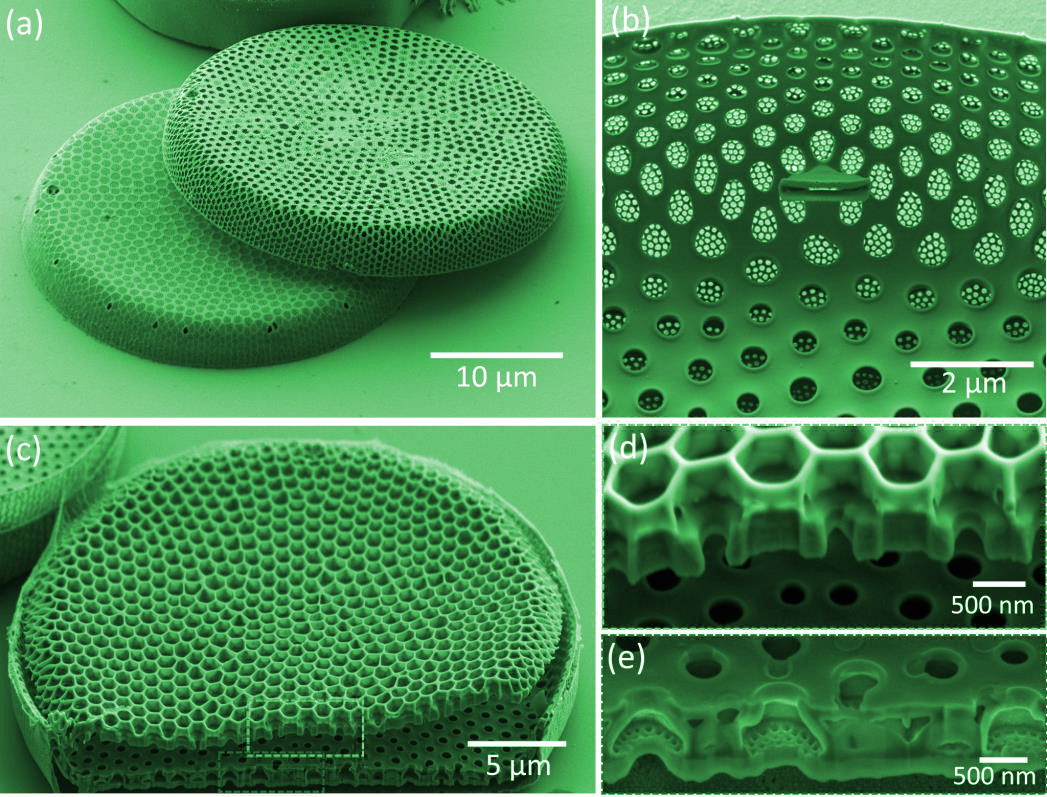
QAZAQ GREEN. Skoltech researchers and their colleagues have uncovered an intricate light manipulation mechanism likely used by microscopic algae to boost photosynthesis. By studying the interaction of light with the elaborately patterned silicon dioxide shells enclosing the single-celled algae, the team hopes to reveal principles that could eventually be leveraged in light detectors, bio- and chemical sensors, protective coatings against ultraviolet rays, solar cells, and other nature-inspired technology, right up to artificial photosynthesis systems using CO2 and water to make fuel.
The Russian Science Foundation-backed study came out in the journal Optica.
Diatom algae are extremely widespread and well-adapted microorganisms. They comprise a large part of phytoplankton, making up nearly half of the organic material found in the oceans and generating a quarter of the planet’s oxygen. The distinctive feature of diatoms is a rigid cell wall made of a glassy substance and perforated with intricate hole patterns, which the algae use for protection, waste removal, nutrient uptake, and — as has been strongly suspected — manipulating light to make the most of the solar energy that reaches the ocean depths inhabited by the algae.
“By investigating the optical properties of diatoms of the species Coscinodiscus oculus-iridis, we have shown that these algae’s frustules, or outer shells, with their intricate pattern of pores, exhibit what’s known as the Talbot effect. Light undergoes diffraction on the hole pattern and is focused in numerous hotspots within the shell. While we don’t think this is specifically what the diatoms evolved their sieve-like shells for, they certainly seem to exploit them to boost the efficiency of photosynthesis, possibly by strategically positioning their light-harvesting chloroplasts,” said the lead author of the study, Associate Professor Sergey Dyakov from Skoltech Physics.
The team confirmed the occurrence of the Talbot effect with calculations and is planning to support the findings with an experiment with a scaled-up artificial structure mimicking the hole pattern of the frustule.
Senior Research Scientist Julijana Cvjetinovic from Skoltech Photonics, a co-author of the study, commented on the kinds of biomimetic technology that could benefit from a better understanding of diatoms: “As we gain more insights into the properties of diatom frustules, eventually some of the uncovered mechanisms could make their way into photonic devices, biosensors, self-adjusting light-sensitive coatings, and photovoltaics, maybe even artificial photosynthesis systems, which would tap into light energy and store it in the form of chemical fuel rather than electricity.”
The grant project’s principal investigator, Professor Dmitry Gorin from Skoltech Photonics shared his opinion on diatoms as an object of research: “Diatoms are a striking example of another masterpiece of nature, which over millions of years of evolution has managed to create a perfect object in terms of combining optical and mechanical properties. I am sure that we will find many more interesting things in the process of further studying the physical and biochemical properties of diatoms.”
The research team behind the study reported in this story also featured Professor Pavlos Lagoudakis of Skoltech Photonics, Professor Alexander Korsunsky, Assistant Professor Alexey Salimon, and Research Scientist Eugene Statnik of Skoltech Engineering, Professor Nikolay Gippius and Research Scientist Ilia Fradkin of Skoltech Physics (the latter also of MIPT), and PhD student Dmitry Dresvyankin, as well as their colleagues Eugene Maksimov from Lomonosov Moscow State University, Nickolai Davidovich from Vyazemsky Karadag Scientific Station of RAS, and Yekaterina Bedoshvili from the Limnological Institute of the Siberian Branch of RAS.
Kazakhstan poultry farm produces 15 million kWh of energy from waste
China, Spain expand partnership in solar and wind power
Mongolia engages Hanwha Group in industrial and clean energy development
Russia to test horizontal and vertical wind power plants at new renewable energy test site in Adygeya
Brussels sets timeline: grid package by summer, electrification strategy to follow
RES 2026 to address workforce training for renewable energy scale-up
Algeria commissions 400 MW of solar capacity
Deadline approaching: KOREM invites bids for wind and solar power auctions
From crisis to security: IRENA lays out renewables roadmap for governments
Renewable energy generation in Kazakhstan rises 15% in Q1 2026
Kazakhstan climbs the Climatescope rankings
Kazakhstan and China launch joint Hydrogen Energy Technology Innovation Center
Switzerland builds world’s most powerful redox-flow battery
UK approves its largest ever solar farm at 800 MW
Sonnedix wins major solar energy contracts in Italy
China-developed 1,000-MW solar project enters operation in Laos
Kazakhstan’s Senate passes agreement to export green energy to Europe
Zayed Sustainability Prize opens global call for submissions
Daily share of ‘green energy’ in Azerbaijan exceeds 29%
Tajikistan to build a 250 MW solar power station