

Education and science08.12.2025
Beyond politics: How public attitudes toward renewable energy affect the development of green technologies in Kazakhstan



Mariyam Omarova, MASc Global Sustainable Development, the University of Warwick
Kazakhstan’s difficult path toward a low-carbon future presents a unique paradox. Being one of the most carbon-intensive economies, the country has pursued highly ambitious goals for decarbonisation and renewable energy development since the early 2010s. However, neither advanced legislation, nor state commitment, nor growing foreign investment has produced the expected transformation of the national economy toward green technologies.
This paradox formed the basis of my scientific research project conducted at the University of Warwick in the United Kingdom. After analysing previous studies on the stagnation of renewable energy development in Kazakhstan and comparing them with the experience of other countries in the region, I concluded that the main challenge lies in the population’s cautious attitude toward this process. The disconnect between ordinary citizens and government policy, as well as the lack of dialogue and public awareness about the critical importance of decarbonisation, do not give a chance for these measures to be accepted with understanding and an adequate attitude.
To gain deeper insight into the problem, we conducted an online survey of Kazakhstan residents and interviews with energy experts.
I would like to present the results of this research.
Existing Barriers
According to the Ministry of Energy of the Republic of Kazakhstan, the share of renewable energy in 2025 reached 6.81%, which corresponds to the set goals of achieving a renewable energy share of 6% by 2025, 10% by 2030 and 50% by 2050. Further progress, however, will require much more serious infrastructural changes in Kazakhstan's economy and industry.
After reviewing available literature on the stagnation of renewable energy deployment in Kazakhstan, I identified several recurring problems. To verify or assess their impact, I consulted experts from the fossil fuel sector, power grid management, renewable energy construction, and renewable energy policy and legislation.
The interviews I conducted helped me draw the following interesting conclusions. On the one hand, I understood that experts working in the field of traditional fossil fuel energy sources and holding quite high positions live in their own information bubble; their skepticism and unwillingness to acknowledge the need for decarbonization affect the perception of renewable energy for all Kazakhstanis working in this field, and in some regions they are the majority.
Also, experts in the field of energy grids noted the critical need to modernize about 50% of all existing grids, which we inherited from the Soviet Union. The development of renewable energy even at the level of 20–30% is impossible without modernizing existing grids.
The expert who directly managed projects for the construction of wind power plants noted that the country critically needs to develop the production of components for renewable energy. The growing demand for these components often forces overpayment to factories in other countries and reduces the percentage of local content in renewable energy projects.
Interviewees also noted that global decarbonisation trends strongly influence the introduction of green technologies. Thus, the Carbon Border Adjustment Mechanism (CBAM), being implemented by the EU on certain types of raw materials, forces producers of this product in Kazakhstan to convert operational capacities to lower-carbon types of energy.
I separately touched upon the topic of nuclear power plant construction in Kazakhstan and the necessity of its construction from the standpoint of energy deficit and overall feasibility. All experts noted that Kazakhstan does not need a nuclear power plant. References to France are outdated, as France developed nuclear power plants at the beginning of the 20th century and at the moment, it is better to develop renewable energy and gas power plants (as a transitional type of energy), rather than invest in expensive nuclear power plant projects.
Online Survey
But the most striking results were shown by the online survey of Kazakhstan residents. This survey covered all regions of Kazakhstan and was participated in by 256 citizens. The majority of respondents (61%) were women, which speaks to the growing demographic dynamic and women's interest in the development of more environmentally friendly and sustainable solutions in the energy sector in the country. The age of participants covered quite a large cross-section from 17 to 68 years. Questions regarding the impact of the country's transition to renewable energy on individual household expenses elicited quite a mixed reaction: 42% are confident that expenses will increase, 18% that they will not increase, 40% do not think about it.
Regarding the most important factor in switching to renewable energy, 41% cited supply reliability, reflecting concerns about technical readiness and grid ageing. Rising energy costs were a concern for 32%, while 16% and 10% mentioned grid readiness and accessibility, respectively.
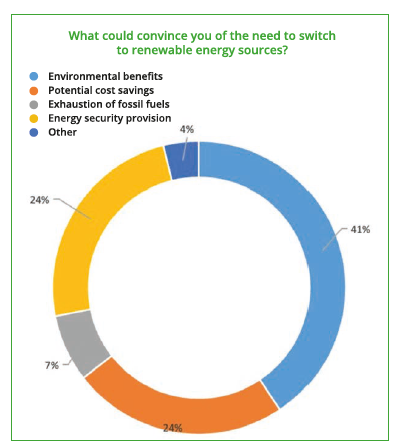
Environmental benefits were the main motivating factor for 41% of respondents, followed by economic considerations and energy security (24% each). Only 7% were concerned about the depletion of mineral resources, demonstrating persistent dependence on fossil fuels, which is also noted by many academic sources.
The survey shows that the Kazakhstan’s population neither categorically opposes renewable energy nor unconditionally supports it. On the contrary, their views are shaped by pragmatic considerations regarding costs and, especially importantly, reliability of supply. To bridge the gap between progressive policy and its actual implementation on the ground, it is necessary to invest both in grid infrastructure and in effective communication strategies that link environmental goals with tangible benefits for households. By identifying these interconnected problems, the research illustrates the importance of quality online surveys as policy analysis tools that transform complex public sentiments into practical solutions.

My research provides a foundation for longer-term studies that combine public opinion with expert assessment to address multifaceted energy policy challenges. Five key factors shape public perception: environmental concern, economic motivation, social influence, institutional trust, and perceived personal benefit. Leveraging these drivers enables the development of messages that resonate with citizens and promote sustainable change.
The study also identified regional disparities. Regions rich in fossil fuels demonstrated higher scepticism toward renewable energy, while support was notably stronger in major metropolitan areas.

Finally, the research revealed a persistent gap between government directives, business ambitions, and public needs. Insufficient public engagement and awareness of the importance of the energy transition risk hindering progress. Kazakhstan’s discourse on renewable energy remains fragmented—government, business, and citizens operate in separate informational spaces. Without constructive dialogue, a socially accepted and successful transition will remain elusive.
In a country as vast as Kazakhstan, ensuring regional equity in the transition process is essential. Fossil-fuel-dependent regions may react negatively to rapid decarbonisation, making a balanced and inclusive approach vital. Only through open dialogue and comprehensive strategies can Kazakhstan achieve an effective and equitable energy transition.
ADB to invest $5.5bn across 15 projects in Kazakhstan
17 agreements worth over $2.3 billion signed at the opening of RES 2026 EXPO in Astana
World Bank to invest $1bn in Central Asia's energy integration
Kazakhstan and China to launch a 500 MW wind farm in Karaganda region
Kazakhstan and Tajikistan move toward clean power deal over Rogun HPP
Regional Ecological Summit 2026 opens in Astana
Solar pumps and drip irrigation help Kyrgyz farmers cut costs amid rising energy prices
Hormuz closure failed to trigger coal comeback as solar and wind filled the gap
Astana set to launch RES 2026 EXPO and ink key international deals
Central Asian countries to discuss energy transition at RES 2026 in Astana
Moldova surpassed 1 GW of installed renewable energy capacity
China begins building US$1 billion hydropower station in Cambodia
Thousands protest in Germany urging faster green shift
Scientists from Russia and Uzbekistan improved the stability of green energy systems by 24%
Kazakh startup ranks in GCIP global top 3 in Vienna
Kazakhstan poultry farm produces 15 million kWh of energy from waste
China, Spain expand partnership in solar and wind power
Mongolia engages Hanwha Group in industrial and clean energy development
Russia to test horizontal and vertical wind power plants at new renewable energy test site in Adygeya
Brussels sets timeline: grid package by summer, electrification strategy to follow