

Green Finance16.06.2022
Scenarios for development of the electric power industry (LCGP) and the balance of electricity and capacities of Kazakhstan until 2035


Zhenis Dyusenov, Director, Department for Development ofthe National Electric Grid,KEGOC JSC
Inna Kim, Head ofthe Energy Systems Research Department, Energy System Researches LLP
The development of the energy industry largely determines the development ofthe country and should be implemented proactively, taking into account the long construction and commissioning of energy facilities. In this regard, forecasting ofthe development of the industry is carried out, which, depending on the goals and planning horizons, is divided into short term, medium-term and long term.
Short-term forecasting (1-3 years) assumes a detailed action plan for the period under review. The goal of medium-term forecasting (5-7 years) is to determine quantitative indicators and resource allocation plan. Long-term planning (more than 10 years) is carried out to make strategic decisions aimed at introducing political and technical innovations in orderto better allocate resources, achieve goals and international commitments.
Thus, medium-term planning (7 years) in Kazakhstan is fixed by the Law of the Republic of Kazakhstan "On Electric Power Industry", whereby the forecast balance of capacity and electricity is compiled annually by KEGOC JSC and approved by the Ministry of Energy of the Republic of Kazakhstan. The forecast seven-year balance is compiled in accordance with the "Rules for development of forecast balances of electric energy and capacity" and allows identifying the period of onset and the size of the shortage of electricity and capacity.
The forecast balance of capacity and electricity until 2035 was carried out in accordance with the President’s instructions given at an expanded meeting of the Government on January 25, 2021. The purpose of this long-term forecast is to consider options for covering the long-term shortage of capacity and electricity, taking into account the adopted energy development targets and the international obligations of the Republic of Kazakhstan on reduction of emission, and to assess the possible results of the decisions taken.
The forecast balance of capacity and electricity until 2035 was developed based on officially provided source data from relevant organizations, large consumers of electricity and government agencies, energy-producing organizations upon request:
• to the Ministry of Energy (DOE) of the Republic of Kazakhstan;
• to the Ministry of National Economy (MNE) of the Republic of Kazakhstan;
• to the Ministry of Industry and Infrastructure Development (MIID) of the Republic of Kazakhstan;
• to SWF "Samruk-Kazyna";
• to Samruk-Energo JSC;
• to Financial Settlement Center of RE LLP;
• to power plants;
• large consumers;
• to electric grid distribution companies (EDC);
• to local executive bodies (akimats);
• to special economic zones (SEZ), etc.
Within three months (April - July 2021), total of more than 240 requests were sent, with fulfillment of 80%. The data of public organizations, NCE RK "Atameken", the election program of the Nur Otan party, etc.were taken into account.
Planning the operation of the power system includes a large number of variables and constraints; therefore, in order to find the optimal scenario of development from all possible alternatives, it is necessary to use mathematical models. Optimization models, usually, assume high requirements to computational resources, therefore, when modeling complex systems, such as energy, a reasonable determination of initial positions and assumptions is required.
The forecast balance of capacity and electricity until 2035 was developed using the ORDENA software, which allows performing long-term forecasting of energy development at the lowest cost when the specified restrictions are met. The block diagram of modeling scenarios forthe development of the power system is shown in the figure below.
1. Input data:
-
Existing grid configuration
-
Existing generating capacities
-
Electricity consumption forecast V-candidates
-
Power plants-candidates
-
Fuel cost
-
Limit on emissions
-
Indicators of renewable energy development etc.
2. Target model
for finding a combination of required investments and distribution of electricity and capacity to cover the need at the lowest cost
3. Output data:
-
New power plants
-
New overhead lines
-
Dispatching of power plants
-
System costs
-
Uncovered demand
-
CO, emissions etc.
This article will present the results of the simulation of scenarios for the development of the electric power industry of Kazakhstan (LCGP) and the resulting balance of electricity and capacity of the National Grid of Kazakhstan until 2035.
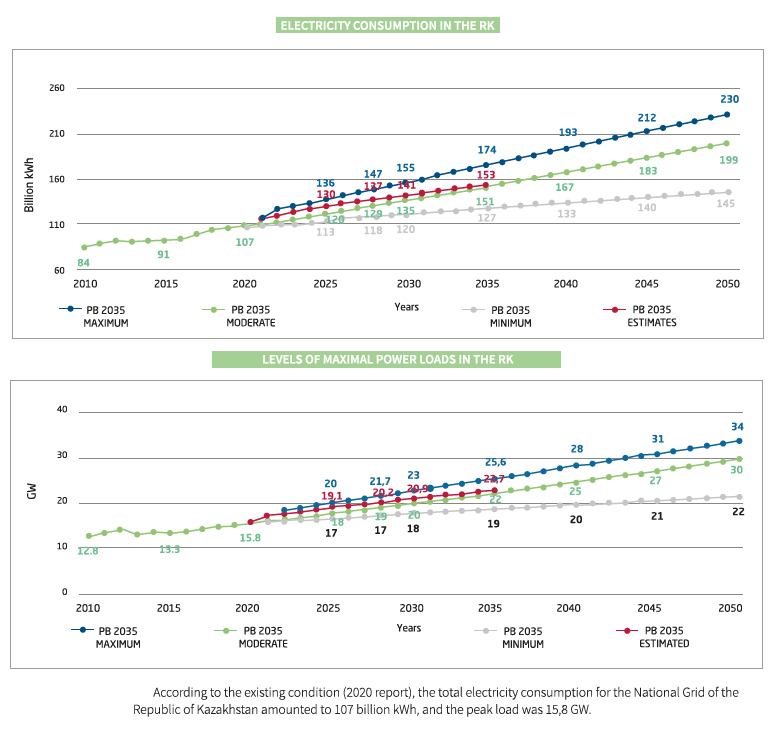
Traditionally, the development of balance begins with forecast of electricity consumption and electrical loads in the long-term, which was carried out according to three scenarios, while the "Estimated scenario" was taken as the basis according to which the electricity consumption in National Grid of the Republic of Kazakhstan would be 137 TWh in 2028 and 153 TWh in 2035. The total electric load ofthe National Grid of the Republic of Kazakhstan is projected to be 20.2 GW in 2028 and 22.7 GW in 2035, respectively.
In addition, based on the results ofthe review of the Concept and Doctrine of Low-Carbon Development (CDLCD), when analyzing the sensitivity ofthe results of optimizing the lean cost generation plan (LCGP), the Maximum scenario was additionally considered, providing active development of agriculture, electric transport, information technology (data processing centers) and a significant increase in the specific rates of municipal consumption.

Kazakhstan and China to launch a 500 MW wind farm in Karaganda region
Kazakhstan and Tajikistan move toward clean power deal over Rogun HPP
Regional Ecological Summit 2026 opens in Astana
Solar pumps and drip irrigation help Kyrgyz farmers cut costs amid rising energy prices
Hormuz closure failed to trigger coal comeback as solar and wind filled the gap
Astana set to launch RES 2026 EXPO and ink key international deals
Central Asian countries to discuss energy transition at RES 2026 in Astana
Moldova surpassed 1 GW of installed renewable energy capacity
China begins building US$1 billion hydropower station in Cambodia
Thousands protest in Germany urging faster green shift
Scientists from Russia and Uzbekistan improved the stability of green energy systems by 24%
Kazakh startup ranks in GCIP global top 3 in Vienna
Kazakhstan poultry farm produces 15 million kWh of energy from waste
China, Spain expand partnership in solar and wind power
Mongolia engages Hanwha Group in industrial and clean energy development
Russia to test horizontal and vertical wind power plants at new renewable energy test site in Adygeya
Brussels sets timeline: grid package by summer, electrification strategy to follow
RES 2026 to address workforce training for renewable energy scale-up
Algeria commissions 400 MW of solar capacity
Deadline approaching: KOREM invites bids for wind and solar power auctions