

Industry News12.09.2025
Cost-optimal energy system development pathways for Kazakhstan




Alexandr Gasilov, Head of Energy Strategy and Climate, Eurasian Resources Group
Kazakhstan's energy system is facing a number of challenges, including growing demand for electricity and heat, aging infrastructure, and the need to reduce greenhouse gas emissions. Some key decisions regarding the development of the energy system have already been made, but many more are yet to come. The choices made today will determine what Kazakhstan's energy sector will look like in the coming decades: how affordable energy will be, what its environmental footprint will look like, and what kind of foundation it will provide for future economic growth.
According to the World Energy Council’s energy trilemma framework, energy system planning must account for three key aspects: energy security, affordability, and environmental sustainability. The goal of this article is to identify the most balanced development scenario for Kazakhstan’s energy system. The material follows a planning-based logic: how much and when new capacity should be added, which technologies are optimal, and how to handle existing power plants.
The analysis concludes that the most cost-effective and sustainable pathway for Kazakhstan is the large-scale deployment of renewables, combined with peaking gas-fired generation.
This article reflects the author’s perspective on the optimal generation mix from the standpoint of minimizing energy costs. Regulatory aspects are deliberately excluded, as they require separate and more in-depth analysis.
Given the discussion-oriented nature of the material, I would be glad to engage in dialogue beyond the scope of this article, answer questions, receive feedback, or share calculations if needed. You can reach me via LinkedIn: www.linkedin.com/in/alexander-gasilov
I would like to thank my colleagues — Yevgeniy Nikitin, Nikolay Posypanko, and Timur Dyussekhanov for their valuable comments and ideas during the development of this work.
HOW MUCH OF THE NEW CAPACITY NEEDS TO BE BUILT, AND WHEN?
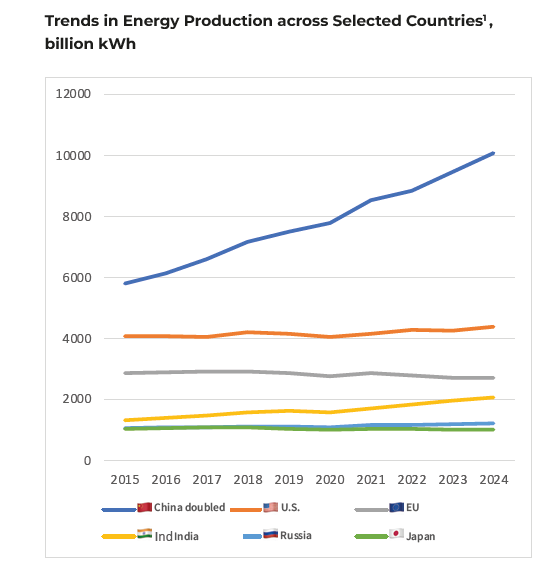
At the early stages of energy system planning, it is important to define the required volume of new capacity. The experience of many countries shows that energy demand growth rates tend to be relatively stable, as they are primarily determined by the structure of the economy and its growth pace. For example, China’s economy is highly electricity-intensive and continues to grow at a strong pace. In contrast, the share of industry in the EU is significantly lower, and GDP growth rates lag far behind those of China. Moreover, the high cost of energy resources and environmental constraints drive a strong focus on energy efficiency.
Average Annual Change in Electricity Generation Over 10 Years: China: +6.3%, USA: +0.8%, EU: -0.7%, India: +5.0%, Russia: +1.4%, Japan: -0.1%.
Compared to these countries, Kazakhstan occupies an intermediate position in terms of both the share of industry in GDP and the pace of economic growth. Over the past 10 years, electricity consumption in Kazakhstan has been growing at an average annual rate of 2.7%.
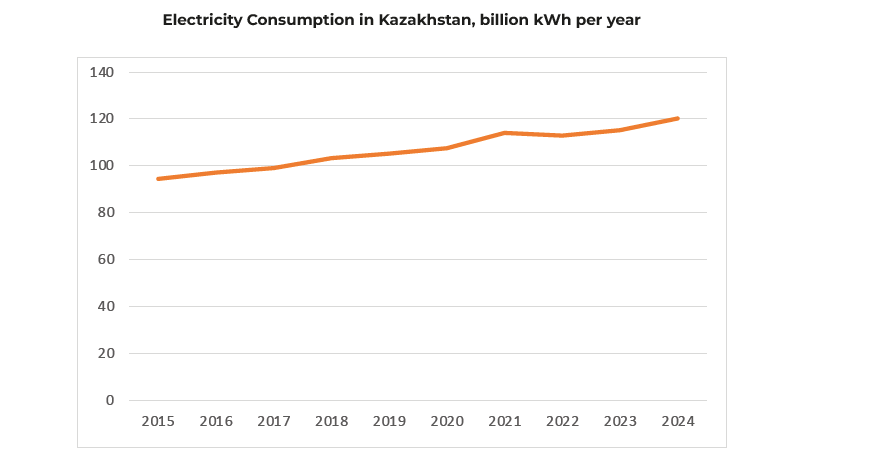
Thus, to meet the growing energy needs of the economy, the required rate of generation increase should be no less than 2.7% per year. Moreover, given the recurring shortages, it should be even higher, as additional reserve capacity is needed.
There is a view that accelerated energy sector development can stimulate the emergence of energy-intensive industries. However, this requires a cautious approach. The problem is that the cost of electricity from new power plants is significantly higher than from existing ones, as, in addition to fuel and operating expenses, it is also necessary to recover the capital investment and ensure a return for investors. Today, the cost of electricity from existing thermal power plants is around 10–15 tenge per kilowatt-hour, whereas electricity from a new coal-fired plant is estimated at no less than 40 tenge (including capacity payments). Therefore, pursuing rapid energy sector expansion carries the risk of significantly increasing the cost per kilowatt-hour — both for current and future consumers. Existing consumers would end up paying for idle new capacity awaiting demand. Expensive electricity could reduce the competitiveness of energy-intensive industries and raise entry barriers for new enterprises. The key conclusion is that capacity additions must be aligned with the real needs of the economy.
An interesting example is China, which has managed to establish large-scale industrial construction of coal-fired power plants at specific capital costs below $1,000 per kilowatt. In 2021, China announced that it would stop developing coal projects abroad and canceled more than 40 GW of coal capacity overseas. Despite this pledge, new overseas coal projects involving Chinese companies continue to surface from time to time, although their total scale is several times smaller than that of the projects that were halted. It is also important to note that the specific costs of Chinese contractors for international projects are significantly higher than for domestic ones.
As the economy transitions from a resource-based or industrial model to a service-based one, a decline in specific energy intensity is inevitable. Naturally, there is a possibility of the major changes driven by emerging factors such as electric vehicles, data centers, or decarbonization. However, their impact tends to unfold gradually over a period of 5 to 10 years rather than occurring within a single year.
The United States offers a clear example of how the data center industry can affect electricity demand. Over the past five years, their share in national electricity consumption has increased from 1.9% to 4.4%. By 2028, this growth is expected to continue at least at the current pace.
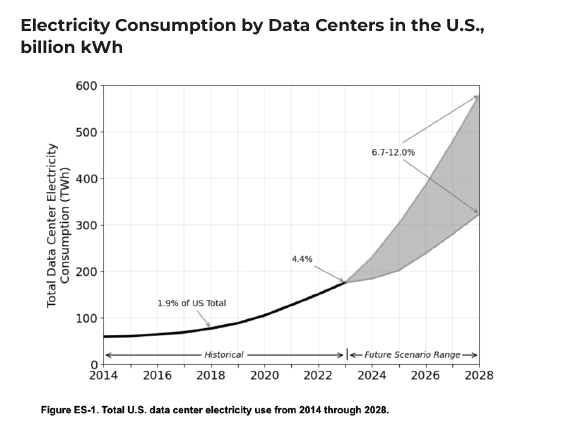
If a similar trend were applied to Kazakhstan’s power system, covering the electricity needs of data centers would require only about 100 MW of new capacity to be added each year.
The rapid surge in the digital mining industry that occurred in Kazakhstan a few years ago was largely driven by the availability of surplus capacity and the possibility of purchasing electricity directly from power plants. Under current conditions, however, this sector has sharply declined and no longer appears as attractive. Given that large-scale investment in the energy sector will inevitably drive up electricity costs, the likelihood of a similar boom occurring again in the near future appears low.
Another illustrative example is the potential electricity demand from Kazakhstan’s vehicle fleet if it were fully electrified.
5.7 million of Vehicle fleet × consumption of 0.25 kWh/km × average mileage of 15,000 km/year = 21.4 billion kWh
This figure is equivalent to 18% of the country’s current electricity consumption. If the entire existing vehicle fleet is replaced with electric vehicles over a 20-year period, the average contribution of electrification would be less than 1% per year. Moreover, with the introduction of time-of-use electricity pricing, electric vehicles could help smooth the load curve, meaning the actual increase in required capacity would be significantly lower than 18%. In addition, each electric vehicle, effectively functioning as a mobile energy storage unit, could, with the appropriate regulatory framework in place, provide services to the grid by consuming electricity during surplus periods and supplying it back during peak demand periods.
Thus, even major factors such as data centers or transport electrification are not unexpected in energy system planning. With a certain reserve of generating capacity, such developments are unlikely to be constrained by system limitations.
Even large additional factors or individual projects do not necessarily add on top of existing growth rates and push energy consumption beyond the long-term trend. Certain sectors of the economy may stagnate or contract due to reduced output, improved energy efficiency, or other reasons.
WHAT TYPE OF NEW CAPACITY IS THE MOST ECONOMICALLY VIABLE?
To compare the cost of electricity from different types of generation, the commonly used metric is LCOE (Levelized Cost of Electricity). In this article, a simplified single-rate energy price is used for clarity. It is conceptually similar to LCOE but does not apply discounting to future generation volumes and costs. This approach allows for a straightforward comparison of new generation costs with current renewable energy auction prices and the costs of existing power plants.
Price = OPEX + Fuel + PMT (10%; 15; -CAPEX) / Sales
• OPEX – operational expenses per kWh, including staffing, maintenance, and other plant operating costs
• Fuel – fuel cost component per kWh
• PMT – an Excel function that calculates the annuity (uniform) loan payment based on the specified loan amount, return rate, and repayment period. This component ensures both loan repayment to the bank and return on investment. Parameters used:
• 10% – project return rate
• 15 years – investment payback period
• CAPEX – capital expenditures for building the capacity
• Sales – total electricity sales in kWh
• The exchange rate used is KZT 500 per USD 1.
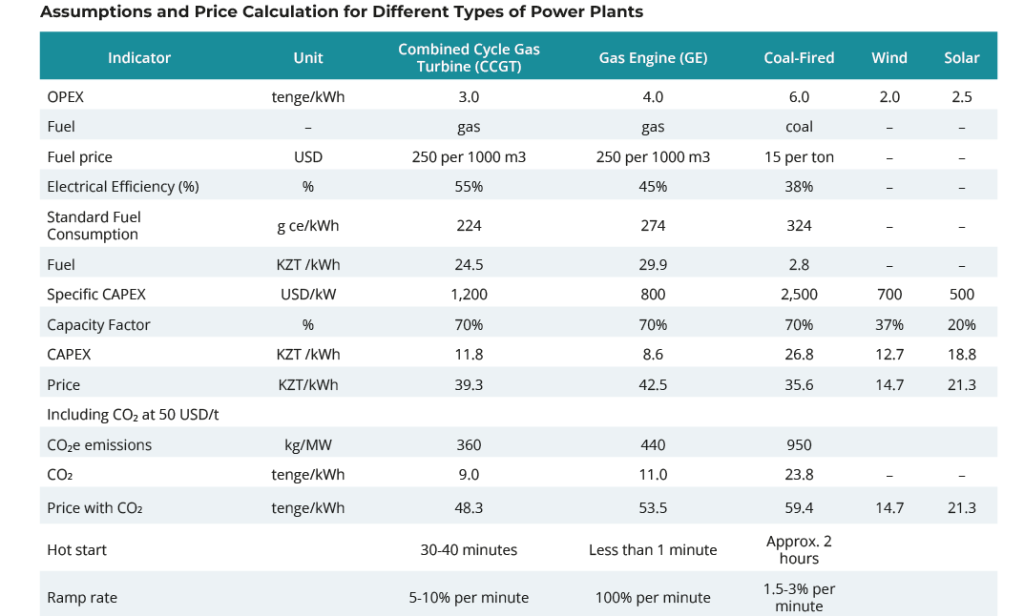
Notes. The gas price is based on export parity. Since the volume of gas available on the market is limited, domestic consumption reduces export potential and the opportunity to earn revenue at a rate of USD 250 per 1,000 cubic meters. Hydropower plants are not included due to limited capacity potential and relatively high costs combined with stability risks. The CO2 price is assumed at an indicative level of USD 50 per tonne. Given Kazakhstan's commitment to reducing greenhouse gas emissions, such a price level can be expected over the next 10 years across the full volume of emissions (without free allowances). It is worth noting that this value is significantly lower than the expected cost of carbon capture and storage. The unit capital cost for coal-fired power plants is based on the most recent projects implemented by China abroad.
As shown in the table above, gas and coal-fired power plants have the highest electricity cost, making them the most expensive options for consumers. For gas, this is due to the high cost of fuel; for coal — due to the high capital expenditures. If CO2 costs are included in the calculation, coal-fired plants become the most expensive option because of their high emissions per kilowatt-hour.
The lowest electricity cost is observed for wind power, which is lower than even the fuel cost alone of the most efficient combined-cycle gas turbines (CCGTs). However, the challenge with wind power lies in its intermittency, which prevents it from being used as a standalone solution. Successful integration of wind power into the grid requires the presence of dispatchable generation that can be activated on demand.
Given the above, the most optimal solution appears to be a hybrid system, where the bulk of electricity is provided by low-cost renewables, while reliability and periodic shortfalls are covered by generation with low capital costs, namely gas-fired power. In such a system, expenditures on expensive gas are minimal, as is the overall cost of electricity. Moreover, this system would result in minimal greenhouse gas emissions, as gas plants would operate with a low capacity factor.
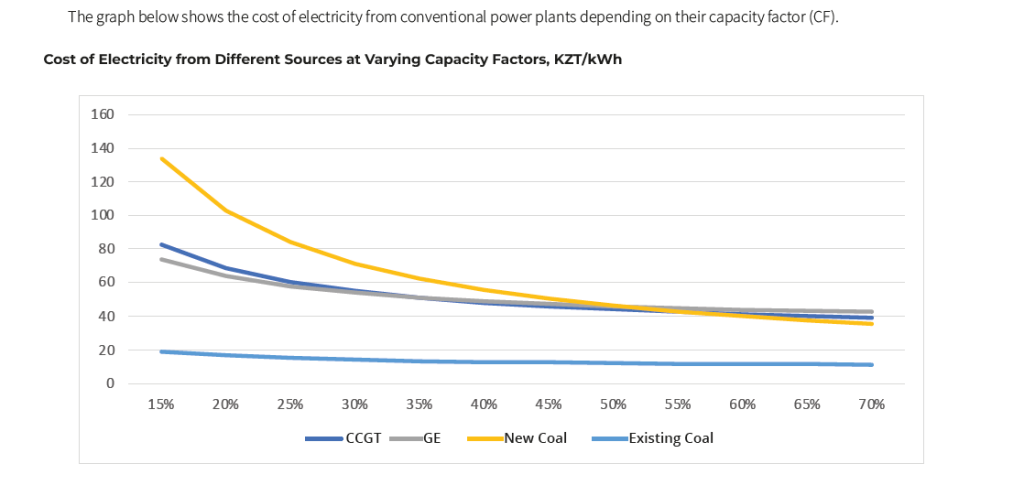
Existing power plants provide the lowest electricity cost. At low capacity factors, new gas-fired plants are cheaper than new coal-fired ones. However, when operating at a capacity factor above 50%, coal plants may offer lower costs due to cheaper fuel. The most competitive tariff from new plants can be achieved with high utilization and comprises around 40 KZT per kilowatt-hour.
As noted above, the lowest cost from new generation can be achieved by leveraging the low cost of renewables. To do this, an excess amount of cheap renewable capacity must be built with the understanding that part of this energy will be curtailed when not needed. When calculating system costs, the cost of curtailed energy must also be taken into account.
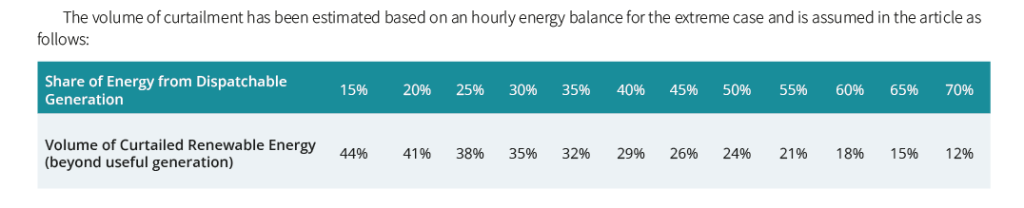
The cost of combined generation is calculated using the following formula:
Cost_dispatchable x Share_dispatchable + Cost_wind x (1 - Share_dispatchable) x (1 + RE_Curtailment_volume)
The results of these calculations are presented in the graph below.
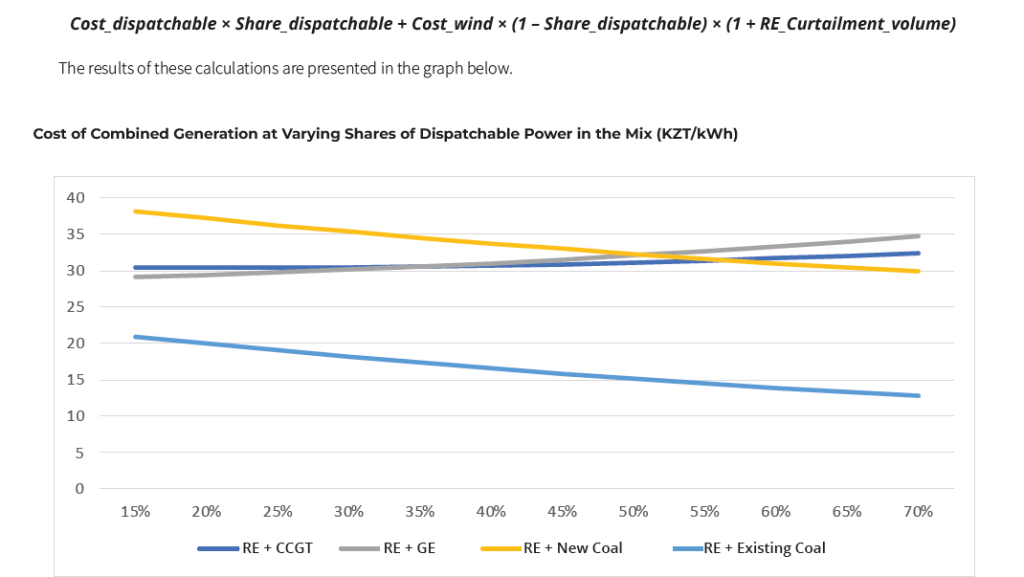
The graph shows that combining gas and wind power can reduce the electricity cost from around 40 to 30 KZT per kWh when gas generation operates in peak mode. The higher the share of renewables, the cheaper the combined kilowatt-hour becomes, thanks to lower specific gas-related costs. With coal, the situation is the opposite: the lower the share of renewables, the cheaper the electricity. This is because the fuel component for coal is lower than the cost of renewables. It is important to note that this is specific to Kazakhstan, where coal is relatively cheap. In China, where coal costs are around USD 100 per tonne, the combination of flexible coal and renewables is economically viable. Given limited gas availability and low specific CAPEX, the development of flexible coal generation is a key trend in China.
Including CO2 costs in the calculation shows that emissions in a hybrid system with a high share of renewables and peaking gas capacity are significantly lower than in a system where thermal generation operates in baseload mode.
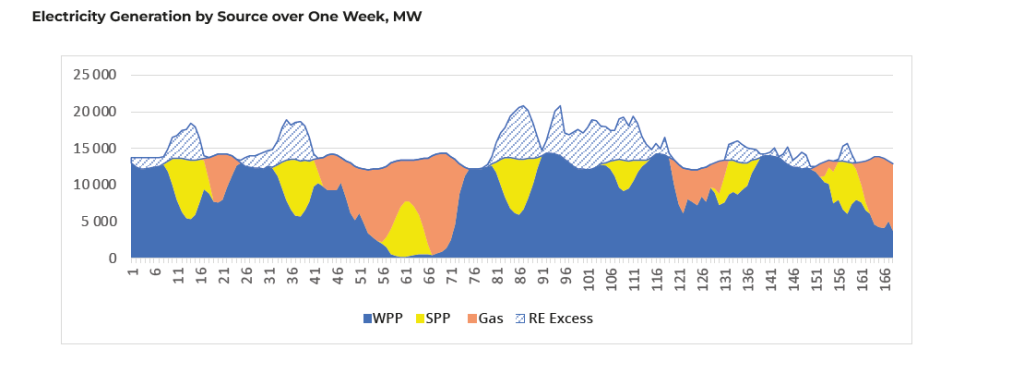
The illustration below presents the generation profile of a hybrid system with an excess of renewable capacity and peaking gas generation. Solar plants are also integrated into the system, further lowering the tariff.
Key parameters of the modeled power system: Peak load of 16 GW, 10 GW of solar power plants, 24 GW of wind power, and 16 GW of gas-fired plants with 45% efficiency. The wind generation profile is based on average values from five sites with an average capacity factor of 37%. The capacity factor for solar power is 20%. Modeling results: renewable energy curtailment amounts to 18% beyond useful generation and is fully compensated to the investor. Gas-fired generation covers 29% of demand, operating at a capacity factor of 23%. The estimated electricity price is 32 KZT/kWh, excluding CO2-related costs.
What should be done with the aging existing power plants?
Different types of existing plants require different solutions.
COAL-FIRED POWER PLANTS
Coal-fired plants with minimal tariffs (around 10-15 KZT per kWh) contribute to low system-wide electricity costs and should be kept in operation for as long as possible. Most of the equipment at these plants can be gradually replaced as part of capital repairs, ensuring relatively high operational reliability and maintaining component life within regulatory limits. At the same time, it is expected that the economic burden on coal-fired plants will increase over time, inevitably leading to higher tariffs and reduced competitiveness compared to other types of generation.
Key factors driving up the cost of coal-fired generation include:
• Mitigation of particulate matter emissions;
• Mitigation of gaseous emissions — sulfur oxides and nitrogen oxides;
• Restrictions on greenhouse gas emissions.
It is important to understand that these factors are manageable. If the government prioritizes keeping energy prices low, regulatory authorities have the ability to delay the implementation of these measures in order to maximize the prolonged use of economic benefits provided by inexpensive fuel. However, if these measures are implemented, the cost of electricity from existing coal-fired plants could increase two- to threefold. In such a scenario, converting these plants to gas, for example, by adding gas turbine units, may become economically viable. At the same time, this gas-fired generation should be accompanied by corresponding additional volumes of renewables, which, as shown earlier in this article, reduce the overall system costs.
GAS-FIRED POWER PLANTS
Gas-fired plants currently have relatively low tariffs due to gas price subsidies. Considering that most plants were built using the traditional steam cycle, their fuel efficiency is significantly lower than that of modern combined-cycle gas turbines (CCGTs), and their production costs and tariffs are notably higher than those of coal plants.
As the power system requires new capacity, it is advisable to transition existing gas plants to flexible operation modes while supporting new renewable capacity additions. This approach will significantly reduce absolute gas consumption and lower system costs. It is also advisable to consider retrofitting steam power plants with gas turbine units to increase their capacity and improve efficiency.
RECOMMENDATIONS FOR PLANNING
To optimize energy costs and maintain the competitiveness of the economy, in my view, the following steps are necessary:
• Conduct energy planning using modern modeling tools such as PLEXOS. The use of such tools will help optimize the cost of electricity.
• Increase the involvement of the expert community in the planning and decision-making process regarding the future of the power system. It is important to consider not only the voices of energy professionals but also those of consumers, economists, and environmentalists, since decisions are planned for many decades ahead.
• Rely as much as possible on established competitive procedures when selecting new capacities. Kazakhstan’s experience has already demonstrated the high effectiveness of auction mechanisms in reducing prices for renewables and new capacity.
• Establish mechanisms to support energy efficiency in the consumption of thermal energy. Extremely high specific consumption for heating and domestic hot water needs requires excessive CHP and heating network capacity, increasing losses. Careful management of thermal energy will help optimize the costs of creating and maintaining thermal capacity and bring Kazakhstan closer to fulfilling its decarbonization commitments.
ADB to invest $5.5bn across 15 projects in Kazakhstan
17 agreements worth over $2.3 billion signed at the opening of RES 2026 EXPO in Astana
World Bank to invest $1bn in Central Asia's energy integration
Kazakhstan and China to launch a 500 MW wind farm in Karaganda region
Kazakhstan and Tajikistan move toward clean power deal over Rogun HPP
Regional Ecological Summit 2026 opens in Astana
Solar pumps and drip irrigation help Kyrgyz farmers cut costs amid rising energy prices
Hormuz closure failed to trigger coal comeback as solar and wind filled the gap
Astana set to launch RES 2026 EXPO and ink key international deals
Central Asian countries to discuss energy transition at RES 2026 in Astana
Moldova surpassed 1 GW of installed renewable energy capacity
China begins building US$1 billion hydropower station in Cambodia
Thousands protest in Germany urging faster green shift
Scientists from Russia and Uzbekistan improved the stability of green energy systems by 24%
Kazakh startup ranks in GCIP global top 3 in Vienna
Kazakhstan poultry farm produces 15 million kWh of energy from waste
China, Spain expand partnership in solar and wind power
Mongolia engages Hanwha Group in industrial and clean energy development
Russia to test horizontal and vertical wind power plants at new renewable energy test site in Adygeya
Brussels sets timeline: grid package by summer, electrification strategy to follow