

Education and science24.05.2025
Center for Energy and Advanced Materials Science, National Laboratory Astana, Nazarbayev University: Shaping the Future of Energy and Materials


Dr. Arailym Nurpeissova, Dr. Yanwei Wang, Dr. Baktiyar Soltabayev, Dr. Nurxat Nuraje, Dr. Woojin Lee, Dr. Zhumabay Bakenov
The Center for Energy and Advanced Materials Science (CEAMS) at the National Laboratory Astana (NLA), Nazarbayev University, stands at the forefront of scientific innovation in Kazakhstan. As a dynamic hub for interdisciplinary research, CEAMS is dedicated to addressing some of the most pressing challenges in energy, materials science, healthcare, and environmental sustainability. Our mission is rooted in a deep commitment to scientific excellence and national development, guided by the belief that science and technology are the cornerstones of progress.
NLA is home to state-of-the-art laboratories and world-class research infrastructure, enabling cutting-edge investigations across a wide array of scientific fields. In collaboration with international research institutions and universities, CEAMS advances pioneering solutions in green energy, smart materials, and energy-efficient technologies. Through these partnerships, our researchers contribute to global scientific progress while tailoring innovations to Kazakhstan’s unique needs and resources.
In an era marked by the urgent need for energy transition and climate resilience, CEAMS plays a critical role in supporting Kazakhstan’s vision for a sustainable and diversified economy. By leveraging the country’s rich natural resources, such as rare earth elements and solar potential, and integrating advanced technologies, our research teams are developing impactful solutions for energy storage, carbon management, environmental remediation, and industrial safety.
Our long-term goal is to establish Kazakhstan as a global leader in scientific research and green innovation. To this end, CEAMS remains steadfast in its pursuit of breakthrough discoveries and practical applications that drive economic development, improve quality of life, and foster a cleaner, more resilient future. Through excellence in fundamental and applied science, we aim to shape not only Kazakhstan’s scientific landscape but also the broader global discourse on sustainability and technology.
Mission: To develop interdisciplinary fundamental, and applied research that addresses the nation’s most pressing science and technological challenges in order to discover a new knowledge to promote the Kazakhstan’s green economic and technological development, diversification of economy and to become a world-class institution well-known in research and technological excellence.
Laboratory of Energy Storage: Advanced Battery Energy Storage Systems
Kazakhstan is undergoing a major energy transformation, striving to balance rapid economic development with sustainability. As the nation taps into its abundant solar and wind energy potential, one of the most critical challenges is the creation of efficient and reliable energy storage systems. Addressing this challenge is essential for ensuring a stable power supply and minimizing reliance on fossil fuels.
The Energy Storage Systems Laboratory (ESS) at the National Laboratory Astana plays a central role in advancing the science of energy storage. Researchers at ESS are pioneering the development of next-generation lithium-ion batteries and supercapacitor systems that enhance energy storage efficiency, safety, and electrode longevity. These innovations are accelerating Kazakhstan’s transition to a cleaner energy landscape and strengthening the reliability of its renewable energy infrastructure.
A particularly promising avenue of research at ESS involves the use of Kazakhstan’s rich natural resources—especially its deposits of rare and rare-earth metals—for battery production. By incorporating locally sourced raw materials, the lab is working toward the development of sustainable, regionally adapted storage technologies that reduce import dependency and improve resource efficiency.
ESS is also at the forefront of developing rechargeable aqueous lithium-ion batteries (RALBs)—a safe and environmentally friendly alternative to conventional batteries. RALBs combine the energy density of commercial lithium-ion batteries with the safety of aqueous systems. They exhibit high cycling stability, lower production costs, and excellent safety profiles, making them highly suitable for large-scale applications such as grid storage and backup systems in industrial and residential settings [1].
In parallel, the lab is advancing microbattery technology to power compact electronics and microdevices. These miniature systems, composed entirely of solid electrodes and solid electrolytes, are a precursor to full-sized all-solid-state batteries—lithium-ion batteries without any liquid components. These solid-state variants promise superior safety and extended lifespan compared to their conventional counterparts [2].
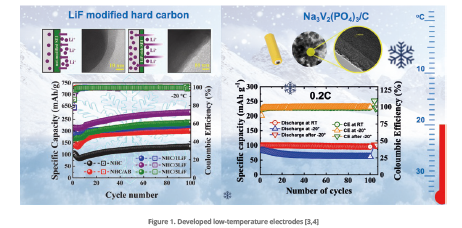
Kazakhstan’s harsh winters pose another unique challenge to battery performance, with sub-zero temperatures impairing conventional storage systems. To meet this need, ESS has developed low-temperature battery systems with advanced electrodes capable of maintaining high performance even in extreme cold [3,4] (Figure 1). This innovation is crucial for energy reliability in remote and off-grid regions of the country.
Another breakthrough initiative is the transformation of recycled plastics into battery components, addressing two global challenges simultaneously: plastic pollution and battery sustainability. This circular economy approach exemplifies Kazakhstan’s growing commitment to green technology and responsible resource use.
To protect and commercialize its innovations, the ESS Lab holds a number of national and international patents.
By addressing key energy challenges, leveraging local mineral wealth, and driving innovation in sustainable technologies, Kazakhstan is charting a bold path toward a low-carbon future. The work at ESS not only enhances national energy security but also sets a global example of how targeted research can support the green transition for generations to come.
Computational Materials Science Laboratory: Accelerating Kazakhstan’s Green Innovation through Computational Materials Science
As Kazakhstan and the world move toward a greener and more sustainable future, materials science is playing a quiet but crucial role, not through giant machines or futuristic infrastructure, but through digitalization and computational modeling that help us design better materials from first principles. At the CMS Lab, we use computational tools to study materials and processes across multiple scales, from atoms to systems, to accelerate innovation in clean energy and environmental technologies.
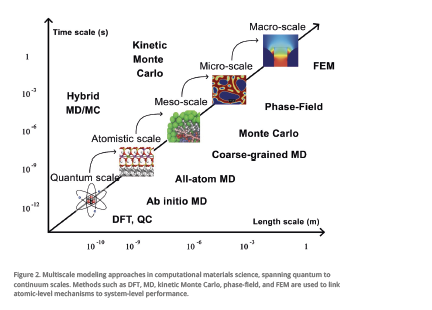
Rather than relying solely on trial-and-error experiments, we employ computational methods (illustrated in Figure 2) to predict structure–property relationships across a wide range of time and length scales, identify promising candidates, and uncover mechanisms not easily observed experimentally. By integrating insights across scales, we move faster, reduce waste, and focus resources where they matter most. Below, we highlight four directions in which our lab’s computational work contributes to Kazakhstan’s transition to a low-carbon and resource-efficient future.
Hydrogen Storage for a Clean Energy Economy: Hydrogen is an important part of Kazakhstan’s clean energy strategy, particularly for decarbonizing transportation and industry. One of the key challenges is identifying materials that can store hydrogen safely, reversibly, and economically. At the CMS Lab, we use density functional theory (DFT) calculations and molecular simulations to evaluate binding energies and structural stability across candidate materials—from doped carbon nanostructures [5] to low-cost alloys. These studies offer atomic-level insight that supports the design of efficient, practical storage systems for hydrogen-powered technologies.
Radiation Effects in Ceramic Materials for Nuclear Systems: Silicon carbide (SiC) is a key material in advanced nuclear reactors, valued for its strength and thermal stability. However, radiation exposure can degrade its thermal transport properties. Using molecular dynamics and multiscale simulations, we investigate how extended defects—such as nano-layered stacking faults and interfaces—influence defect recombination and phonon scattering in irradiated SiC [6]. Our findings guide the design of more radiation-tolerant ceramic materials that better withstand the extreme conditions of next-generation nuclear energy systems.
Green Remediation Fluids for Polluted Soils and Aquifers: Environmental pollution from mining and oil operations presents a major challenge in Kazakhstan. We investigate gas-in-liquid dispersions stabilized by surfactants and polymers as soft-matter fluids for soil and groundwater remediation [7]. Using molecular simulations and AI-assisted image and data analysis, we examine their interfacial dynamics, stability, and flow behavior in porous media. These systems can be engineered to deliver oxidants or nutrients into contaminated zones with minimal environmental impact.
Biochar for CO2 Capture and Sustainable Agriculture: Biochar, produced from pyrolyzed agricultural waste, can capture carbon dioxide while also improving soil properties. We use DFT calculations and multiscale modeling to study how surface chemistry, doping, and pore structure affect CO2 adsorption [8] and interaction with soil minerals. Our work contributes to the design of multifunctional biochars tailored for long-term carbon retention and improved soil function, supporting both climate mitigation and land restoration in Kazakhstan—particularly in saline or degraded soils.
From hydrogen storage and radiation-tolerant ceramics to green remediation fluids and multifunctional biochar, our work at the CMS Lab demonstrates how multiscale modeling can drive real-world sustainability innovation. By integrating computational methods spanning quantum to continuum scales, we support the development of advanced materials and systems with precision and efficiency. As Kazakhstan moves toward a greener future, we believe that computation-guided science—spanning from atoms to systems—will remain essential to delivering cleaner, smarter technologies.
Advanced Sensors Laboratory: Toward a Greener Kazakhstan: Advanced Gas Sensors for Cleaner Air and Safer Industry
As Kazakhstan deepens its commitment to sustainable development and environmental stewardship, addressing industrial emissions and air quality becomes an urgent priority. With rapid expansion in the mining, oil, and gas sectors—alongside growing urbanization—the need for real-time, accurate gas detection is more critical than ever. At the Advanced Sensors Laboratory (ASL) of the National Laboratory Astana, our mission is to develop innovative gas sensor technologies that contribute to a cleaner, healthier, and safer environment.
Gas sensors may be compact and silent, but their impact is far-reaching. They serve as the invisible sentinels of modern society, monitoring toxic emissions, preventing industrial accidents, and enabling smart energy systems. The work of ASL is firmly rooted in this essential role—pushing the boundaries of sensor sensitivity, selectivity, and integration for applications ranging from environmental monitoring to industrial safety and energy optimization.

Why Gas Sensors Matter in a Greener Future
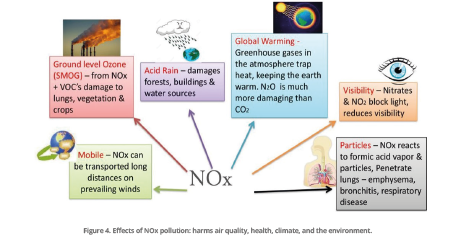
The rapid growth of the energy sector especially in mining, oil, and gas has led to a significant rise in emissions of harmful gases such as nitrogen oxides (NOₓ) and carbon dioxide (CO₂). These gases not only degrade air quality but also accelerate climate change, endanger public health, and compromise safety in industrial environments.
● NOₓ gases, for instance, contribute to the formation of ground-level ozone (smog), acid rain, and fine particulate matter. These pollutants are associated with respiratory diseases such as bronchitis and emphysema, while also harming forests, crops, and water systems.
● CO₂, the primary greenhouse gas, is a major driver of global warming. But lesser-known gases like nitrous oxide (N₂O) are far more potent and equally pervasive, highlighting the urgent need for accurate detection.
Innovating for a Safer and Smarter Future
At ASL, our mission is to develop highly sensitive, selective, and portable gas sensors capable of detecting hazardous and explosive gases in real time. These sensors are crucial not only for environmental monitoring but also for preventing industrial accidents in hazardous workspaces.
Our team has achieved notable breakthroughs in:
● Miniature gas sensors tailored for extreme environments in mining and oil industries.
● Self-powered sensors using integrated energy storage systems.
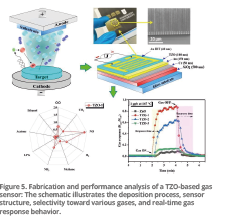
● Advanced nanomaterials like doped ZnO structures, enhancing sensitivity to gases such as H₂S, NO₂, and CO.
Through novel and advanced fabrication techniques, including magnetron sputtering and sol-gel deposition, we tailor sensor materials to optimize morphology, surface area, and gas adsorption capabilities. Real-world performance testing shows excellent gas response, selectivity, and durability across a wide range of operating conditions.
From Lab to Landscape: Green Technology for a Green Economy
These sensor technologies are more than laboratory curiosity; they are enablers of the green transition. Integrated into renewable energy systems, smart buildings, and industrial safety networks, our sensors help optimize energy use while monitoring emissions in real time.
By detecting leaks, measuring air quality, and triggering safety protocols, our innovations support the national vision for:
● Cleaner air in urban and industrial zones
● Safer workplaces in the energy and mining sectors
● Stronger compliance with environmental regulations
● A more resilient and green electric power sector
A Shared Commitment to Sustainability
As Kazakhstan works to expand its share of renewables and promote eco-conscious development, partnerships between academia, industry, and government are essential. At Nazarbayev University, ASL collaborates with local and international partners to bring sensor innovations into practical deployment, protecting lives, reducing environmental impact, and paving the way for a carbon-neutral future.
Environmental Systems Laboratory: Sustainable Development with High Energy Efficiency
The Environmental Systems Laboratory (LES) at National Laboratory Astana focuses on sustainable development in environmental and energy sectors, addressing challenges pertinent to Kazakhstan and the global community.
Key Research Areas:
1. Sustainable Water/Wastewater Treatment & Environmental Catalysis:
o Development of advanced technologies for efficient contaminant removal while minimizing environmental impact.
o Synthesis and optimization of novel bimetallic catalysts supported by porous materials such as Metal-Organic Frameworks (MOFs), Zeolitic Imidazolate Frameworks (ZIFs), and zeolites.
o Effective elimination of heavy metals like Hg(II) and Cr(VI), as well as anions including NO₃⁻ and BrO₃⁻.
2. CO₂ Conversion & Sequestration:
o Exploration of CO₂ conversion and sequestration technologies to mitigate greenhouse gas emissions.
o Interdisciplinary approaches encompassing geochemistry, electrochemistry, and modeling to assess the effectiveness of Carbon Capture, Utilization, and Storage (CCUS) strategies in Kazakhstan.
o Development of robust Life Cycle Assessment (LCA) protocols and assessment of resource potentials for hydrogen production.
3. Environmental Risk Assessment & Life Cycle Assessment:
o Comprehensive assessments to evaluate environmental risks and life cycles associated with infrastructure and contamination in Kazakhstan.
o Utilization of methodologies like LCA and stochastic human health risk assessment to quantify carbon emissions from urban water infrastructure and assess the impact of water and soil contamination.
o Provision of insights for developing environmental guidelines and improving existing regulations.
Recent Research Outputs:
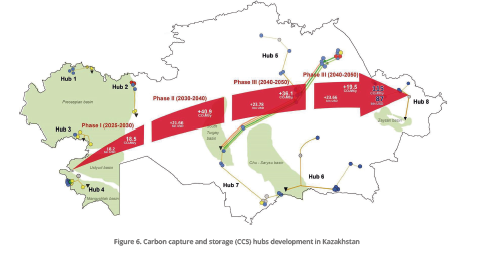
● Development of Carbon Capture and Storage (CCS) Hubs in Kazakhstan:
o A study [9] published in the International Journal of Greenhouse Gas Control (October 2024) focusing on the establishment of CCS hubs to mitigate greenhouse gas emissions in Kazakhstan (Figure 6).
● Enhanced Reductive Removal of Aqueous Hg(II) by a Novel Pd-Cu-BTC and Co/NC Catalysts:
o Research [10] published in the Chemical Engineering Journal (June 2024) on the development of a novel catalyst for the efficient removal of mercury from water sources.
o Research [11] published in the ACS ES&T Engineering (January 2025) on the development of a novel catalyst regeneration approach during aqueous Hg(II) removal by Co/NC.
● Effect of Carbonized Zeolitic Imidazolate Framework-67 (ZIF-67) Support on the Reactivity and Selectivity of Bimetal-Catalytic Aqueous NO₃⁻ Reduction:
o A study [12] in Chemosphere (June 2024) examining how carbonized ZIF-67 supports influence the performance of bimetal catalysts in nitrate reduction processes.
● Microplastic contamination of municipal wastewater streams and its impact on the environment
o A study [13] published in Marine Pollution Bulletin (June 2024) provides the results on the concentrations and removal of microplastic throughout different wastewater treatment processes.
o A study [14] published in Science of The Total Environment (January 2025) examined the impact of microplastic containing wastewater streams discharge to the Ishim River.
Through these research endeavors, the LES aims to contribute significantly to environmental sustainability and the advancement of green technologies.
Renewable Energy Laboratory: Towards Green Energy
The Renewable Energy Laboratory is a cutting-edge research facility dedicated to the design and development of novel solar-sensitive and multifunctional materials. The lab addresses both fundamental and technical challenges in various areas, including solar cells, solar fuels, hydrogen production, hydrogen storage, hydrogen sensing and value-added chemicals production including medicine from renewable resources.
The vision of the lab is to drive scientific progress in renewable and green energy and to create sustainable technologies for a cleaner future.
The Renewable Energy Lab is recognized as one of the leading research facilities at National Laboratory Astana, Nazarbayev University. Kazakhstan is making significant strides in embracing renewable energy to diversify its economy and reduce carbon emissions. The country has set an ambitious goal of achieving 60% green energy by 2050. Investments in clean energy will play a crucial role in ensuring energy security, fostering sustainable growth, and creating a healthier environment for future generations.
President of the Republic of Kazakhstan Kassym-Jomart Tokayev has underscored the importance of this transition, stating: "The development of renewable energy is a key priority for Kazakhstan’s sustainable future. We must harness our natural potential to ensure energy security, economic resilience, and environmental protection."
In alignment with this vision, the Renewable Energy Lab (NLA), has spearheaded the establishment of advanced Renewable Energy Laboratories to accelerate the shift toward sustainable power. These state-of-the-art research hubs are dedicated to exploring solar, wind, and energy storage technologies, leveraging Kazakhstan’s abundant natural resources.
Key Research Areas:
Next generation photovoltaics team:
The research activity of the Next generation photovoltaics team is directed to the development of highly efficient, cost-effective and highly stable photovoltaic cells and devices as a source of renewable energy. The main objective of the team research includes third-generation solar cells such as dye-sensitized solar cells, perovskite solar cells and polymer solar cells. The tasks of the research cover improvement of the stability and power conversion efficiency of solar cells via applying engineering solutions and using low-cost materials and components.
To this day the research team has developed several best performing highly efficient and cost-effective counter electrode materials and light absorbing dyes for dye-sensitized solar cells. These findings were published in high-ranking journals including Surfaces and Interfaces, Dyes and Pigments, ACS Applied Energy Materials and Chemical Communications.
Recently the team has demonstrated a remarkable result in the improvement of dye-sensitized solar cells stability. By introducing metal-organic framework into the liquid electrolyte the stability of the solar cell was improved noticeably. Moreover, the dye-sensitized solar cell with MOF-based electrolyte and standard N719 dye showed record 27.6 % efficiency at indoor light conditions of 6000 lux under LED light. The results were published in a prestigious Nature Scientific Reports journal.
Hydrogen Production Team:
The core features and objectives of this project regarding the solar-driven hydrogen production via photocatalytic water splitting are highlighted in the figure above with a focus on advanced materials, computational modeling, and pilot-scale implementation. First, advanced computational tools, namely, density functional theory and machine learning, are used to design and simulate the behavior of photocatalytic materials. It helps to refine these materials’ structure, light absorption potential and charge separation efficacy - all of which are vital in improving the photocatalytic water-splitting process. Second, the central section depicts in-lab trials, where the designed photocatalytic materials are synthesized and tested under controlled conditions to validate their performance after our hypothesized modifications such as doping, co-catalyst deposition, and protective coatings. Our latest study, published in Communications Materials (doi.org/10.1038/s43246-024-00574-5), emphasizes the importance of photonic design and optimization of photoelectrode systems for improving the light-harvesting property of photoactive materials. The central idea and the novelty of our work is the utilization of the whole solar spectrum which is possible due to the implementation of the upconverter device.
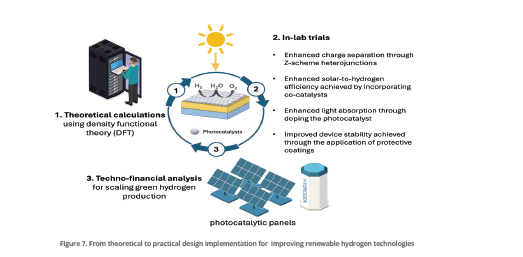
The last step brings the insights learned from material modeling and lab experiments to large-scale production. Process simulation software (e.g., Aspen Plus) is used to design these systems so that they are easily scalable and operationally feasible. Figure 7 summarizes the pathway from theoretical to practical design implementation as an integrated cycle for improving renewable hydrogen technologies.
The Hydrogen Storage Team focuses on studying solid-state hydrogen storage, which includes:
⮚ Development of novel materials and composites for enhanced hydrogen storage.
⮚ Utilization of biomass-derived activated carbon to improve hydrogen storage efficiency.
⮚ Synthesis and optimization of high-surface-area MOFs such as MOF-177 and MOF-210 and their composites for enhanced hydrogen adsorption.
⮚ Design of bimetallic ZIFs and metal hydrides, including TiFe alloy and alanates, for reversible hydrogen storage.
The main outcomes to highlight from this research group are that one patent is currently under review. Additionally, another patent and several research articles are in preparation by the Hydrogen Storage Team. These findings remain suitable for publication in Q1 journals; however, the team is striving to target even higher-impact journals.
Biomass Research Team
The Biomass Research Team focuses on the sustainable conversion of agricultural biomass into high-value products, including active pharmaceutical ingredients (APIs), biodegradable polymers, and bio-based fuels. Leveraging Kazakhstan’s renewable resources, the team develops efficient and scalable synthesis methods using conventional, microwave-assisted, and flow chemistry approaches. Their research also includes catalyst optimization, high-yield product synthesis, and process integration. Life cycle and techno-economic analyses are conducted to ensure environmental and economic viability.
The team’s research has been published in leading journals, including Chemical Engineering Journal and Scientific Reports. A utility model patent for a biomass processing method is under review
Solar pumps and drip irrigation help Kyrgyz farmers cut costs amid rising energy prices
Hormuz closure failed to trigger coal comeback as solar and wind filled the gap
Astana set to launch RES 2026 EXPO and ink key international deals
Central Asian countries to discuss energy transition at RES 2026 in Astana
Moldova surpassed 1 GW of installed renewable energy capacity
China begins building US$1 billion hydropower station in Cambodia
Thousands protest in Germany urging faster green shift
Scientists from Russia and Uzbekistan improved the stability of green energy systems by 24%
Kazakh startup ranks in GCIP global top 3 in Vienna
Kazakhstan poultry farm produces 15 million kWh of energy from waste
China, Spain expand partnership in solar and wind power
Mongolia engages Hanwha Group in industrial and clean energy development
Russia to test horizontal and vertical wind power plants at new renewable energy test site in Adygeya
Brussels sets timeline: grid package by summer, electrification strategy to follow
RES 2026 to address workforce training for renewable energy scale-up
Algeria commissions 400 MW of solar capacity
Deadline approaching: KOREM invites bids for wind and solar power auctions
From crisis to security: IRENA lays out renewables roadmap for governments
Renewable energy generation in Kazakhstan rises 15% in Q1 2026
Kazakhstan climbs the Climatescope rankings