

Education and science24.05.2025
Institute of Physics and Technology: Research and Technologies for a Sustainable Future




Klara Toxanbayeva, Deputy Director for Commercial Issues, Institute of Physics and Technology
Institute of Physics and Technology (IPT) is one of the key research centers in Kazakhstan, engaged in fundamental and applied developments in the field of solid-state physics, nuclear physics, and modern technologies. Founded in 1990 by a decree of the Council of Ministers of the Kazakh SSR, it has undergone significant transformation and has become part of the Kazakh National Research Technical University.
Today, the IPT comprises nine high-tech laboratories working on such promising scientific areas as:
- research of innovative functional materials,
- study of photoelectric phenomena,
- development of heterojunction solar cells,
- radiation ecology,
- high-energy physics and cosmic rays, and much more.
The Institute of Physics and Technology is actively engaged in the research and deployment of technologies related to renewable energy sources. For more than ten years, the development and optimization of heterojunction solar cells has been one of its principal areas of activity.
Heterojunction solar cells are innovative photovoltaic devices based on heterostructures — unique multilayer materials composed of different semiconductors. Each of these materials possesses distinct electrophysical and optical properties, enabling the formation of internal electric fields within the solar cell that directly affects the efficiency and performance of solar modules.
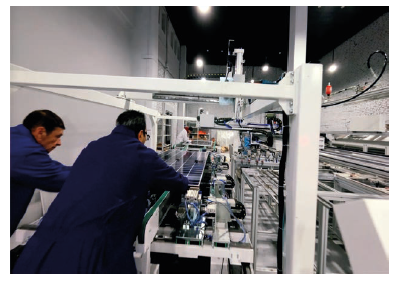
An important milestone in the institute's development was the establishment of a pilot industrial facility for the production of photovoltaic modules. This made it possible to elevate scientific developments to a new level, i.e. from laboratory research to industrial application. The acquisition of the СТ-KZ certificate confirmed the compliance of the products with high national standards and marked a significant step forward in the development of solar energy in Kazakhstan.
The Institute of Physics and Technology takes pride in the contribution of the scientists of Kazakhstan to the development of renewable energy. Significant progress in this field has been achieved thanks to the efforts of leading experts, including S.Zh. Tokmoldin, Doctor of Physical and Mathematical Sciences, N.A. Chuchvaga, PhD, N.S. Tokmoldin PhD, V.V. Klimenov, I.S. Nevmerzhitsky, K.P. Aimaganbetov PhD, K.S. Zholdybayev, S.R. Zhantuarov, A.K. Shongalova PhD and others.
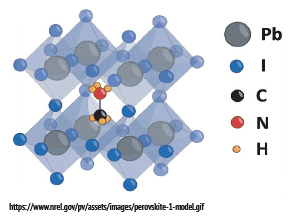
Today, one of the key research areas of the institute is perovskite solar cells. These innovative photovoltaic devices have attracted the attention of the global scientific community due to their combination of high efficiency and low production cost. Unlike traditional silicon-based solar panels, perovskite solar cells are manufactured using organic compounds, which makes their production more cost-effective.
However, this technology faces significant challenges. The primary issue is its rapid degradation: while conventional silicon solar panels lose approximately 10% of their power over 25 years of operation, perovskite counterparts can lose up to 80% in just one day. Solving this issue is one of the main goals of ongoing research, and despite the hurdles, scientists believe perovskite solar cells are the future of solar energy.
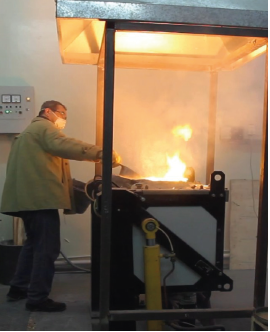
The IPT is also focused on developing technology for producing and purifying silicon from Kazakhstan’s sand deposits. Leading experts in this area include B.N. Mukashev, academician, Doctor of Physical and Mathematical Sciences, G.N. Chumikov, S.N. Tarakanova, N.M. Kislyakova, Y.A. Taraknov, S.S. Bazarbayev, A.S. Serikkanov, a candidate of physical and mathematical sciences, and others, who have contributed their time, expertise, and knowledge to this research. One of the recent breakthroughs is the production of electronic-grade silicon from slag. The research conducted as part of the project has led to the development of an efficient technology for producing and purifying silicon. This will make it possible to create a method for producing high-purity silicon for solar energy applications. The method will keep production costs low while being environmentally clean, in line with current standards for sustainable technologies. The slag produced during the silicon extraction process can be used for the production of high-grade slag-alkali cement.
The laboratory technology for producing low-cost silicon offers several advantages over traditional purification methods. It requires fewer steps to achieve high silicon purity, significantly accelerating the purification process. Besides reducing processing time, this technology cuts production costs by optimizing resource use. A key factor is its environmental safety, making the process cleaner and minimizing its environmental impact. As a result, it allows for the production of solar-grade silicon with minimal costs and environmental impact.
Another promising area of research at the Institute of Physics and Technology is energy storage systems. A key topic in this field is Vanadium Redox Flow Battery. A.G. Umirzakov is the project leader for this direction.
This is an environmentally friendly large-capacity battery capable of deep charging and discharging. It utilizes the chemical potential energy of vanadium ions in different oxidation states for energy storage and exhibits high charge and discharge efficiency. The advantage of high safety lies in the fact that the capacity can be increased by expanding the storage reservoir, and the electrolyte can be reused.
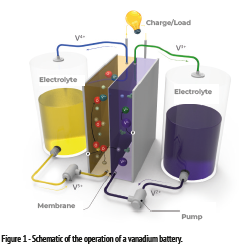
Using vanadium ion solutions V(Ⅱ)/V(Ⅲ) and V(Ⅳ)/V(Ⅴ) as the positive and negative electrolytes, the battery's standard potential difference can reach 1.26 V, making vanadium a suitable material for energy storage (Figure 1).
Advantages
• Fire safety
The active material of the vanadium redox battery is stored in separate liquid storage tanks outside the system as an aqueous solution. There is no risk of explosion or fire, and no danger even when the positive and negative electrolytes are mixed. The non-explosive nature of the battery is the most notable advantage of the vanadium redox battery (VRB) compared to other electrochemical batteries.
• Long service life
The positive and negative active materials of the VRB are located in the positive and negative electrolytes, respectively. No phase change occurs during charging and discharging. The battery can be deeply discharged without damage, and its lifespan can reach up to 20 years. At present, the VRB module with the longest operational time in the commercial demonstration of the energy system by the Canadian company VRB has been running smoothly for more than 9 years, with a charge and discharge cycle life exceeding 18,000 cycles, which is considerably higher than that of lithium and lead-acid batteries.
• Large-scale energy storage is easily achievable.
The power and capacity of the vanadium redox battery depend on the size of the stack, and the volume and concentration of the electrolyte, respectively. Increasing the electrolyte concentration enhances the power, while increasing the electrolyte volume doubles the power. Therefore, vanadium redox batteries can be used in large-scale power plants for energy storage with capacities of hundreds of megawatts.
Disadvantages
• Low energy density.
Due to the relatively large atomic mass of vanadium, the energy density of the vanadium redox battery typically ranges from 12 to 40 Wh/kg, which is lower than that of lithium batteries, which range from 80 to 300 Wh/kg.
Therefore, to achieve the same energy reserve, the energy density of the vanadium redox battery is much lower than that of lithium batteries, specifically 3 to 5 times lower, which significantly complicates the use of vanadium redox batteries in mobile terminals and power batteries.
• Low energy conversion efficiency.
To maintain the flow of the electrolyte in the vanadium redox battery, a pump is needed, which results in significant energy losses. The energy conversion efficiency of the vanadium redox battery typically ranges from 70% to 75%, which is lower than the energy conversion efficiency of lithium batteries, which ranges from 85% to 95%.
• High initial installation cost.
The initial cost of installing a vanadium redox battery primarily consists of the stack and the electrolyte. Raw materials are relatively costly. Furthermore, the development of the vanadium redox battery industry is progressing at a relatively slow pace, and the industrial supply chain is imperfect. Currently, the initial installation cost ranges from 252 to 400 tenge per hour. This is more than twice the initial cost of the battery compared to lithium batteries, but in the long-term operation, these costs are compensated.
Comparison between VRBs and other major batteries.
Vanadium redox batteries offer significant advantages over lithium, lead-acid, and other types in terms of service life, safety, and lifecycle cost. However, they still remain at a relatively disadvantageous position in terms of energy density, energy efficiency, and other factors.
The operating principle of a vanadium redox battery differs from that of a lithium battery.
The vanadium redox battery has two electrolytes, one for the positive electrode and one for the negative electrode. The current is generated through the oxidation and reduction of vanadium ions, whereas in a lithium battery, the current is primarily generated by ion transfer.
The electrolyte in a vanadium redox battery is stored in separate reservoirs for the positive and negative electrodes. Under the action of a pump, the electrolytes are moved to the positive and negative electrodes of the stack. This design allows for the regulation of the capacity of the vanadium redox battery. The electrolytes are stored separately and do not react, which ensures high safety. In this regard, lithium batteries are significantly inferior to vanadium redox batteries.
The vanadium redox battery can be charged and discharged up to 15,000 times, while lithium batteries can be charged and discharged approximately 3,000 times, which is five times more than lithium batteries.
Moreover, the vanadium redox battery has a natural liquid cooling system. During operation, both the positive and negative electrolytes engage in chemical reactions and dissipate heat generated by the stack, helping maintain the battery at a moderate temperature. Lithium batteries have relatively low stability during prolonged charging, which leads to heating and increases the likelihood of ignition.
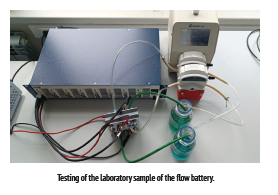
Testing of the laboratory sample of the flow battery.
The vision of IPT is to ensure the sustainable development and competitiveness of the Institute as a leading scientific and innovative organization; to integrate itself into the global community through increasing the quantity and quality of publications in high-impact international journals.
The mission of IPT is to conduct a wide range of fundamental and applied research in the fields of solid-state physics and semiconductors, alternative energy, materials science, nanoscience, high-energy physics, and cosmic rays; to develop new samples and technologies based on this research, with subsequent implementation in scientific studies and production in the interests of the socio-economic development of the Republic of Kazakhstan.
Expanding the portfolio of scientific projects by involving the Institute in the implementation of state grants and attracting external projects for the execution of scientific and technological programs on R&D/innovation topics.
Azerbaijan to raise renewables share to 34% by end-2027
Solar power helped Europe weather the energy crisis, but growth is slowing
Nepra tightens wheeling rules, mandates battery storage for solar, wind projects
Women in Bangladesh turn EV battery swapping into a new source of income
Sydney CBD solar farm to cut carbon emissions by 2,000 tonnes a year
IEA: Türkiye needs faster investment in grids and storage as energy demand rises
Kazakhstan holds auction for selection of hydroelectric power plant construction projects
Equinor brings its largest US battery storage project online
Norway launches project to integrate wind propulsion into commercial shipping
China's photovoltaic power capacity overtakes coal-fired power for first time
Germany moves to cut the cost of offshore wind
UN presents Climate Report: 1.5°C threshold will be breached without urgent action
Europe on track for a record year in wind power
Rosatom plans wind turbine component plant in Russia’s Amur region
EBRD backs Tajikistan’s plans for solar power auctions
Solar power helps Europe avoid €30 billion in gas imports
Kazakh scientists test energy storage device with more than 750,000-cycle lifespa
Agrivoltaics cut worker heat stress and saved 22% of water, new model shows
Uzbekistan commissions 300 MW solar plant with 150 MW ESS
SolarWindow unveils ultra-thin solar film for curved surfaces