

News Kazakhstan27.08.2024
Government adopts decision on holding referendum on NPP construction in Kazakhstan


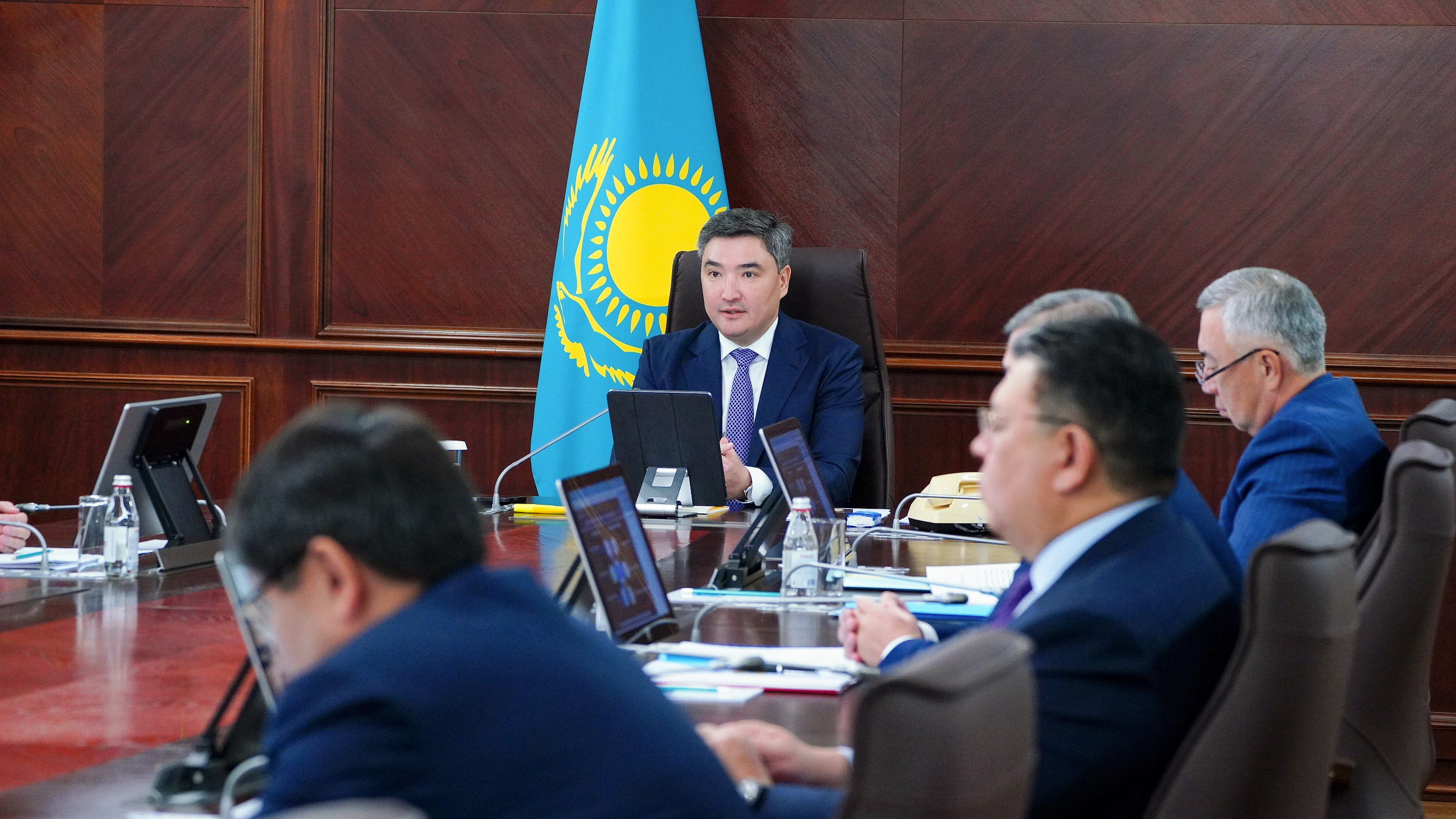
QAZAQ GREEN. During the Government session under the chairmanship of Prime Minister Olzhas Bektenov with the participation of scientists considered the prospects for the development of nuclear energy in the country, reports primeminister.kz
Following the discussion of the issue, Energy Minister Almassadam Satkaliyev made a proposal to submit for consideration a draft resolution of the Government "On the draft decree of the President of the Republic of Kazakhstan “On holding a national referendum”.
"Holding a referendum will help to make a balanced decision on the development of nuclear energy and ensuring energy security of the country. Today we are standing on the threshold of a historic event. Without a stable, environmentally friendly and cost-effective power supply, we risk being left on the margins of history. We, the people of Kazakhstan, will have to make an important decision for the country. A decision that will determine our future," Almassadam Satkaliyev said.
Head of the Government Olzhas Bektenov emphasised that the issue of nuclear power development in Kazakhstan has been studied for a long time and the prospects for this industry are obvious. The country has mastered almost a full cycle of nuclear fuel production. The experience of using small reactors has been gained, there are specialists and scientists in this direction. In addition, personnel training is underway.
In this connection, it becomes natural to move to the next stage of nuclear power development. This is especially important against the background of the growing load on the energy infrastructure of the country.
Prime Minister noted that already today in Kazakhstan there is a deficit of energy capacity. If the solution to the problem is not found now, then for further growth of the economy will need to purchase large amounts of electricity.
According to the International Atomic Energy Agency, 415 nuclear power units are currently in operation in 31 countries. Sixty-one new nuclear plants are under construction in 15 countries, including China, Japan, South Korea, the UK and Turkey.
All this is driven by the global agenda of carbon neutrality, which has caused international financial institutions to refuse to invest in coal-fired power plants.
At the same time, RES cannot serve as a stable source of electricity generation. The potential of hydroelectric power plants in Kazakhstan is limited because there are not so many rivers with the necessary conditions. The country is currently working on converting some CHPPs to gas and building new combined cycle gas turbines. But, given the prospects for economic and population growth, this is not enough to cover the electricity deficit in the future.
The development of nuclear energy is the most promising direction for us, Prime Minister emphasised.
Modern nuclear power plants are equipped with a multi-level safety system. If a decision is made to build a nuclear power plant in Kazakhstan, its design, construction and operation will be carried out in accordance with strict international safety standards of the IAEA. With a significant raw material base, Kazakhstan will be independent of uranium price fluctuations. This will ensure stable and predictable electricity tariffs.
"It is nuclear power that should be the basis for the development of an energy-intensive economy, which will make it possible to achieve a higher standard of living for the population. As world experience shows, nuclear power stimulates the introduction of innovations in many sectors of the economy, it will give an impetus to the development of domestic industry. Therefore, we cannot stay away from sources of stable and reliable energy supply, for which we have no alternative," Olzhas Bektenov noted.
As a result of the consideration of the issue, voting took place. The presented draft resolution of the Government was unanimously supported. The Ministry of Energy together with the Government Apparatus was instructed to submit the draft decree to the Presidential Administration.
CAREC and Central Asian universities sign new memoranda on green skills development
100,000 jobs and a skills gap: how Central Asia is preparing for the renewables boom
No transition without transmission: How Central Asia is building its energy future
ADB to invest $5.5bn across 15 projects in Kazakhstan
17 agreements worth over $2.3 billion signed at the opening of RES 2026 EXPO in Astana
World Bank to invest $1bn in Central Asia's energy integration
Kazakhstan and China to launch a 500 MW wind farm in Karaganda region
Kazakhstan and Tajikistan move toward clean power deal over Rogun HPP
Regional Ecological Summit 2026 opens in Astana
Solar pumps and drip irrigation help Kyrgyz farmers cut costs amid rising energy prices
Hormuz closure failed to trigger coal comeback as solar and wind filled the gap
Astana set to launch RES 2026 EXPO and ink key international deals
Central Asian countries to discuss energy transition at RES 2026 in Astana
Moldova surpassed 1 GW of installed renewable energy capacity
China begins building US$1 billion hydropower station in Cambodia
Thousands protest in Germany urging faster green shift
Scientists from Russia and Uzbekistan improved the stability of green energy systems by 24%
Kazakh startup ranks in GCIP global top 3 in Vienna
Kazakhstan poultry farm produces 15 million kWh of energy from waste
China, Spain expand partnership in solar and wind power