

News Kazakhstan24.04.2026
100,000 jobs and a skills gap: how Central Asia is preparing for the renewables boom


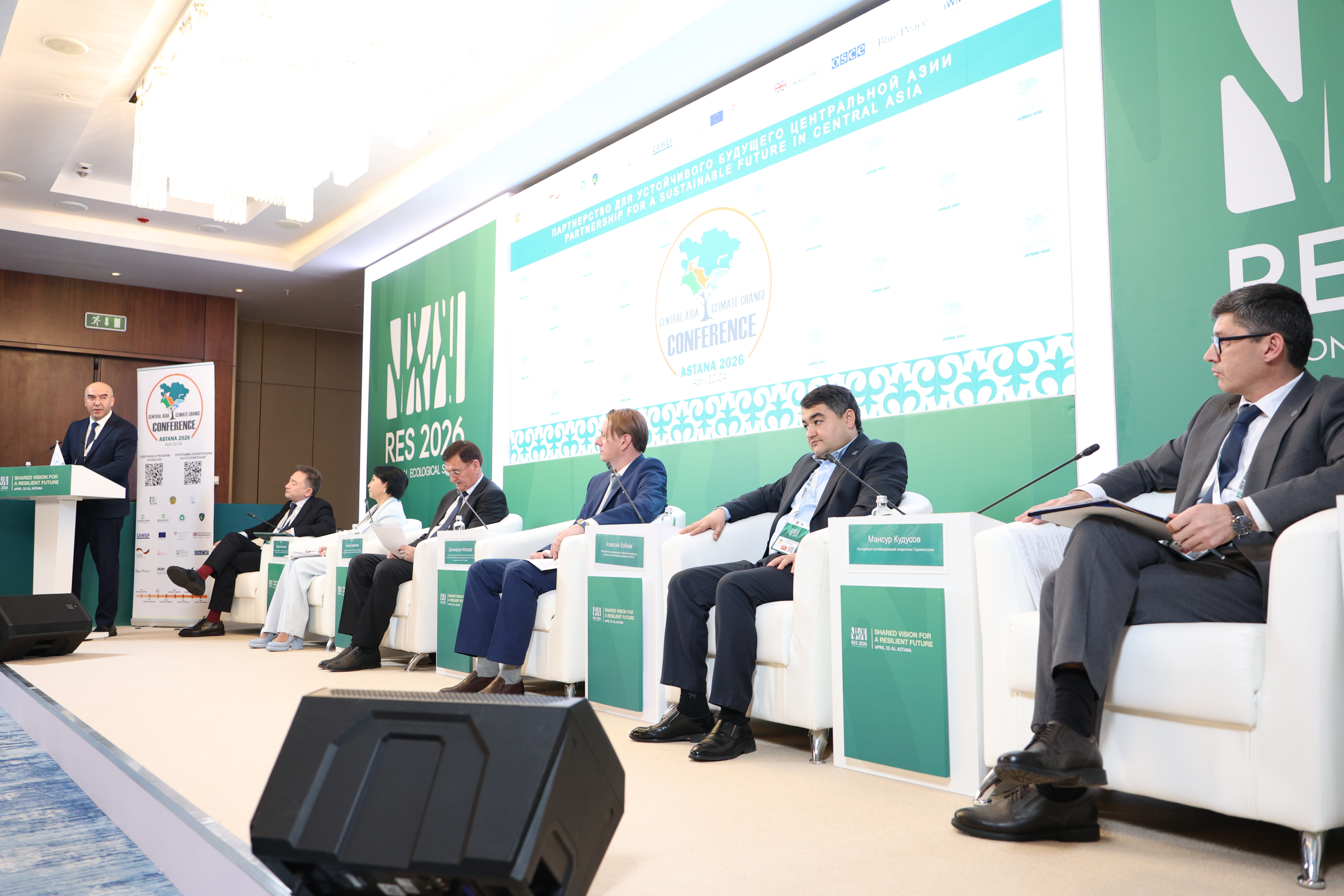
QAZAQ GREEN. On April 23, 2026, in Astana, as part of the Central Asian Conference on Climate Change (CACCC-2026), a panel session was held dedicated to the development of human capital and research cooperation in the field of renewable energy. The session organized in joint collaboration of the OSCE-CAREC Initiative “Regional Task Force on Education for a Just and Inclusive Energy Transition (RTEET) in Central Asia” (part of the OSCE project “Promoting Women’s Economic Empowerment in the Energy Sector in Central Asia”), the Regional GIZ Project “Green Skills for a Green Economy in Central Asia (PROGRESS)”, and Regional EU-GIZ Programme “EU4SustainableCentralAsia: Renewable Energy in Central Asia (EURECA)”.
People Are the Bottleneck
Central Asian countries plan to commission up to 8 GW of new solar and wind capacity. Globally, the renewable energy sector is expanding fast: in 2023 it employed 16.2 million people — 2.5 million more than the previous year — with around 44% of jobs in solar energy alone. By 2030, renewables are projected to account for 43% of global electricity generation. Yet behind these figures lies a pressing problem: the pace of sector growth is already outrunning the capacity of education and training systems to keep up.
This gap was the central subject of the panel session "Development of Human Capital and Research Cooperation to Advance Renewable Energy in Central Asia," held on 23 April 2026 in Astana as part of the Central Asian Climate Change Conference (CACCC-2026). The conference was organised by the Regional Environmental Centre for Central Asia (CAREC) under the World Bank's RESILAND CA+ Programme in collaboration with the Central Asia Water-Energy Programme (CAWEP), the World Bank, and GIZ. The session brought together government representatives, technical universities, industry associations, and international organizations.
"The transition to clean energy is not only about technology and investment. It is first and foremost about specialists who can design, build, and operate the energy systems of the future. We have enormous solar and wind potential, and to ensure that potential does not remain on paper, our task at this session is to lay the foundation for regional cooperation that allows companies and universities to speak the same language," said CAREC Executive Director Batyr Mamedov in framing the agenda.
Shortages at Every Level
Emomali Mirzoev, Energy Security Specialist at the OSCE Secretariat, presented findings from a large-scale regional assessment conducted jointly with CAREC. Approximately one year ago, the two organizations established a task force bringing together representatives of energy and education ministries, transmission system operators, energy companies, and universities from five countries in the region. The task was practical: understand what skills the sector needs, what universities can provide, and what barriers stand in the way.
Opening the session, Mirzoev set out the central argument: "The energy transition needs a skilled and diverse workforce."
The assessment produced three troubling findings. The first is a clear and widespread shortage of qualified personnel across the entire energy value chain — from technical specialists in generation, storage, and grid integration, to project developers capable of preparing bankable, investment-ready projects. The second is that around 85% of surveyed stakeholders reported an insufficient number of specialist graduates and a clear mismatch between skills taught and skills needed in the labour market. The third finding concerns gender imbalance.
"Women still remain significantly underrepresented in the energy workforce. Countries around the world, not only in our region, are still not leveraging the transformative power of women in driving the energy transition. And that limitation will slow down our energy transition," Mirzoev warned.
OSCE Coordinator for Economic and Environmental Activities Bakyt Dzhusupov added a further dimension: OSCE analysis from 2024 showed that the renewable energy capacities announced by Central Asian countries by 2050 would create around 100,000 new jobs in the region. That is an enormous opportunity — but only if education systems can produce the people to fill those roles.
Uzbekistan: Skills Shortage Against a Backdrop of Rapid Renewables Growth
The representative of the National Energy Association of Uzbekistan gave a ground-level account of the problem. Over recent years, Uzbekistan has commissioned more than 2.5 GW of renewable energy capacity — and in doing so exposed a critical gap between building facilities and operating them. Universities provide foundational knowledge but do not prepare graduates to work with modern technologies. Over a six-year university cycle, technologies advance so far that graduates arrive at their jobs with already outdated knowledge. Many technical colleges lack the practical equipment needed to train students, while working specialists have no accessible system for upgrading their qualifications.
The most effective solutions, in his view, are a dual education system in which students work directly at facilities — solar and wind plants, substations — alongside modular training programmes of 6–12 months rather than multi-year courses, and a fundamental shift in universities' approach: competency-based certification rather than degrees for their own sake.
Tajikistan: The Gap Between Education and Practical Skills in the Energy Sector
A similar diagnosis came from Isozoda Dilovarshoh Tarik, Rector of the Energy Institute of Tajikistan. The core problem, he argued, lies at the intersection of theoretical knowledge and the practical skills needed to work with solar and wind energy facilities, grid infrastructure, and storage systems. The greatest impact, in his view, would come from launching short-term placements developed jointly with the private sector and international partners, together with technical upskilling courses for engineers at the institute's own base.
Turkmenistan: Integrating the Climate Agenda Across All Levels of Education
Deputy Minister of Education of Turkmenistan Azat Atayev offered a systemic perspective that extends well beyond vocational training. Turkmenistan, despite its substantial gas reserves, has embraced climate commitments: the country joined the Paris Agreement in 2022 and set a target of reducing emissions by 20% by 2030.
To understand what changes are needed in workforce preparation, the country conducted foresight sessions across all major green transformation sectors, involving employers, stakeholders, and educational institutions. The results were concrete: 13 specializations are directly linked to green transformation and require new educational programmes, while 156 other specializations need integration of cross-cutting sustainability skills.
"Climate resilience education must be ahead of all plans by at least 6–10 years," Atayev stated.
Turkmenistan has already been implementing a systematic programme to embed climate topics at every level of education. In 2019, a climate "toolbox" was developed in multiple languages. In 2022, adaptive materials for teachers were created, allowing climate perspectives to be incorporated into existing physics, chemistry, biology, and geography lessons without changing educational standards. In 2025, with UNEP support, similar materials were developed for preschool institutions, where climate awareness is built through everyday learning rather than as a separate subject.
"It is wrong to treat climate as a separate sector — it must be integrated into all educational programmes as a cross-cutting condition of their design," he emphasized.
Calling for common regional standards, Atayev put forward a concrete proposal:
"We must unite our efforts to develop a common framework and a unified approach to building educational programmes — a methodology that takes into account the economy, challenges, and climate situation of each specific country. This would allow us not to duplicate efforts, but to learn from each other."
The Factory Floor as a Classroom
Satbayev University Rector Meiram Begentayev presented Kazakhstan's model, in which the boundary between study and professional work is deliberately blurred:
"In essence, students become engineers as early as their second or third year, when they work alongside industry professionals not on academic assignments, but on real production processes that need updating."
His conviction is that the key to progress lies in pooling resources and forming consortia. The very fact that representatives of different countries and institutions had gathered in one room, he suggested, is itself a result: the region's scientific communities have long been collaborating and innovating together — the task now is to institutionalize that collaboration.
From Words to Memoranda
The session produced a tangible outcome: the signing of memoranda of understanding between leading Central Asian technical universities and CAREC, formalizing the shift from discussion to structured cooperation in education and research.
Alongside this, the launch was announced of a joint educational course on the integration of variable renewable energy into power systems — the first regional course of its kind, developed by a team of national experts and professors from five Central Asian technical universities, with support from the OSCE, GIZ, and CAREC.
Mirzoev put the logic of all this work plainly: "Investing in renewables and investing in a skilled and diverse local workforce will allow our countries to develop new industries, attract new investments, and drive innovation."
The session confirmed that scaling up renewable energy in the region depends directly on how quickly a qualified workforce and research base can be built. The next 12–18 months must be a time of concrete action, not new declarations.
CAREC and Central Asian universities sign new memoranda on green skills development
100,000 jobs and a skills gap: how Central Asia is preparing for the renewables boom
No transition without transmission: How Central Asia is building its energy future
ADB to invest $5.5bn across 15 projects in Kazakhstan
17 agreements worth over $2.3 billion signed at the opening of RES 2026 EXPO in Astana
World Bank to invest $1bn in Central Asia's energy integration
Kazakhstan and China to launch a 500 MW wind farm in Karaganda region
Kazakhstan and Tajikistan move toward clean power deal over Rogun HPP
Regional Ecological Summit 2026 opens in Astana
Solar pumps and drip irrigation help Kyrgyz farmers cut costs amid rising energy prices
Hormuz closure failed to trigger coal comeback as solar and wind filled the gap
Astana set to launch RES 2026 EXPO and ink key international deals
Central Asian countries to discuss energy transition at RES 2026 in Astana
Moldova surpassed 1 GW of installed renewable energy capacity
China begins building US$1 billion hydropower station in Cambodia
Thousands protest in Germany urging faster green shift
Scientists from Russia and Uzbekistan improved the stability of green energy systems by 24%
Kazakh startup ranks in GCIP global top 3 in Vienna
Kazakhstan poultry farm produces 15 million kWh of energy from waste
China, Spain expand partnership in solar and wind power