

World News09.10.2025
New technology enables stable solar arrays for autonomous spacecraft docking


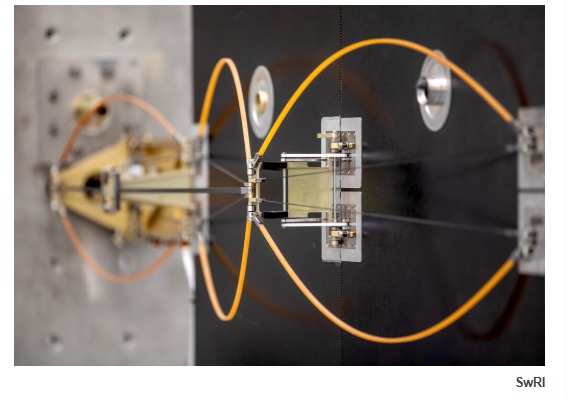
QAZAQ GREEN. The Southwest Research Institute (SwRI) has developed an advanced structural technology that enhances the rigidity of deployable spacecraft components, enabling precise autonomous docking maneuvers. The new Parallelogram Synchronized Truss Assembly (PaSTA) system is being integrated with solar arrays on the Astroscale U.S. Refueler spacecraft, as well as into two deployable booms for another SwRI project.
The Astroscale U.S. Refueler, a 300-kilogram spacecraft, will perform the first hydrazine refueling mission above geostationary orbit for the U.S. Space Force — marking the first on-orbit refueling operation to support a U.S. Department of Defense asset. SwRI is responsible for building, integrating, and testing the spacecraft, which requires highly stable solar arrays to maintain precision during docking.
“Vibrations can disrupt docking operations, so stiffness is critical,” said SwRI Institute Engineer Randy Rose, inventor of the patented PaSTA technology. “PaSTA provides the rigidity necessary for accurate spacecraft maneuvers.”
The PaSTA framework acts as a structural backbone, keeping solar arrays stable once deployed. On the Astroscale U.S. Refueler, the arrays extend 4.5 feet from the spacecraft. On another SwRI spacecraft, each array will span 20 feet and generate up to 5,000 watts of power while maintaining the same precision.
According to Ryan Rickerson, head of SwRI’s Deployable Structures Section, PaSTA ensures all components deploy in sync, eliminating unpredictable hinge movements typical of conventional designs. The technology enables smooth, controlled unfolding even under challenging testing conditions on Earth.
Testing and integration of the PaSTA-equipped arrays are currently in progress at SwRI’s facilities in San Antonio, Texas.
Solar pumps and drip irrigation help Kyrgyz farmers cut costs amid rising energy prices
Hormuz closure failed to trigger coal comeback as solar and wind filled the gap
Astana set to launch RES 2026 EXPO and ink key international deals
Central Asian countries to discuss energy transition at RES 2026 in Astana
Moldova surpassed 1 GW of installed renewable energy capacity
China begins building US$1 billion hydropower station in Cambodia
Thousands protest in Germany urging faster green shift
Scientists from Russia and Uzbekistan improved the stability of green energy systems by 24%
Kazakh startup ranks in GCIP global top 3 in Vienna
Kazakhstan poultry farm produces 15 million kWh of energy from waste
China, Spain expand partnership in solar and wind power
Mongolia engages Hanwha Group in industrial and clean energy development
Russia to test horizontal and vertical wind power plants at new renewable energy test site in Adygeya
Brussels sets timeline: grid package by summer, electrification strategy to follow
RES 2026 to address workforce training for renewable energy scale-up
Algeria commissions 400 MW of solar capacity
Deadline approaching: KOREM invites bids for wind and solar power auctions
From crisis to security: IRENA lays out renewables roadmap for governments
Renewable energy generation in Kazakhstan rises 15% in Q1 2026
Kazakhstan climbs the Climatescope rankings