

Education and science26.05.2025
Challenges and prospects of green transformation in Kazakhstan


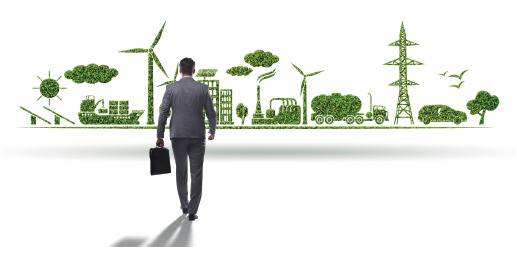

Although Kazakhstan possesses one of the largest wind and solar energy potentials globally, it still depends on coal and oil. Despite political declarations — from the “Kazakhstan-2050” strategy to the goal of carbon neutrality by 2060 — actual progress in developing renewable energy sources has been slow. Why?
A study conducted by an expert group has identified systemic barriers in Kazakhstan that are hindering the green transition. The findings paint a clear picture: without structural legal reforms, technological modernization, and well-designed financial support, a sustainable energy future cannot be achieved.
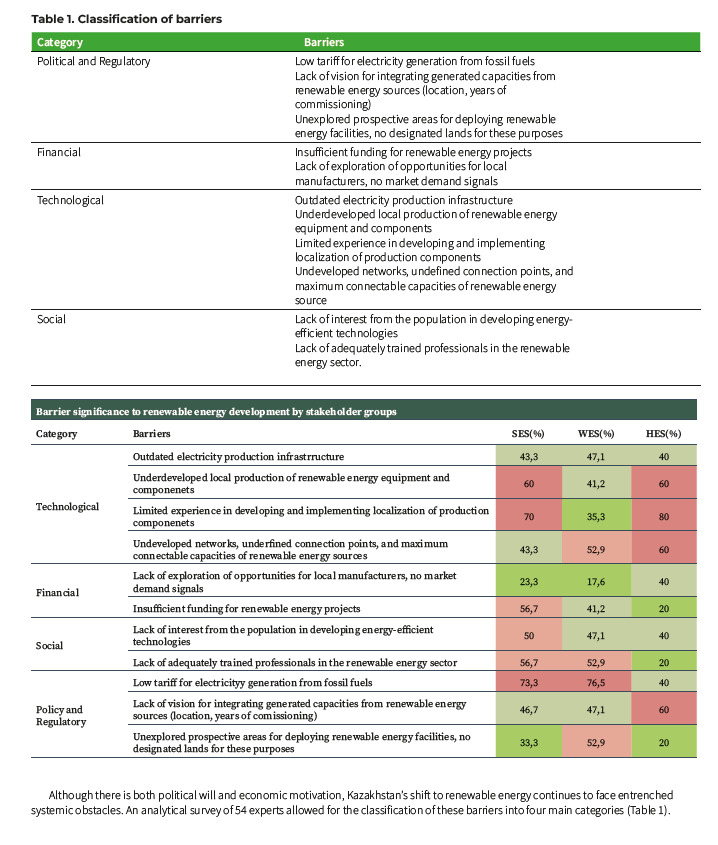
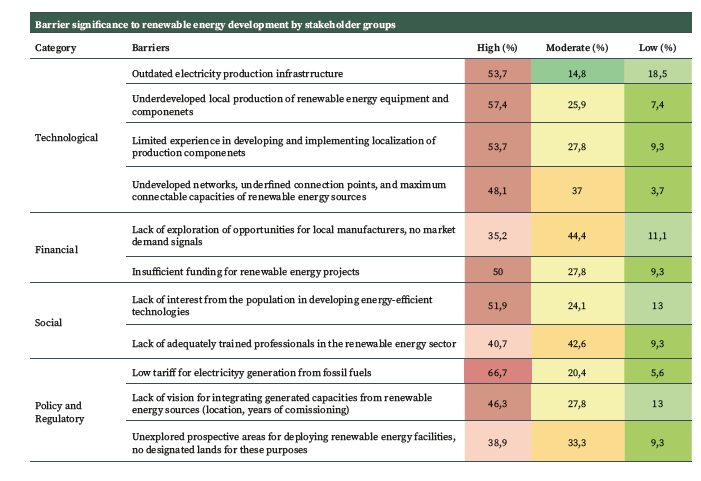
Although there is both political will and economic motivation, Kazakhstan's shift to renewable energy continues to face entrenched systemic obstacles. An analytical survey of 54 experts allowed for the classification of these barriers into four main categories (Table 1).
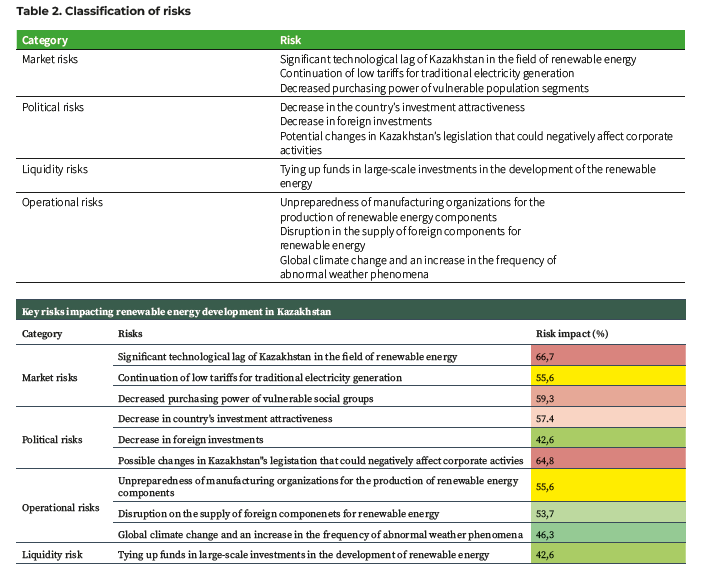
According to the results of an expert survey, the key risks hindering investments in Kazakhstan's renewable energy sector are technological lag, which 66.7% of participants identified as the main obstacle; unpredictability of legislation, which creates uncertainty and can undermine investors' efforts; and high initial costs, particularly in wind energy. For investors, the most critical risks turned out to be macro-level risks — political and market risks, rather than operational ones (see Table 2).
The research revealed that each sector of renewable energy in Kazakhstan faces distinct barriers: the solar energy sector struggles the most due to regulatory uncertainty and insufficient experience in local production; the wind energy sector is hindered by limited access to power grids and a critical shortage of qualified specialists; while hydropower is heavily dependent on natural conditions and suffers from the absence of clear strategic planning at the government level.
While Kazakhstan has developed a legal framework for green financing and initiated the issuance of green bonds, the majority of experts argue that access to financial instruments remains constrained. Only 25.9% consider green bonds to be genuinely accessible. Over half of the experts struggled to provide an assessment, reflecting a lack of awareness.
Experts suggest that to expedite the development of renewable energy in Kazakhstan, it is necessary to ensure government guarantees to mitigate investment risks, provide long-term financing in the national currency at reduced interest rates, introduce technical guarantees for grid connections, support the development of local renewable energy component manufacturing, and implement large-scale programs aimed at increasing public awareness and training qualified specialists.
Kazakhstan finds itself at a pivotal moment: it must choose whether to continue depending on coal infrastructure or make a bold move toward a sustainable future. The country possesses immense potential in solar, wind, water, and, crucially, a growing interest in renewable energy among both professionals and the public. However, for success to be achieved, transparent regulations, access to financing, and seamless collaboration among all stakeholders are essential.
As highlighted in the article, a sustainable energy transition cannot be achieved without robust institutional support, technological advancement, and public engagement. This is the only way Kazakhstan can emerge as a leader in green energy in Central Asia.
Solar pumps and drip irrigation help Kyrgyz farmers cut costs amid rising energy prices
Hormuz closure failed to trigger coal comeback as solar and wind filled the gap
Astana set to launch RES 2026 EXPO and ink key international deals
Central Asian countries to discuss energy transition at RES 2026 in Astana
Moldova surpassed 1 GW of installed renewable energy capacity
China begins building US$1 billion hydropower station in Cambodia
Thousands protest in Germany urging faster green shift
Scientists from Russia and Uzbekistan improved the stability of green energy systems by 24%
Kazakh startup ranks in GCIP global top 3 in Vienna
Kazakhstan poultry farm produces 15 million kWh of energy from waste
China, Spain expand partnership in solar and wind power
Mongolia engages Hanwha Group in industrial and clean energy development
Russia to test horizontal and vertical wind power plants at new renewable energy test site in Adygeya
Brussels sets timeline: grid package by summer, electrification strategy to follow
RES 2026 to address workforce training for renewable energy scale-up
Algeria commissions 400 MW of solar capacity
Deadline approaching: KOREM invites bids for wind and solar power auctions
From crisis to security: IRENA lays out renewables roadmap for governments
Renewable energy generation in Kazakhstan rises 15% in Q1 2026
Kazakhstan climbs the Climatescope rankings