

News of Central Asia12.11.2025
Masdar to build Uzbekistan’s largest battery energy storage project


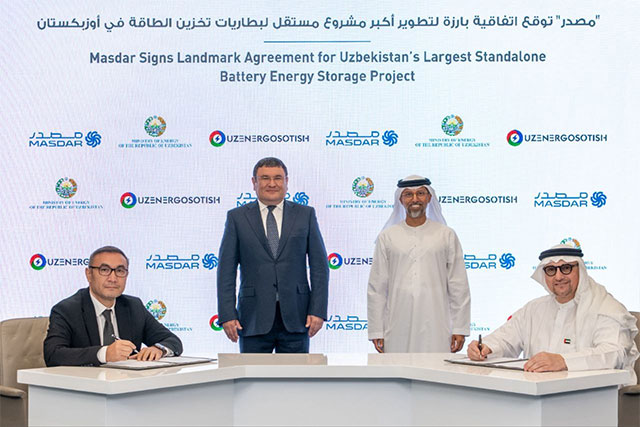
QAZAQ GREEN. Masdar, Abu Dhabi Future Energy Company PJSC, has signed an agreement with Uzbekistan’s state-owned JSC Uzenergosotish to develop the country’s largest standalone battery energy storage system (BESS), according to Masdar.
The Zarafshan BESS marks the first stage of a national energy storage program launched after Masdar’s 2023 agreement with Uzbekistan’s Ministry of Energy and Ministry of Investments, Industry and Trade to install up to 575 MW / 1.15 GWh of capacity nationwide.
The first phase of the Zarafshan project will provide 300 MW / 600 MWh of storage—enough to power about 1.3 million homes for two hours—and will connect to the Murunau Substation. A second 300 MW / 600 MWh phase will later expand the facility.
Scheduled for commissioning in the third quarter of 2028, the Zarafshan BESS will enhance the reliability and flexibility of Uzbekistan’s power grid, supporting the national target to generate 54 percent of electricity from renewable sources by 2030.
The agreement was signed at ADIPEC by Masdar CEO Mohamed Jameel Al Ramahi and Uzenergosotish Chairman Jahongir Obidjonov.
According to Uzbekistan’s Minister of Energy Jurabek Mirzamahmudov, the partnership reflects the strong relations between Uzbekistan and the UAE and contributes to large-scale renewable energy development. Masdar and Uzbekistan are already cooperating on several solar and wind projects totaling more than 1.8 GW, including a 63 MW energy storage system and a new 300 MW solar plant now under construction.
Masdar CEO Mohamed Jameel Al Ramahi said the project represents an important milestone in Uzbekistan’s energy transition and reinforces Masdar’s role as a global leader in renewable energy and storage.
Uzenergosotish Chairman Jahongir Obidjonov noted that the initiative will significantly contribute to Uzbekistan’s green energy goals.
Masdar’s portfolio in Uzbekistan currently includes around 2 GW of clean energy capacity worth more than $2 billion. The company plans to add another 2 GW of capacity and extend the Zarafshan BESS by an additional 300 MW / 600 MWh. These efforts support Uzbekistan’s goal to reach 20 GW of renewable energy and Masdar’s ambition to achieve 100 GW globally by 2030.
Masdar is also developing large-scale storage projects worldwide, including the world’s first gigascale 24/7 solar and battery system in Abu Dhabi – a 5.2 GW solar plant integrated with a 19 GWh BESS delivering 1 GW of baseload renewable power.
India approves grid development scheme to integrate 135 GW of renewable energy
A major wind farm worth KZT380 billion be built in Kostanay region
Kazakhstan Development Bank secures up to $200 million for renewable energy projects
Exus acquires four US solar projects totalling 715 MWp
AIP acquires two Swedish wind farms totalling 312 MW
Zayed Sustainability Prize 2027 finalists include Astana school
Germany awards 480 MW of solar-plus-storage projects
Scientists develop method to convert end-of-life solar panels into silicon carbide
Hyperborea 150 MW wind farm reaches full design capacity
European ports test renewable energy and clean energy solutions
Australia grants first licence under new offshore infrastructure regime
Samruk-Kazyna and Chinese companies agree to jointly develop up to 1 GW wind power project
Kazakhstan completes final auction for 50 MW solar power project
Australia approves 1.4 GW Wongalee wind project
Kazakhstan and China agree on 450 MW wind power projects in Akmola region
Almaty to host Kazakhstan-China Investment Forum on September 25
Third round of trilateral talks on Kambarata HPP-1 project held in Almaty
Yerzhan Yertayev appointed Vice Minister of Energy of Kazakhstan
ACWA starts construction of 1.5 GW wind farm in Uzbekistan
European Commission proposes common rating system for data centres