

World News07.01.2025
China surprises the world with the Great Solar Wall


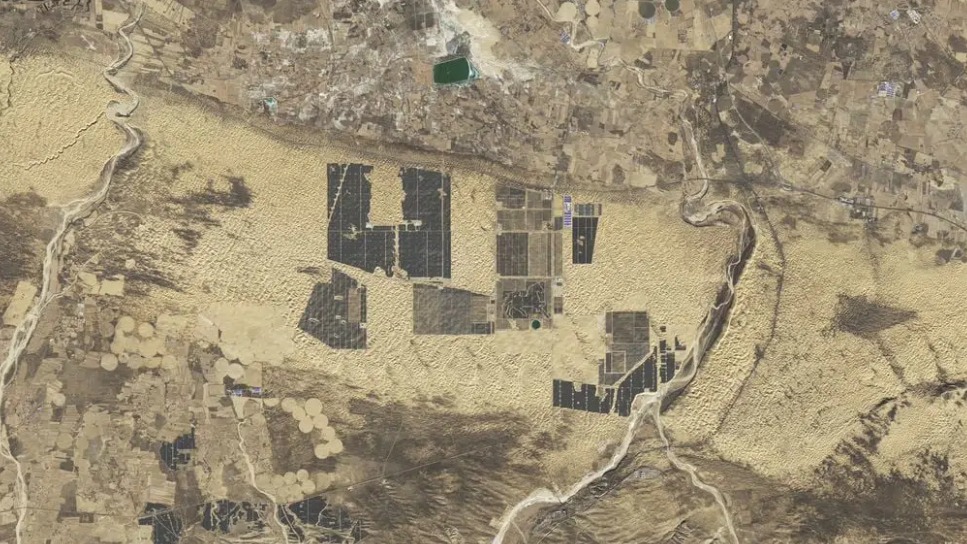
QAZAQ GREEN. In the Kubuqi Desert, China is working on a new pharaonic megastructure that promises to make history. It is the Great Solar Wall of China, a project with thousands of photovoltaic solar panels. The project, which is expected to redefine the potential of clean energy, especially solar energy, is expected to be completed early in the next decade, CPG reports.
The choice of the name for the Great Solar Wall, which will provide electricity to important cities in the Asian country, is a direct reference to the Great Wall of China, built more than 2.000 years ago. While the purpose of the first wall was to provide protection, the new wall aims to increase energy autonomy by turbocharging the supply in Beijing.
This is because, when construction is completed, the maximum generating capacity of the pharaonic megastructure will be 100 gigawatts. At the moment, 5,4 gigawatts are generated, according to Chinese authorities.
The site chosen for the construction of the Great Solar Wall of China is the Kubuqi Desert, considered one of the largest in the region, located in Inner Mongolia. Before the project, the place was nicknamed the Sea of Death.
There, the sand dunes are gradually being replaced by equipment that allows the generation of solar energy through light and solar radiation. The first images of the pharaonic megastructure can now be seen from space, as shown in photos from the Landsat 8 and 9 satellites.
When completed, the solar power plant will be 400 km long and 5 km wide, making it even more impressive to see from space. And its power could strengthen China's leadership in the generation of this type of renewable energy.
In addition to the renewable source of electrical energy, Chinese engineers expect other impacts associated with the pharaonic megastructure in the field of ecology and sustainability.
With the installation of solar energy panels, the expectation is that soil erosion will reduce and, consequently, the deposit of sediments in the Yellow River, also known as Huang He, which is the second longest in the Asian country, will be reduced.
Another important point is that the elevated panels create shade on the ground, which can slow evaporation and may make it easier to grow grasses and other crops beneath them. In fact, previous analysis has suggested that solar plants have enabled the greening of deserts in other parts of China in recent years.
In addition to this pharaonic megastructure, the CNH Energy, China's state-owned energy company, connected the first batch of solar panels from the world's largest offshore solar power plant to the power grid in November.
The project is located 9 km off the coast of Dongying, Shandong Province, covering 1,2 hectares. The largest offshore solar plant has nearly 3 photovoltaic solar panels, each measuring 60×35 meters.
The total capacity of the largest offshore solar plant is 1 GW, enough to supply 2,6 million people per year. The country, the world’s largest energy consumer, is accelerating its transition to renewable sources with this megaproject from China. In addition to generating energy, the largest solar plant will also have fish farms, maximizing the use of maritime space.
This milestone is a symbol of China's energy transition in recent decades. It is worth mentioning that JinkSolar provided its Tiger Neo n-Type tunnel oxide passivated contact (TOPCon) bifacial modules for the project.
Solar pumps and drip irrigation help Kyrgyz farmers cut costs amid rising energy prices
Hormuz closure failed to trigger coal comeback as solar and wind filled the gap
Astana set to launch RES 2026 EXPO and ink key international deals
Central Asian countries to discuss energy transition at RES 2026 in Astana
Moldova surpassed 1 GW of installed renewable energy capacity
China begins building US$1 billion hydropower station in Cambodia
Thousands protest in Germany urging faster green shift
Scientists from Russia and Uzbekistan improved the stability of green energy systems by 24%
Kazakh startup ranks in GCIP global top 3 in Vienna
Kazakhstan poultry farm produces 15 million kWh of energy from waste
China, Spain expand partnership in solar and wind power
Mongolia engages Hanwha Group in industrial and clean energy development
Russia to test horizontal and vertical wind power plants at new renewable energy test site in Adygeya
Brussels sets timeline: grid package by summer, electrification strategy to follow
RES 2026 to address workforce training for renewable energy scale-up
Algeria commissions 400 MW of solar capacity
Deadline approaching: KOREM invites bids for wind and solar power auctions
From crisis to security: IRENA lays out renewables roadmap for governments
Renewable energy generation in Kazakhstan rises 15% in Q1 2026
Kazakhstan climbs the Climatescope rankings