

World News22.09.2023
Solar airship one has hybrid solar-hydrogen propulsion, can fly forever


QAZAQ GREEN. The era of airships effectively came to an end with the tragic 1937 Hindenburg Disaster, but now we're on the cusp of witnessing a revival of these majestic giants of the sky. Rigid airships with hybrid propulsion systems hold the promise of leading the way toward full decarbonization of aerial travel, spanning from cargo transports to humanitarian missions and air tourism, Autoevolution reports.
Rigid airships offer a significantly lower carbon footprint compared to traditional aircraft, boasting larger volumes for carrying cargo or passengers, resulting in smoother journeys.
Enter the Solar Airship One, which presents the intriguing possibility of flying indefinitely without the need for ground resupply. While this might not be a practical goal, it remains within the realm of possibility. The Solar Airship One is more than a dream; it's a real airship with plans for a maiden flight as early as 2026.
Developed by the French company Euro Airship, the Solar Airship One serves as a demonstrator for a novel approach to rigid airships that will eventually give rise to three distinct models of varying sizes, tailored for diverse applications, including military and civilian use. This project has been in development for the past decade, with the last three years seeing the collaboration of over 100 engineers from Capgemini during the pre-production phase.
The Solar Airship One is a tangible reality, even though no images of the actual demonstrator have been made public as of now. Euro Airship envisions it as the future of human flight, a path towards complete decarbonization of the aviation industry. This is primarily due to its hybrid solar-hydrogen propulsion system and the array of advantages it offers, unmatched by conventional aircraft.
These advantages include an expansive volume, the capability to operate with zero emissions, no reliance on fossil fuels, minimal noise pollution, and no need for extensive ground infrastructure. As Euro Airship puts it, it's "a masterpiece of technology, energy efficiency, and safety."
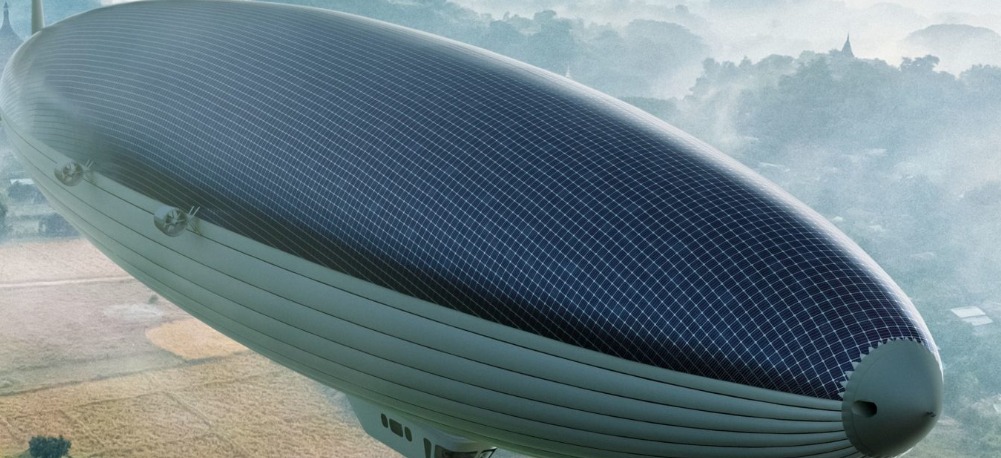
The Solar Airship One takes the form of a whale-shaped aircraft, measuring 151 meters (495.4 feet) in length, with a helium volume of 50,000 cubic meters (1,765,733 cubic feet). Its double-layered envelope is covered with 4,800 square meters (51,666 square feet) of solar film, enabling it to harness solar energy during the day and hydrogen propulsion at night. Energy generated during daylight hours is used to produce hydrogen through water electrolysis.
This airship features 15 gas envelopes, each managed independently by AI, providing rapid responses and the ability to anticipate meteorological events while counteracting helium inertia. Its robust structure incorporates a double-layered reinforced envelope to mitigate pressure and temperature differentials during travel, allowing it unprecedented freedom in choosing travel routes and altitudes.
For landing, the Solar Airship One employs a classic water ballast system and a compressed-air-based system, which is still under development. Euro Airship asserts that a single rotating platform on any water surface is all that's needed for landing.
In 2026, the Solar Airship One will take to the skies with three pioneering pilots for a historic and record-breaking journey: the first non-stop flight around the world in a rigid airship powered by green propulsion. The trio of pilots includes Bertrand Piccard, known for his first non-stop flight in a hot-air balloon and the first non-stop flight in a solar plane, Michel Tognini, an experienced ESA astronaut, and Dorine Bourneton, the first disabled female aerobatic pilot. They will guide the airship on a journey covering over 40,000 km (21,600 nautical miles) from West to East, spanning 20 to 30 days at an average altitude of 6,000 meters (19,700 feet). The route will pass over 25 countries, with the pilots maintaining contact with local authorities, universities, and international groups throughout their global circumnavigation.
Euro Airship has also pledged full coverage of the flight on social media and the production of a documentary, allowing the general public to join in on this remarkable journey.
Dubbed the "commercial airship of the future," the Solar Airship One promises an 80% reduction in fuel consumption and CO2 emissions compared to traditional aircraft. Its practical applications range from military operations to eco-conscious tourism. It represents the embodiment of a net-zero, boundless flight.
"The goal is to educate, to inspire the younger generation," says Bourneton, "because of climate change and impending natural disasters, we need new mobility – green mobility."
Construction of the Solar Airship One is set to commence in 2024, with assembly scheduled for the following year. After the demonstration flight, Euro Airship intends to pursue proper certification to introduce the rigid airship into the market in several models, including one without solar panels and a limited range of 1,000 km (540 nautical miles).
Solar pumps and drip irrigation help Kyrgyz farmers cut costs amid rising energy prices
Hormuz closure failed to trigger coal comeback as solar and wind filled the gap
Astana set to launch RES 2026 EXPO and ink key international deals
Central Asian countries to discuss energy transition at RES 2026 in Astana
Moldova surpassed 1 GW of installed renewable energy capacity
China begins building US$1 billion hydropower station in Cambodia
Thousands protest in Germany urging faster green shift
Scientists from Russia and Uzbekistan improved the stability of green energy systems by 24%
Kazakh startup ranks in GCIP global top 3 in Vienna
Kazakhstan poultry farm produces 15 million kWh of energy from waste
China, Spain expand partnership in solar and wind power
Mongolia engages Hanwha Group in industrial and clean energy development
Russia to test horizontal and vertical wind power plants at new renewable energy test site in Adygeya
Brussels sets timeline: grid package by summer, electrification strategy to follow
RES 2026 to address workforce training for renewable energy scale-up
Algeria commissions 400 MW of solar capacity
Deadline approaching: KOREM invites bids for wind and solar power auctions
From crisis to security: IRENA lays out renewables roadmap for governments
Renewable energy generation in Kazakhstan rises 15% in Q1 2026
Kazakhstan climbs the Climatescope rankings