

International experience21.12.2024
PV module take-back and recycling in Germany


 Alex Bologa, RES expert, Global Factor
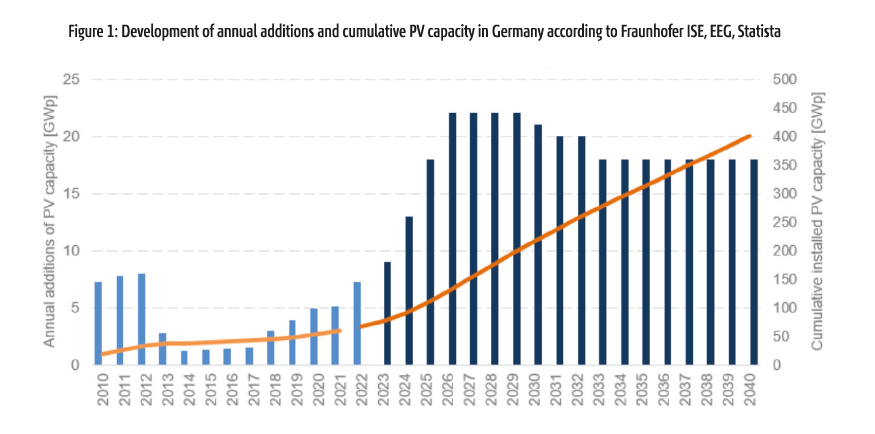
 Photovoltaics (PV) is one of the key technologies needed for transforming Germany’s energy system and meeting the targets of a low-carbon electricity generation system. Germany is one of the top five countries in terms of installed PV capacity, together with China, the United States of America, Japan, and India. According to Fraunhofer Institute for Solar Energy Systems (ISE), approximately 67 GWp of cumulative PV power were installed in Germany by the end of 2020. With the update to Germany’s RES Act [3] in 2023, the PV expansion targets were significantly increased to the cumulative installed PV power of 215 GWp in 2030 and 400 GWp in 2040 (Figure 1).
During this period, the first larger PV plants will also reach the End Of their Life (EOL) and will need to be gradually replaced (Figure 2).
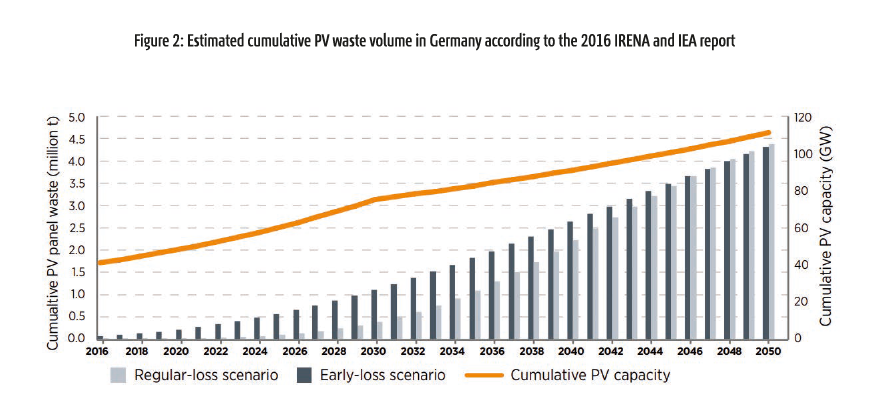
Because Germany was the first country to install large numbers of PV modules, it will be the first country that will need to handle large numbers of EOL modules. The current returns of EOL PV modules are still comparably low in number but will start to significantly increase by the end of the decade. It is estimated that the waste streams in Germany for 2030 will range from 400,000 to 1,000,000 tons.
With regard to PV as part of a sustainable energy system, it is necessary to provide appropriate treatment and recycling processes for returned PV waste streams to ensure the circularity of used materials. Additionally, the recycling capacities need to be expanded to meet future demand. Further, professional coordination and infrastructure for the take-back and collection of PV module waste are required to ensure that EOL modules are treated via the intended recycling routes.
Legal Framework for Take-Back and Recycling of PV Modules
In Europe, PV modules that reach their EOL are classified as electrical and electronic waste. The take-back and treatment of EOL PV module waste in Europe is covered by the legal framework of the WEEE directive.
The first version of the WEEE directive, enacted in 2002, did not include PV waste; this was added in an updated version in 2012, 2012/19/EU. The deadline for transposition into national legislation was 2014, but it wasn’t until the beginning of 2016 when every member state implemented it into national law.
The requirements of the WEEE directive are implemented into Germany’s legislation by ElektroG (German Electrical and Electronic Equipment Act). The first version of ElektroG was enacted on March 15, 2005, with a major update (ElektroG2) on October 24, 2015, which became obligatory for manufacturers to follow on February 1, 2016. With this update to ElektroG, electrical and electronic equipment manufacturers must take more responsibility throughout the life cycle of their products:
• For PV modules, the minimum recovery rate is 85%. In this context, the recovery rate includes the preparation for reuse and refurbishment, the recycling of material, and the energy recovery from thermal treatment, e.g., waste incineration.
• The recycling rate for PV module waste is 80% of mass. These minimum quotas - the 85% recovery rate and the 80% recycling rate of PV mass - are applied as target quotas for Germany.
Since the implementation of the revised WEEE directive into national law, all manufacturers or authorized representatives that place PV modules on the German market must register the modules with the German WEEE register, Stiftung EAR. Stiftung EAR, as a joint body of manufacturers, has been assigned sovereign tasks by the Federal Environment Agency to ensure the implementation of ElektroG. According to ElektroG, manufacturers of PV modules bear responsibility for the products they place on the market, i.e., the manufacturers are responsible for the products’ return, logistics, sorting, dismantling, recovery, and recycling. To this end, the manufacturers must provide financial guarantees. Stiftung EAR records the quantities placed on the market and coordinates the provision of waste containers at public locations of the waste management authorities.
In Germany, PV modules are classified as business-to-consumer (B2C) and business-to-business (B2B). The different regulations apply for the collection and take-back of PV modules.
• PV modules from private households can be handed in free of charge at collection points of municipal waste management authorities or points registered by Stiftung EAR. In Germany, however, these are limited to typical quantities that are customary for households - for a maximum of 20–50 modules. The collection and further treatment of residential volumes are coordinated by the public legal waste management authorities.
• The collection of larger quantities is organized by the manufacturers, which can commission haulers to collect the EOL modules directly from the end user and transport them to the appropriate treatment facilities.
Stakeholders of Take-Back Logistics, Authorizations and Obligations
Public waste management authorities, distributors, manufacturers, and authorized representatives of the manufacturers are entitled to collect and take back WEEE, according to ElektroG, including PV modules, and third parties can also participate in the collection process; however, commercial collection without a commission from the authorized players is not permitted. A distinction is made between B2C and B2B PV modules. PV modules that can be used in residential and commercial applications are referred to as B2C modules. PV modules that are for commercial use only, and for which the manufacturer can demonstrate that they are not usually used in residential applications, are referred to as B2B modules.
The public waste management authorities have an obligation to take back PV modules from “private households.” For this purpose, they must set up municipal collection points, called bring systems. Currently, approximately 1,700 collection points exist in Germany, which can be supplemented by collection systems. The PV modules can come either directly from the end user or from a distributor that has set up collection points. Distributors that have a sales area of at least 400 m2 for electrical and electronic equipment are obliged to take back old electrical or electronic equipment when selling a similar one.
Distributors that are not obliged to do so may carry out the take-back on a voluntary basis. WEEE must be collected in containers that are separated into six collection groups, of which Collection Group 6 includes PV modules.
Manufacturers whose PV modules are distributed in Germany are responsible for taking back and disposing of their PV modules. Manufacturers that do not have a branch in Germany must appoint an authorized representative to fulfill this obligation; otherwise, their PV modules may not be distributed. The manufacturers must set up collection containers at the transfer points of the local authorities. Once the collection containers are full, the manufacturers must transport the container to certified primary treatment facilities (Erstbehandlungsanlage [EBA]), where either the contents are prepared for reuse, or a depollution and separation of recyclable materials is carried out. To perform this step, manufacturers can contract with third parties, such as private logistics or waste management companies. Manufacturers can set up an individual take-back system or join a collective take-back system, such as PV Cycle. A manufacturer can also set up private collection points.
The public authorities, manufacturers, and distributors of PV modules and the operators of the initial treatment facilities have obligations to provide information, notification, and reporting, as well as verification and registration. The most important obligations are summarized as follows:
• Module manufacturers must provide treatment facilities free of charge with information on the treatment of their products, including hazardous substances contained therein.
• All participants involved in the take-back of WEEE have reporting obligations to Stiftung EAR. They must report the quantities of electrical and electronic equipment that are placed on the market, collected, recovered, or disposed according to the collection group and category.
• Module manufacturers, distributors, and operators of collection points and initial treatment facilities are listed in registers of Stiftung EAR.
• The transport of WEEE from the collection point to the initial treatment facilities and recycling sites require accompanying documentation.
• WEEE volume or associated parts leaving the initial treatment plant are considered hazardous waste, so verification obligations must be fulfilled in accordance with the Circular Economy Act (KrWG) for their transport to waste treatment facilities.
Financing System of Take-Back Logistics and Recycling
In Germany, there are two mechanisms for financing the take-back and recycling of PV modules:
1. In the B2C mechanism, PV modules are sold directly to private households or users with similar requirements.
2. In the B2B mechanism, product responsibility is transferred to the end owner of the PV modules for commercial use.
In the B2C mechanism, there are two levels of financing: Level 1 and Level 2.
• Level 1 covers collection operations and direct collection and recycling costs. Costs for legacy EOL PV modules, i.e., EOL modules from manufacturers that no longer exist, are included here.
• Level 2 ensures funding for the collection and recycling of future waste. When a manufacturer registers with Stiftung EAR, it assumes the Level 1 costs according to its current market share, and it declares covering the Level 2 costs of its products placed on the market. Manufacturers can operate their own take-back and recycling system or join a cooperative. Among these cooperatives, PV Cycle and take-e-way are the most relevant associations. If a manufacturer leaves the market, other manufacturers must take over its market share.
In the B2B mechanism, manufacturers or authorized representatives must take over the costs for the take-back and recycling of modules that were placed on the market after October 24, 2015. In the case of legacy modules, end users are responsible for the take-back and recycling costs. The B2B mechanism applies to operators of solar parks.
Recent Updates of the ElektroG3
The latest update to ElektroG, ElektroG3, took effect on January 1, 2022. Despite the previous updates, this revision was not based on new WEEE requirements but on a national revision.
• Among other points, ElektroG3 provides stronger liability for online markets. These updates should ensure that online vendors have authorized representatives and are registered with Stiftung EAR, and hence they are responsible for the consequential obligations for financing, take-back, and recycling. Online vendors and fulfilment service providers are committed to regularly reviewing that their offered products are registered and comply with the current regulation. In addition, from January 2023 on, online traders from other countries must designate an authorized representative for the German market, and they must register with Stiftung EAR. Further, traders are committed to informing users and customers about the options of free returns of WEEE, and they must ensure that the return collection points are located within a reasonable distance to end users.
• Further, the initial treatment facilities (EBA) can now also be collection points, thus extending the availability of return points for private end users. A new uniform logo should give WEEE collection points better visibility. As part of the initial registration, manufacturers of B2B products must present a take-back and recycling concept to Stiftung EAR. These concepts must be reviewed and accepted by the manufacturers.
• ElektroG3 also sets new take-back obligations in commerce, such as the possibility for end users to return WEEE to grocery stores that sell electronic products; and even occasionally for stores within an 800 m2 sales area, which were previously exempt from the 400 m2 rule, to allow the free return of up to three old appliances to the store, even if no new goods are purchased, or obligations for free-of-charge take-back in online trade.
• Further updates to ElektroG3 are related to providing better information and communication to customers and end users on the return options, the use of hazardous substances (e.g., in light bulbs), and the chemical systems of used batteries in products. Batteries in products must be removable with standard tools without damaging the product, and information must be provided for this purpose.
Germany’s Circular Economy Act (KrWG)
In addition to ElektroG, the Circular Economy Act (KrWG) provides a legal framework for the treatment, recovery, and disposal of waste. The Circular Economy Act took effect on June 1, 2012, and it implemented the requirements of the European Union Waste Framework Directive (2008/98/EC) into national law. According to paragraph §1 of the KrWG, “the purpose of this Act is to promote circular economy in order to conserve natural resources and to ensure the protection of human health and the environment in the generation and management of waste”.
The KrWG regulates the point at which products receive a waste status (§3) and the point at which the status is revoked (end of waste status) (§5). According to paragraph §5 of the KrWG, the waste status of a product or substance ends when it has been treated in a suitable recovery process; there is a use, demand, or market for the substance; and certain technical and legal requirements are met. In addition, the use of the substance must be harmless.
In paragraph §6, the KrWG defines a five-level waste hierarchy that follows the basic principle of recovery before recycling and determines the order of waste management measures (Figure 3).
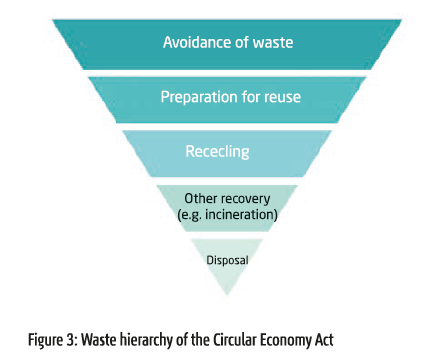
According to the Circular Economy Act (KrWG), a product receives a waste status from the moment the product is no longer used and the owner wishes to dispose of it or when a product is no longer used for its originally intended purpose. The waste status ends when a product has completed the designated recovery or recycling process.
Owners must ensure compliance with all waste regulations that are required to dispose of waste. The return and disposal of PV modules is carried out in accordance with the regulations for PV modules in ElektroG. In paragraphs §20 and §21 of ElektroG, the basic principle of recovery before recycling (KrWG paragraph §7) applies. Accordingly, reuse and recycling have priority over waste disposal.
• To ensure this, nondestructive dismantling and transport of the modules is mandatory.
• Upon receipt of the EOL modules at the primary treatment facility, the modules must first be tested for reuse. If the tested modules are suitable for reuse, they must be marketed under the requirements of ElektroG paragraph §23 (certificate of origin, test certificate, appropriate packaging).
• If the test determines that the modules are not suitable for reuse, they must be sent for recycling, material recovery, and/or waste disposal via the designated disposal system. In an initial treatment, pollutants (e.g., lead or cadmium [Cd]) or valuable materials (e.g., aluminium [Al] or copper [Cu]) must be separated if technical feasible before the modules are shredded for recycling.
• Si-based and non-Si-based modules must be treated separately. The waste hierarchy shown in Figure 5 also applies here.
In case PV owners want to sell used modules via a secondary market, PV modules continue to be treated as a product. Prior to the sale, the owners must ensure that the modules are still functional for their originally intended use. Also, in this case, modules must be dismantled, transported, and tested in a nondestructive manner before they are supplied to a secondary market. Further, the obligations to provide evidence according to paragraph §23 of ElektroG apply.
Monitoring and Statistics on the Provision of Evidence in ElektroG
Manufacturers and authorized representatives that place PV modules on the German market must register with Stiftung EAR (WEEE register) and report the monthly quantities of PV modules sold as well as the EOL modules that will be disposed via the take-back system. On this basis, Stiftung EAR compiles the annual statistics for WEEE, and they are also reported to the European Commission to demonstrate compliance with the specified collection and recovery targets, which are accessible via the statistical database Eurostat [8]. Stiftung EAR publishes the statistics once per year. Manufacturers and authorized representatives must report the annual statistics of the previous year (reporting year) to Stiftung EAR by April 30. The data are evaluated by independent experts and forwarded to the German Federal Environment Agency (UBA). If necessary, the data are further processed before they are forwarded to the European Commission. All manufacturers and authorized representatives that were registered in the reporting year are obliged to report.
With the reporting obligation to Stiftung EAR, the following quantities are queried:
• Input quantities: Products put on the market: Total amount of PV modules that were put on the German market in the reporting year.
• Output quantities: PV modules prepared for reuse: Includes PV modules that were initially reported as waste but after testing are prepared to be reused for their originally designated use without further pretreatment
• Recycled PV modules: Represents the share of PV modules or fractions from EOL treatment from which materials or substances have been used for the manufacture of new PV modules or another purpose. Here, the summarized weight of EOL modules along the treatment chain is decisive. All quantities of modules recycled in Germany, within the European Union, and outside the European Union are reportable, provided they were recycled according to European standards.
• Recovered PV modules: Describes the proportion of PV modules or fractions from treatment that are prepared for reuse, recycled, and/or sent for other recovery. Here, too, the quantity includes the modules recycled in Germany, within the European Union, and outside the European Union, provided compliance with the European standards. The evaluation quantity is the weight that is fed into the last plant in the treatment chain and whose output is the successful preparation, recycling, or recovery of the device or the recovered materials.
• Disposed PV modules: Includes the share of PV modules or fractions from the treatment that were not fed into any of the previously mentioned types of use or recovery but were disposed of as waste - for example, landfilled or disposed of via waste incineration plants. Here, too, the quantity includes the modules disposed of in Germany, within the European Union, and outside the European Union.
• PV modules exported for treatment: Total quantity of PV modules exported for treatment. The decisive factor is in which country the first treatment step of depollution, separation of recyclables, or preparation for reuse was carried out. If the initial treatment was subcontracted, the metric is counted as an initial treatment in the corresponding state only if it included the first treatment step.
Summary of Main Findings on PV Sector Circularity in Germany
In March 2021, the nongovernmental organization Environmental Action Germany (Deutsche Umwelthilfe [DUH]) published a white paper addressing the challenges and opportunities for improving the circularity in the PV sector in Germany. DUH defines the main targets for improving the circular economy of PV modules as follows:
• Waste prevention: PV modules have comparably long lifetimes, from 20–30 years; hence, appropriate use and maintenance is necessary.
• Preparation for reuse: In case of early exchanges of intact modules, e.g., for repowering PV plants, the repair or the reuse of intact modules must be ensured.
• Recycling: Broken or unfunctional modules must be recycled by modern, advanced processing to recover rare materials and to avoid contaminations of pollutant substances.
The white paper highlights the need for:
• improvements to the current collection of used PV modules and PV module waste with regard to the collection process but also in terms of transparency and economic aspects.
• Due to improper treatment, the repair and reuse of used modules is not always ensured.
• Further, improper collection might lead to the disposal of modules.
• Also, there is the need for better communication and information to the relevant stakeholders as well as the public regarding the collection and take-back processes and responsibilities in the recycling and disposal of used PV modules or PV module waste.
China raises RES share to 60% of total installed capacity
Batys Kaspiy Energo wins auction for 250 MW wind farm in Atyrau region
Ember: Renewables overtake coal in global power generation for the first time
Kazakhstan continues accepting applications for May RES auctions
Water-energy balance of the region discussed by ministers of four Central Asian countries
Just transition: leaving no one behind in the energy transformation
CAREC and Central Asian universities sign new memoranda on green skills development
Kazakhstan and UNECE discuss energy resilience and low-carbon technologies
100,000 jobs and a skills gap: how Central Asia is preparing for the renewables boom
No transition without transmission: How Central Asia is building its energy future
ADB to invest $5.5bn across 15 projects in Kazakhstan
17 agreements worth over $2.3 billion signed at the opening of RES 2026 EXPO in Astana
World Bank to invest $1bn in Central Asia's energy integration
Kazakhstan and China to launch a 500 MW wind farm in Karaganda region
Kazakhstan and Tajikistan move toward clean power deal over Rogun HPP
Regional Ecological Summit 2026 opens in Astana
Solar pumps and drip irrigation help Kyrgyz farmers cut costs amid rising energy prices
Hormuz closure failed to trigger coal comeback as solar and wind filled the gap
Astana set to launch RES 2026 EXPO and ink key international deals
Central Asian countries to discuss energy transition at RES 2026 in Astana