

International experience26.05.2025
Battery Energy Storage systems are key to power systems' efficiency and resilience


Meeting the net-zero targets established by many countries requires, in most modern power systems, a substantial increase in the use of renewable energies, mostly wind and solar. The growing penetration of variable, non-dispatchable renewable generation not only increases the need for system flexibilities to balance the variations of demand and supply, it also raises the need for capacity reserves to guarantee supply security for several hours, particularly during peak demand or contingency situations. Furthermore, it poses challenges for our electricity grids, both in terms of operational management and grid stability. In short, both the need for flexibilities and for capacity reserves is heightened due to the lower predictability and dispatchability of renewables.
Traditionally, flexibility and capacity reserves are provided by fast-reacting resources like Combined Cycle Gas Turbines (CCGT).
Battery Energy Storage Systems (BESS) offer a greener replacement to this fossil-fuel based resource. Whilst their role was mainly focused on ancillary services in the early days, today's state-of-the-art BESS are designed to stack multiple functions over different time constants, helping
1- to balance supply and demand,
2- to ensure security of supply, and
3- to optimize grid management and guarantee grid capacity and stability.
As we all work towards Net Zero , they play a critical role in capturing and valuing precious zero-carbon electricity which otherwise risks being curtailed -at an economic and environmental cost¬and to substitute vital, but currently fossil-fuel based flexibility and capacity resources.
Battery storage is becoming increasingly competitive delivering peak power at a cost similar to gas peakers. In the USA, tenders have already been awarded to ESS rather than gas peaking. In the EU, because energy costs have increased, any battery storage-based function is now a more profitable venture than it was before.
ENERGY SHIFTING WITH ESS
The major role of storage therefore consists of absorbing renewable energy when produced in excess of consumption or in excess of the transmission capacity of the grids, and to inject this energy to the grid when needed, with arbitrage as the predominant remuneration mechanism. This function is technically described as “energy shifting”, typically realized with 2-hour to 4-hour storage systems, with a trend to longer discharge durations. Most systems operate in a daily charge/discharge scheme (e.g. charging solar energy during daylight hours and discharging during evening hours), but some go up to the equivalent of two discharge cycles per day.
The predominant remuneration model for BESS is storing electricity in periods of abundant production and low market prices, and selling electricity when prices are high, typically during early evening peaks. This operation can be directly coupled to a wind or solar generator, in which case the operator simply delays selling a portion of his production to periods of higher market prices - the prevailing operation and revenue generation model in the USA driven by tax incentives installed by the US Inflation Reduction Act (IRA). The BESS can also be operated as a “standalone” asset, absorbing and storing energy from the grid and re-injecting energy back to the grid. In this case, arbitrage is usually combined with other ancillary services (i.e. primary and secondary frequency regulation) - the predominant remuneration model in Europe.
The value generation is enhanced when it comes to curtailment avoidance: not only, the energy is valued at market prices instead of being lost, but additional savings are realized by avoiding substitution costs and, possibly, grid enhancements. Currently we see a steady increase of curtailed renewable energy, which is lost for the community at a relatively high and continually increasing- economic and environmental cost.
However, such remuneration mechanisms are based on merchant markets, and hence exposed to market price variability, considered as a relatively high risk from the investor's perspective.
SECURITY OF SUPPLY
Especially in Europe the recent energy crisis has revealed the vulnerability of electricity systems in periods of constraints, related to its dependency on (often imported) natural gaz. We now see capacity markets being created in many countries to ensure electricity is available at an affordable cost even during infrequent peak periods (e.g. cold winter evenings) and contingency situations. The typical required duration for capacity markets is 2 hours, again with a trend to increase towards longer time periods.
Capacity markets are an interesting revenue adder for storage operators, as contracts are signed for multi-year periods with usually stable prices ensuring a secure and predictable income for investors.
GRID SERVICES
Besides the a.m. balancing and security of supply functions, the contribution and competitiveness of BESS in frequency regulation and voltage support ancillary services is well established and used by transmission and distribution grid operators as a lifeline to ensure voltage and frequency stability of the power systems. BESS have reached significant shares on frequency regulation markets in several countries.
However, the ever-increasing penetration of variable renewable sources (wind, solar) brings new challenges to grid operators, in particular problems of grid congestions as well as grid stability and resilience.
However, the ever-increasing penetration of variable renewable sources (wind, solar) brings new challenges to grid operators, in particular problems of grid congestions as well as grid stability and resilience.
Grid congestions are linked to the different locational distribution of wind and solar generators, much more distributed compared to conventional power plants, yet with “hot spots” of renewable generation in places not foreseen in the grid topology. A prominent example is the massive generation of wind energy in Germany's norther coastal area, challenging grid operators to transport energy to the southern regions where most power-hungry industries are located. In the short run, this situation leads to curtailments and increasing cost for dispatch management and feed-in management. For example, curtailment of renewable energies has reached 9.3 TWh in Germany in 2024, up 50% from 2021 levels and equalling 3% of the country's renewable generation.
Grid stability can be threatened by the reduction of dispatchable base generation -typically large-scale synchronous generators- and the subsequent increase of asynchronous renewable energy plants which are connected by inverter¬based technologies. This substitution process not only reduces the operator's flexibility in dispatch management, it also leads to a reduction of inertia of the grid, making it more vulnerable to sudden power fluctuations, outages or other unpredictable incidents. A lack of inertia can lead to a very fast collapse of grid frequency in case a major generation plant or transmission line is lost.
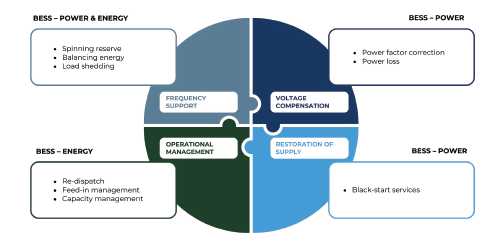
State-of -the art BESS offers technically sound solutions to address various problems in a single solution. They can support four fundamental areas of grid management typically under the responsibility of Transmission System Operators (TSO's):
- Frequency support services: in addition to existing primary and secondary frequency regulation, BESS can offer inertia support combining grid forming capability of inverters with the ability to inject active power within milliseconds.
- Operational management services: they address the 3C's: Congestion, Curtailment and Capacity reserve. They can temporarily relieve transmission lines by storing energy ahead of grid bottlenecks, thus avoiding curtailments. BESS can either substitute or complement other technologies implemented by TSO's, such as DLR (Dynamic Line Rating) and Power flow control.
- Voltage compensation services: they can be supplied by BESS both at distribution and transmission levels, avoiding the need for CAPEX intensive solutions. Their ability to provide power factor correction and to inject active power enables BESS to absorb the VAR and keep statutory voltage levels of distribution networks, and to compensate the losses during transit of power voltage compensation in transmission networks.
- Restoration of supply: During black start of a particular network in the grid, batteries can replace expensive fossil- fuelled backup resources. Black-start services are need to re¬energize sections of the network after a breakdown.
It is essential to recognize that a single BESS can deliver multiple services, if properly sized and engineered, and well managed in operation. The need for above mentioned services does usually not occur simultaneously, and it is common practise to “reserve” certain services for given periods of a day, a week or a year. Yet it is technically possible to combine multiple functionalities, e.g. supersede energy shifting with a frequency regulation service. An operational example of this principle can be found in Taiwan (called EdReg).
Remuneration models for frequency regulation (FCR, FRR), capacity services and arbitrage are increasingly well established in many countries. We also see operators include inertia-type services with frequency regulation (eg. FCAS in Australia or Dynamic Containment in the UK). The use of BESS for grid congestion management, however, is still in its early days with regulators trying to define services and remuneration models that enable TSO's and DSO's to outsources such services rather than to own and operate BESS by themselves - an option which is not authorized or not desirable in many jurisdictions. The “Gridboosters” in Germany or “Ringo” demonstrator in France represent early exceptions to this rule. Today, we see the first local flexibility markets emerge in the UK, France Spain or Australia, with a prominent example of the GOPACS congestion management platform in the Netherlands. These remunerate local flexibilities, which can usually be provided by energy storage or demand side management, able to withdraw or to inject power at certain parts of the grid and during certain periods. The value created for the system is based on cost reductions for re-dispaching and curtailment, as well as reduced expenditures on grid re-inforcement and grid stability, such as re-conductoring of existing lines or investments in new lines and other inertial supports.
It is obvious that the value creation of one single service is usually not sufficient to build a sound economic model for the BESS. Application Stacking is becoming current practice today to capture multiple value streams, and to de-risk return on investment by combining merchant and contractual services, and by enabling systems to change operation pattern over the operational life of the BESS to optimize revenue streams. This has a direct impact on the design of BESS, essentially in three areas:
- Energy throughput: to stack multiple services, BESS are increasingly used beyond a single charge-discharge cycle per day. During periods of intensive use, a single battery must be able to sustain multiple charge/discharge cycles at various DOD (depth of discharge), leading to a cumulated throughput of up to 300% per 24h. This puts high requirements on the thermal management system.
- Digitalization is key to supervise BESS remotely and to ensure highest availability, in particular when systems increase in size and when operation patterns are complex, dynamic and changing over time.
- Safety: multi-MW BESS are no longer exclusively destined to remote areas. As we need them to provide local flexibilities, they are increasingly installed in infrastructure- and population- dense areas, as well as behind-the-meter on industrial sites and datacenters. This implies ever increasing levels of safety requirements on BESS and rejection of “let it burn” options in such places.
THE LATEST ESS DEVELOPMENTS
Currently, we are seeing increasing trends in energy density, system architecture and digitalization.
SCALING UP FASTER WITHOUT COMPROMISING SAFETY AND CYBERSECURITY
Today, systems of 100 MW for two hours (200 MWh) or four hours (400 MWh) are commonplace, and we start to see single installations at the gigawatt level. To accommodate this requires more ESS containers. So, installation space is becoming an increasing challenge, knowing that battery containers need to be connected to Power Conversion Systems (PCS) and Transformers, and be installed at safe distances allowing access for maintenance. So, how do we account for the need to economize space, whilst ensuring the highest levels of safety?
Since the first lithium-ion battery container left Saft factories in 2012, the energy density of a single 20-foot container has increased 10-fold from 500 kWh to 5.1 MWh today. Whilst bigger sizes and densities of lithium-ion cells are enabling such densities, the challenge in engineering lies in developing and qualifying high-performance battery system solutions which can be transported to any place in the world, and to guarantee reliable operation over 15 to 20 year lifetimes, with the highest safety standards, and efficient cooling in minimum space volumes with high energy efficiency.
Saft's latest generation of lithium-ion BESS, called Intensium® Flex, provides 5.1 MWh of storage capacity in standard ISO 20-foot containers. Manufactured under stringent quality controls in our factories, the product has been developed, tested and qualified by in-house engineering teams to integrate
- proprietary control electronics (BMS) from module level to system level. Combined with stringent qualification testing as well as component sourcing in Europe and the US, the control system exceeds industry standards in reliability and cybersecurity.
- a liquid cooling system ensuring temperature homogeneity among all battery modules, under extreme environmental conditions and with high energy efficiency,
- a risk-analysis based safety approach implementing redundant, electronic and physical safety barriers at multiple levels to manage, among others, fire and explosions risks. Saft's safety approach is holistic, anticipating worst-case scenarios at product level, site installation level, and with the operating personnel and fire fighters.
The footprint of a full BESS is also impacted by the size and number of power conversion systems (PCS) needed to convert the DC energy of multiple containers into AC. Saft's control system accurately manages up to eight containers in parallel, i.e. more than 40 MWh can be connected to a single PCS. This allows Saft to design system architectures based on the largest, cost-optimized PCS systems available on the market.
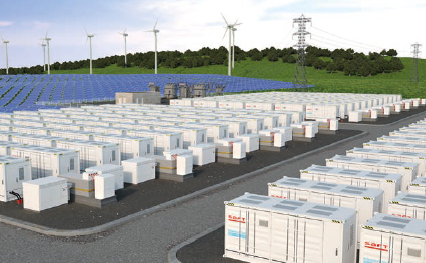
The increased energy density of the container building blocks, combined with advanced controls, sophisticated safety features and a space-saving plug-and-play installation, is game-changing. All in all, this means industry can now deliver utility-scale BESS for up to eight hours of energy shifting, all while dividing floorspace and installation time by a factor of 2 or 3.
INCREASING DIGITALIZATION
Modern BESS are also becoming increasingly digitalized, enabling real-time system management and the use of Artificial Intelligence and Machine Learning. This improves efficiency while reducing downtime and maintenance costs. Data interfacing with the cloud provides remote monitoring of key performance indicators (KPIs) and control over all operational parameters of their system
With Saft's I-Sight system, for example, the digital cloud-connected platform monitors performance in real¬time to ensure the BESS delivers on contract specific KPI's. The platform will alert about any deviations, enabling immediate action. AI allows the implementation of predictive maintenance functionalities, further reducing downtime, cost and safety risks thanks to the detection and thorough interpretation of weak signals within a tremendous amount of data gathered and stored by the system.
It is also now possible to resolve most issues without ever needing a site visit, thanks to remote diagnostic and reconfiguration tools.
CONCLUSIONS
The tide is now turning. Most countries -and resulting energy policies- recognize the need to invest into both flexibilities and grid capacities, in order to integrate massive amounts of wind and solar energy so as to match their carbon reduction targets. BESS are not only efficient alternatives to fossil-based flexibilities, but they are also crucial enablers to capture, store and deploy that energy when it is needed. By doing so, they are instrumental to help balance demand and supply, to constitute precious capacity reserves and to prevent grid congestion and curtailment, in other terms avoid wasting energy - an increasingly precious resource in today's world.
With a track record of more than 7.5 GWh of BESS installed or under construction worldwide, Saft offers expertise in battery energy storage systems to developers from project inception to installation and end of life. Our brand stands for reliable, guaranteed high performance product solutions, excellence in project execution and reliable service over decades, thus securing return on investment for long-life battery assets.
China raises RES share to 60% of total installed capacity
Batys Kaspiy Energo wins auction for 250 MW wind farm in Atyrau region
Ember: Renewables overtake coal in global power generation for the first time
Kazakhstan continues accepting applications for May RES auctions
Water-energy balance of the region discussed by ministers of four Central Asian countries
Just transition: leaving no one behind in the energy transformation
CAREC and Central Asian universities sign new memoranda on green skills development
Kazakhstan and UNECE discuss energy resilience and low-carbon technologies
100,000 jobs and a skills gap: how Central Asia is preparing for the renewables boom
No transition without transmission: How Central Asia is building its energy future
ADB to invest $5.5bn across 15 projects in Kazakhstan
17 agreements worth over $2.3 billion signed at the opening of RES 2026 EXPO in Astana
World Bank to invest $1bn in Central Asia's energy integration
Kazakhstan and China to launch a 500 MW wind farm in Karaganda region
Kazakhstan and Tajikistan move toward clean power deal over Rogun HPP
Regional Ecological Summit 2026 opens in Astana
Solar pumps and drip irrigation help Kyrgyz farmers cut costs amid rising energy prices
Hormuz closure failed to trigger coal comeback as solar and wind filled the gap
Astana set to launch RES 2026 EXPO and ink key international deals
Central Asian countries to discuss energy transition at RES 2026 in Astana