

International experience21.12.2024
Energy transition in Germany


Ainur Sospanova, Chairperson of the Qazaq Green Renewable Energy Association
Timur Shalabayev, Executive Director of the Renewable Energy Association Qazaq Green
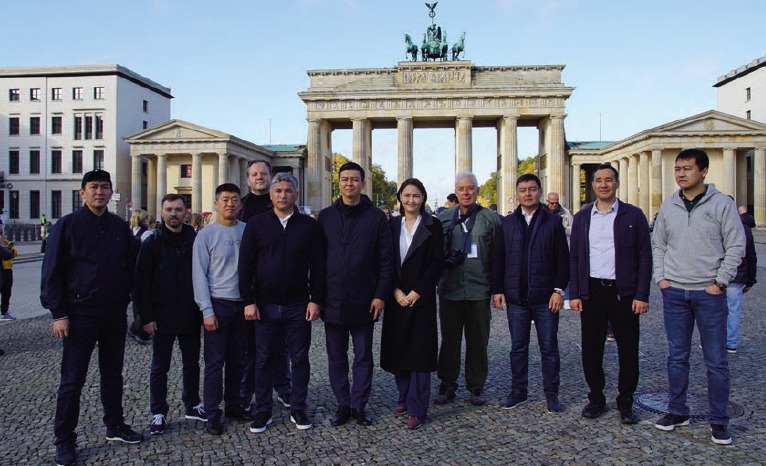
In October 2024, the German Society for International Cooperation (GIZ) organized a study tour to Germany on expanding the use of renewable energy sources within the framework of the project "Capacity Development in the field of climate policy in the countries of South- Eastern and Eastern Europe, South Caucasus and Central Asia". The tour was attended by Deputy of the Senate of the Parliament of the Republic of Kazakhstan Yevgeniy Bolgert, representatives of KEGOC JSC, KOREM JSC, Energy System Research Design Institute, Kazakhstan Electric Power Association, Qazaq Green Renewable Energy Association, energy and environmental experts.
During the tour, meetings were held with representatives of the Federal Ministry of Economy and Climate Protection (BMWK),the Federal Grid Agency for Electric Power, Gas Supply, Communications, Post and Railways (Beundesnetzagentur), the Ministry of Economy, Labor and Energy of Brandenburg (MWAE), the German Renewable Energy Federation (WEE), the Federal Association of Heat Pumps (BWP), the Institute of Energy Technologies of the Technical University of Berlin, Agora Energiewende GG GmbH, also visit to demonstration studio of the Tennet system operator was carried out.
The tour provided a clear understanding of policies, support measures, problems and the role of various institutional stakeholders in the process of forming and implementing renewable energy policy at the federal and regional levels.
RES POLICY AT THE FEDERAL LEVEL
In Europe, Germany is one of the first leaders in the field of energy production from environmentally friendly sources.
Germany has been encouraging more active use of RES for 20 years — for environmental, economic and democratic reasons. The energy turnaround (or energy reform) not only ensures the availability of carbon-neutral energy, contributing to the fight against global warming. It reduces dependence on expensive energy imports, increases value added in one's own country and allows citizens to participate in energy production. However, the concept of "energy turnaround" does not only mean the construction of new wind turbines and solar power plants. Essential aspect is also the rational use of energy.
Back in 1990, Germany adopted the world's first law on supply of electricity from renewable energy sources to the general grid (the so-called Stromeinspeisungsgesetz), for which remuneration was provided, although relatively modest. Everything changed ten years later with the adoption of the Renewable Energy Act (EEG). Higher subsidy rates were introduced and better conditions were created in the electricity market. Investments in wind turbines and photovoltaic plants have become attractive to many citizens and businesses. The expansion process accelerated, as a result of which prices fell sharply and renewable energy sources became competitive. Subsidy rates were repeatedly reduced, and eventually an auction model was introduced to achieve the most acceptable prices.
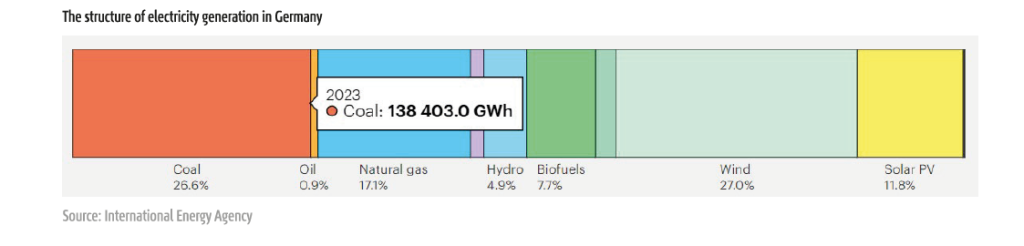
According to the International Energy Agency (IEA), electricity generation in Germany in 2023 amounted to 520 003 GWh, of which 27% was wind energy, 27% coal, 17.1% natural gas, 11.8% solar, 4.9% hydropower, 7.7% - biofuels. The output of renewable energy power plants exceeds the output of fossil fuel-based power plants.
At the same time, Increased electricity consumption Is also taken into account. After all, when millions of electric vehicles appear on the roads, heat pumps will replace old boilers, and many industrial processes will be electrified, demand for electricity will increase by a third by the end of the decade. Therefore, the economical use of energy is the central pillar of the energy revolution. The general rule is that the less energy is consumed, the easier is achievement of the goals in the fight against climate change.
On July 29,2023, amendments to the Renewable Energy Sources Act (EEG) came into force in Germany. According to the new amendments, renewable energy sources are the "main public interest1' and serve public safety. The Ministry of Economy and Climate Protection clarifies thatdue to the worsening climate crisis and Russia's aggressive war in Ukraine, the expansion of renewable energy has become a matter of national and European security. In this regard, the government is doing everything possible to improve significantly the political environment for renewable energy.
Amendments to the legislation imply a priority for the placement of renewable energy generation plants. Thus, they should be given preference where the law allows for compromises between different legal interests (for example, in historical buildings and nature conservation). In addition, it is planned to increase funding for new photovoltaic installations on roofs: the remuneration for solar energy for owners of such installations can now be up to 13.4 cents per kilowatt hour (kWh). At the same ti me, connecting to the grid will become easier.
The guidelines for expanding the use of renewable energy sources mean that the Renewable Energy Act 2023 is consistently focused on achieving the 1.5 degree target set in the Paris Agreement for the first time.
Agroelectric installations and other special solar installations will be subject to regular financing. In the future, this will allow, in principle, financing agroelectric installations on all arable lands through the Law on Renewable Energy Sources. This will facilitate the use of the same land for both agricultural and energy purposes.
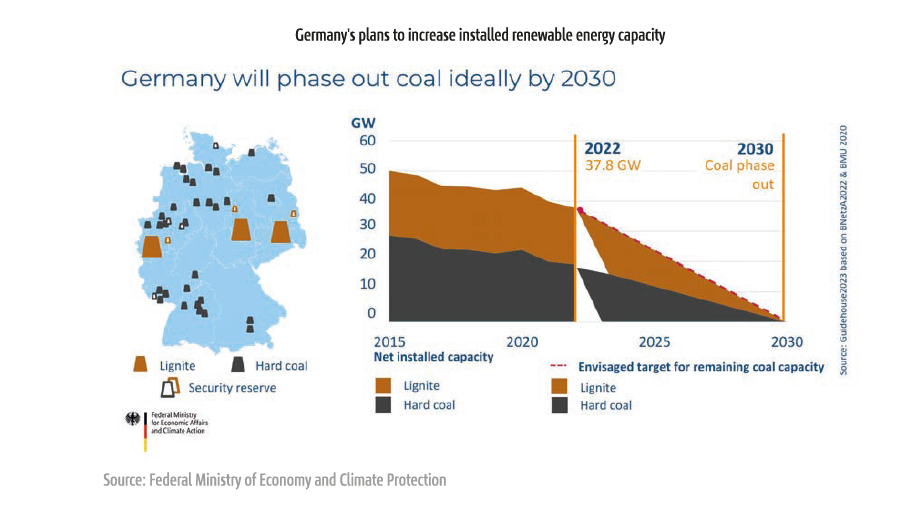
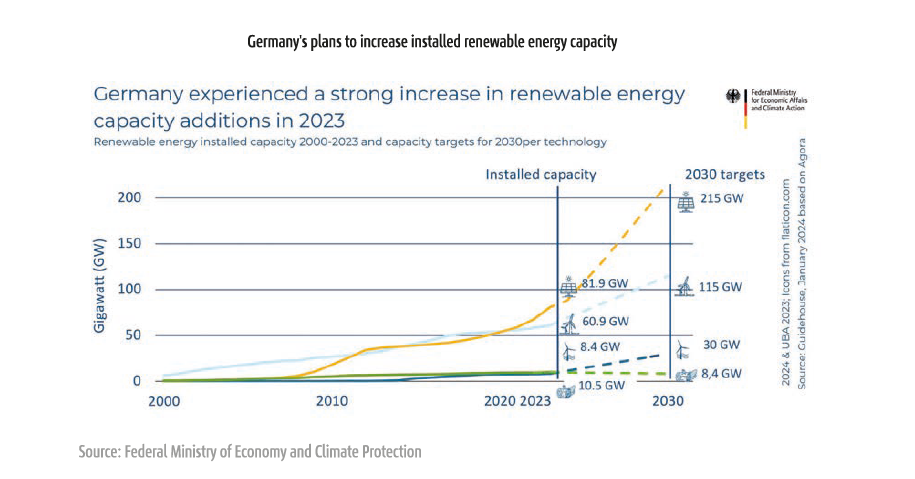
The concept of participation of all citizens of the country in the energy transition and the possibility of financial participation of municipalities in this process has been expanded and strengthened. Thus, according to the German Federal Grid Agency (Bundesnetzagentur), 220 000 balcony photovoltaic systems with a total capacity of 200 MW were installed in the country in the first half of 2024. It explained the recent growth of more simplified registration of plug-in solar devices, which have been available since April this year. The average registered gross power of these systems has increased from 800 watts last year to about 900 watts this year. Bundesnetzagentur stated that the actual total installed capacity may be higher as many PV system owners may still need to register their installations.
In an effort to end Germany's dependence on fossil fuels in the construction sector, the Federal government has decided that from 2024, wherever possible, renewable energy sources should provide 65% of the energy for all newly installed heating systems.
This decision shifted the relevant provision of the coalition agreement by a year—from 2025 to 2024 — in view of Russia's aggressive war against Ukraine and the energy crisis caused by it.
More than 80% of the heat demand is currently covered by burning fossil fuels. Natural gas dominates the heating of premises in the building sector. Almost every second household in Germany uses gas for heating, almost 25% use heating oil and more than 14% use district heating. The share of gas heating in newly installed heating systems was about 60% in 2021.
Therefore, the Law on Energy in Buildings requires that newly installed heating systems must use at least 65% of renewable energy for heating. The obligation to use renewable energy for heating applies only to newly installed heating systems. However, there may be exceptions that suggest that existing heating systems can continue to be operated, and systems that have failed can be repaired. If the gas or oil heating system cannot be repaired (heating failure), pragmatic transitional solutions and transitional periods spanning several years are provided. Gas heating systems can continue to be installed in existing buildings if these systems operate using 65% green gas or in combination with a heat pump.
Although the new approach is generally open to any technology, the Federal Ministry of Economy and Environmental Protection assumes that the installation of heat pumps will continue to gain momentum. Heat pumps are the best and most economical option for many buildings when it comes to decarbonizing heat supply. In the context of the 2022 German Heat Pump Summit, stakeholders agreed to install 500 000 heat pumps per year from 2024.
REGIONAL RENEWABLE ENERGY POLICY: BRANDENBURG
The German capital region is a pioneer of innovative energy and environmental technologies in national and European comparison. In particular, the development of new systems and processes for use of renewable energy sources and their improvement serve the main objectives of the Berlin Program on Energy and Climate Protection 2030 and the Energy Strategy 2040 of the land of Brandenburg.
According to the regional Energy strategy 2040 of the land of Brandenburg, by 2030 the share of renewable energy in final electricity consumption should be 100%, and by 2040 the share of thermal energy generated by renewable energy should be 82%.
The installed capacity of WPP by 2040 should be 15 GW, the SPP - 33 GW. By 2032, about 2.2% of the total land area of the Brandenburg region should be provided for WPP projects. At the same time, clear guidelines have been given to simplify the installation procedures for small-scale solar plants. Thus, the Brandenburg Building Code (BbgBO) states that solar installations inside and on roofs and surfaces of exterior walls of houses, with the exception of high-rise buildings, and building-independent solar installations with a height of up to 3 meters and a total length of up to 9 meters are not subject to approval by authorized bodies.
The expansion of renewable energy sources is accelerated by the support offered by the federal lands. The developed Brandenburg Solar Atlas, which has been integrated into the Brandenburg Energy Portal, shows the potential of using solar energy on roofs and open spaces in the ground. In addition to data on heating needs in the construction sector and heating networks, the Brandenburg Thermal cadastre also provides data on the potential for use of renewable heat sources on a global scale that can replace fossil heat sources in the future. Berlin, on the other hand, has set itself the goal of radically increasing rooftop solar energy production in the city with its Solar city master plan. Thus, the solar atlas shows the solar potential of the roofs of individual buildings.
Thus, photovoltaic (PV) systems are already making an important contribution to the supply of the capital region. With 2.6 kWh, Brandenburg now has the highest installed capacity of photovoltaic systems per capita in Germany (2023). Expansion is also gaining momentum in Berlin: in 2023, more than 10,000 new photovoltaic systems were installed — more than ever before - reaching a historic high of 72.7 MW of new connected capacity.
With an installed capacity of about 8.6 GW and more than 4,000 wind turbines, Brandenburg ranks second in Germany in terms of wind power (as of early 2024). Berlin-Brandenburg is home to numerous providers of wind farm planning, construction, operation, maintenance and repair services such as ENERTRAG, Energiequelle and Turbit Systems. In addition, various companies and scientific institutions in the region are engaged in research on rotor blades and foundations, as well as modernization and predictive maintenance of wind turbines.
Large number of companies and research institutions are working together on solutions in the field of agroforestry systems and algae research, as well as biogas, biofuels and biochar. Research at the Leibniz Institute of Agricultural Engineering Potsdam-Bornim (ATB) is aimed, among other things, at studying the energy use of biomass. By providing practice-oriented application laboratories for business partners, ATB promotes agricuItural in novation untiI they are ready to enter the market.
In addition, as a support measure for the areas where renewable energy facilities are located within a radius of3 kilometers, a profit support measure is provided for local municipalities in the form of a subsidy of 10,000 euros per 1 wind turbine (on average about
2,000 euros per 1 MW of installed capacity). At the same time, all renewable energy stations cannot be located closer than 1 km to a populated area. All this increases interest in the issue of renewable energy expansion among the local population.
THE ISSUE OF INTEGRATING RENEWABLE ENERGY INTO THE GERMAN ENERGY SYSTEM
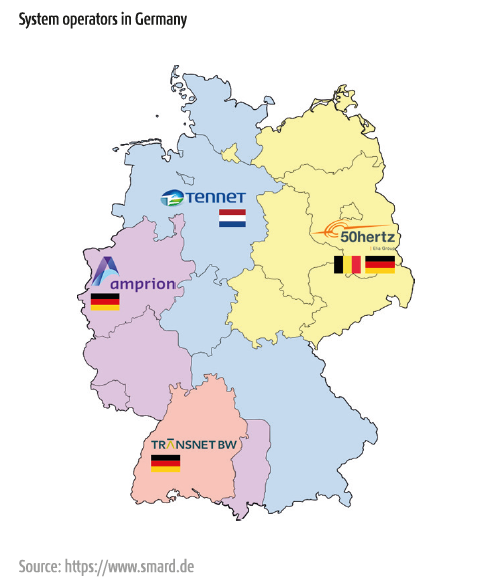
The German transmission system is divided into four regions, known as control zones. Each control area has a transmission system operator, or TSO, responsible for the safety and stability of the grid: Amprion GmbH, TransnetBW GmbH, TenneT TSO GmbH and 50Hertz Transmission GmbH.
The German power grid is divided into several voltage levels, with transmission systems being the highest. They cross the entire country with a voltage of at least 220 kilovolts (kV), transporting electricity over long distances from the main generating plants (power plants and offshore wind power plants) to downstream distribution systems. This is the only way to meet the electricity needs in the south of Germany, for exam pie, by using energy generated by wind turbines in the north. Transmission systems also connect the German grid to those of its neighbors through cross-border interconnections and submarine cables, allowing electricity to be traded across European borders.
The role of the TSO in Germany is specified in law. As stated in section 11(1) of the German Energy Industry Act (EnWG), their job is to "operate and maintain a safe, reliable and efficient energy supply grid, as well as optimize, strengthen and expand the network in accordance with the requirements in a non-discriminatory manner."
They operate the grid independently of the generation and sale of electricity and must make the grid accessible impartiaIly to a 11 market participants.
Thus, TSO is responsible for operation, maintenance and expansion of the transmission system infrastructure in accordance with the requirements. To avoid fluctuations in the frequency of the system, they must take certain measures to maintain grid stability, such as using balancing services.
Given the ambitious plans for development of renewable energy, the integration of renewable energy into the grid is a key challenge for the energy system. The problem is complicated by the fact that wind power plants are mainly located in the north of the country, and solar power plants are located in the south, which, taking into account the weak grid infrastructure in the north-south direction, the closure of nuclear power plants in 2023, which were mainly located in the south of the country, as well as the high energy consumption of the southern regions (Bavaria, Baden-Wurttemberg, etc.) form certain problems in the transmission and balancing of renewable energy.
This problem is partially solved due to effectively built interstate flows and built market relations between subjects, including within the framework of the balancing issue.
Thus, the European Network of Electricity Transmission System Operators (ENTSO-E) regulates issues of interstate flows. As of June 2021, the European Network of Electricity Transmission System Operators (ENTSO-E) comprised 42 TSO members from 35 European countries.
ENTSO-E unites the knowledge and interests of all European TSO and coordinates the operation of grids in Europe, ensuring the functioning of grids and the European internal electricity market. Regulation (EC) No 543/2013 requires TSO to notify ENTSO-E of its data on electricity markets, consumption and generation. This makes events in the electricity market transparent.
In addition, system operators in Germany are responsible for resolving imbalances and, moreover, are responsible for forecasting the generation of electric energy by stations located in the energy system, including renewable energy stations. That is, renewable energy stations are not financially responsible for imbalances. Forecasting of electric power generation is performed by the system operator at the system level, which makes it possible to have clearer data and respond promptly to weather changes.
In addition, there is no obligation in Germany to install energy storage systems for renewable energy generating capacities. Basically, the storage systems are installed by households to ensure uninterrupted supply of their own energy consumption. At the same time, the prospects for using storage on the scale of the energy system are being considered within the framework of the auxiliary services market. In this direction, separate auctions for hybrid stations are being prepared: WPP + storage or SPP + storage.
According to Dr. Frank Behrend, Representative of the President for International Affairs at the Technical University of Berlin, the prospects for using energy storage systems have a limited vision: "First, it is necessary to understand that electrochemical energy storage systems are expensive solutions. Secondly, if we talk about more efficient technologies, for example, pumped storage power plants, then this is also a very significant investment. It is very difficult to build such a structure in Europe, it is possible to face a lot of opposition from the population. Thirdly, you need to understand that the operation of any storage systems is limited in ti me. Do we need huge expenses to get savings for only 2-3 hours?
In this regard, if energy storage technologies are used, then it should be a mix, one should not give preference to any particular technology.
After all, Europe does not rely on ESSs as a solution for regulating energy systems. We are more focused on building effective ma nagement of interstate flows for regulation."
INDEPENDENT REGULATOR: GERMAN FEDERAL GRID AGENCY (BUNDESNETZAGENTUR)
The Federal Grid Agency for Electricity, Gas, Telecommunications, Postand Railways is an independent supreme federal body with its headquarters in Bonn, working in the field of activities of the Federal Ministry of Economy and Climate Protection Measures (BMWK) and the Federal Ministry of Digital Technologies and Transport (BMDV). The Agency has been responsible for the main infrastructures of the German electric power industry, gas supply, telecommunications and postal services for more than 20 years.
The Agency's Advisory Board consists of members of both houses of the German Parliament (16 from the Bundestag and 16 from the Bundesrat). The management is appointed fora period of5years by the Federal President of Germany on the recommendation of the Agency's advisory board. The Agency has 330 employees involved in the regulation of the electric power industry and about 220 employees in the planning and expansion of networks. The total annual budget of the agency is about 300 million euros.
The Agency was founded in 1998 as part of the process of liberalizing the postal and telecommunications markets. The main task was to ensure fair and non-discriminatory competition for all market participants. Successful regulatory experience has led to the fact that the energy and railway sectors have also come under the responsibility of the agency.
The Telecommunications and Postal Regulatory Authority, which took over the responsibilities of the former Federal Ministry of Posts and Telecommunications and the Federal Office of Posts and Telecommunications, was renamed Bundesnetzagentur on July 13,2005.
On January 1,2006, the scope of the Bundesnetzagentur was expanded to include regulation of the railway sector.
In 2011, the Bundesnetzagentur also took on tasks related to the grid development plans. If the grid development plan indicates the need to expand the ultra-high voltage network, effective Bundesnetzagentur planning and approval procedures help accelerate implementation.
In June 2013, the Bundesnetzagentur received additional tasks related to the expansion of the electric grid. Since then, it has been responsible for conducting plan approval procedures for expansion projects crossing federal lands or national borders. The Agency is responsible for fair access to the electric grid for all market participants, as well as for stimulating regulation of electricity tariffs in the grids.
Today, as the main body responsible for infrastructure, the agency establishes general conditions for fair competition in these sectors and, as a supervisory authority, also assumes some consumer protection functions. Modern energy, communication and transport networks are the daily arteries of life in the German economy. Without these networks, a thriving economy based on the division of labor would be impossible. Germany's competitiveness and its future as a successful export country depend on the capabilities of these networks. Basic infrastructures allow achieving market power. The interests of companies, politics, economics and society do not always coincide. Competition that strikes a balance between these interests usually doesn't happen on its own.
The regulation of these infrastructures by an independent institution such as the Bundesnetzagentur is a key task in the German national economy.
The results of the tour: key conclusions
THE KEY CONCLUSIONS THAT CAN BE DRAWN FROM THE RESULTS OF THE STUDY TOUR CAN BE STRUCTURED AS FOLLOWS:
1. Germany has set ambitious goals for development of renewable energy sources for generation of electric and thermal energy. The country has already achieved great results, despite a sharp reduction in basic generation (closure of nuclear power plants in 2023, plans to close coal plants by 2024). At the same time, the country is limited in gas supplies. In this regard, the energy crisis that has arisen has prompted to strengthen measures for development of renewable energy sources. The legislation stipulates that renewable energy meets the highest public interests.
2. Renewable energy facilities are not responsible for imbalances. According to the legislation, the system operator assumes full responsibility for imbalances. Balancing is carried out due to effective interstate flows and well-established market relations, including within the framework of the issue of regulation in the energy system. For example, there is a requirement to have up to 70% redundancy in the networks to ensure an unhindered flow of electricity between neighboring countries on the territory of Germany. At the same time, one of the priorities is to ensure energy L security and independence of the energy system.
3. There is no obligation for renewable energy facilities to install energy storage systems. Germany is developing ESSs as a separate type of support services. In this regard, auctions are organized separately: WPP + storage or SPP + storage. At the same time, experts note that it is impossible to rely only on storage systems and a mix of technologies is needed.
4. System operators are responsible for forecasting the
generation of electric energy by renewable energy plants. The ability to make forecast schedules for the entire power system provides advantages for the operational management of the power system.
5. Conditions have been created for development of small-scale generation: private households, balcony installations in apartments, requirements for equipping all new buildings with heat pump systems, government subsidies for use of renewable energy by the population.
6. The basis for development of the electric power industry and renewable energy sources is based on market relations. The main mechanism for implementation of renewable energy projects is auctions. Additionally, renewable energy facilities on the market have the opportunity to make additional profits on the spot market (market premium model). Price signals for market participants form the technological development of the industry.
China raises RES share to 60% of total installed capacity
Batys Kaspiy Energo wins auction for 250 MW wind farm in Atyrau region
Ember: Renewables overtake coal in global power generation for the first time
Kazakhstan continues accepting applications for May RES auctions
Water-energy balance of the region discussed by ministers of four Central Asian countries
Just transition: leaving no one behind in the energy transformation
CAREC and Central Asian universities sign new memoranda on green skills development
Kazakhstan and UNECE discuss energy resilience and low-carbon technologies
100,000 jobs and a skills gap: how Central Asia is preparing for the renewables boom
No transition without transmission: How Central Asia is building its energy future
ADB to invest $5.5bn across 15 projects in Kazakhstan
17 agreements worth over $2.3 billion signed at the opening of RES 2026 EXPO in Astana
World Bank to invest $1bn in Central Asia's energy integration
Kazakhstan and China to launch a 500 MW wind farm in Karaganda region
Kazakhstan and Tajikistan move toward clean power deal over Rogun HPP
Regional Ecological Summit 2026 opens in Astana
Solar pumps and drip irrigation help Kyrgyz farmers cut costs amid rising energy prices
Hormuz closure failed to trigger coal comeback as solar and wind filled the gap
Astana set to launch RES 2026 EXPO and ink key international deals
Central Asian countries to discuss energy transition at RES 2026 in Astana