

Education and science14.09.2025
Engineers for the Energy Transition: KBTU Responds to the Renewable Energy Workforce Shortage


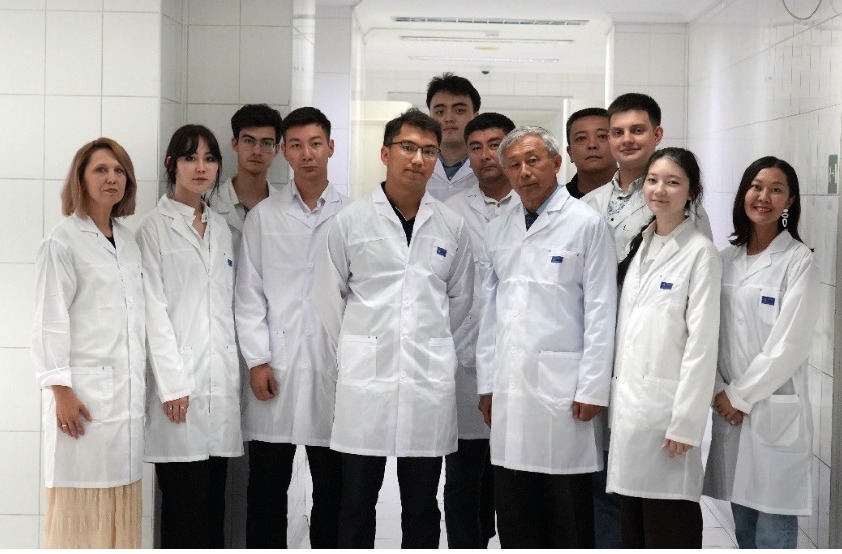

Beisenkhanov Nurzhan, Dean of School of Materials Science and Green Technologies Sultanov

Assanali, Head of Laboratory of Alternative Energy and Nanotechnology
Over the past decade, the modern world has undergone fundamental changes in the way energy is produced, distributed, and consumed. The growing interest in renewable energy sources (RES) has long gone beyond environmental concerns. Today, the development of renewables is a strategic necessity for the sustainable development of the economy.
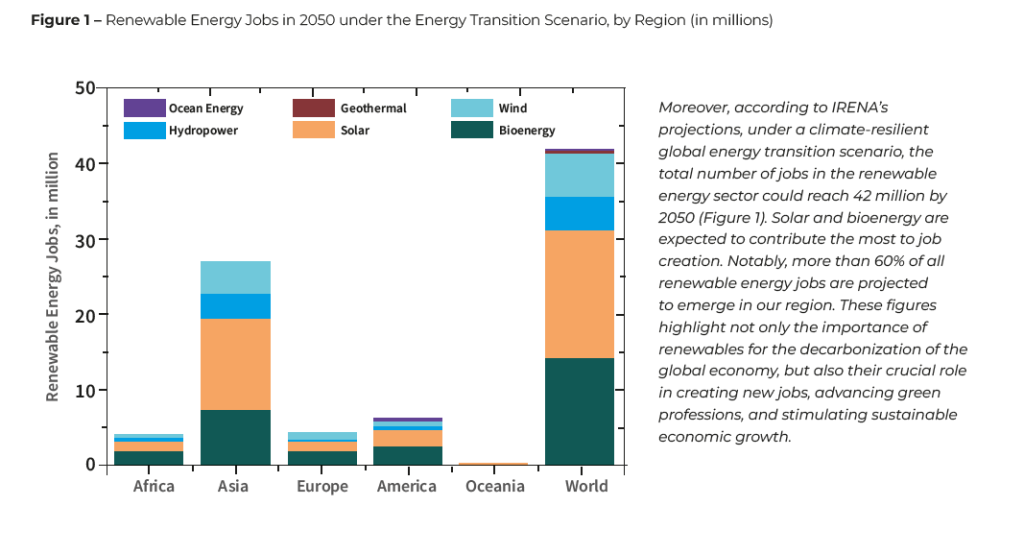
THE TRANSITION TO SUSTAINABLE ENERGY REQUIRES NEW TALENT According to a report by the International Renewable Energy Agency (IRENA), the number of jobs in the renewable energy sector has shown steady growth over the last ten years, nearly doubling from approximately 7 million in 2012 to 13.7 million in 2022. This growth has been driven by the rapid development of solar, wind, hydro, and bioenergy around the world, as well as the expansion of supply chains, manufacturing capacity, and projects for the construction and operation of renewable energy facilities.
Kazakhstan, the ninth largest country in the world by land area, possesses significant potential for solar, wind, and other green energy sources. The country is striving to reduce its carbon footprint, achieve energy independence, and develop a competitive green industry. However, none of these goals can be achieved without the systematic training of a new generation of qualified professionals.
The Kazakh-British Technical University (KBTU), as the country’s leading engineering and technical university, is systematically building a science and education ecosystem aimed at training specialists in the field of renewable energy. A key role in this process is played by the School of Materials Science and Green Technologies (SMSaGT), which is an experimental platform for undergraduate, master's, and PhD students.
KBTU’S SCHOOL OF MATERIALS SCIENCE AND GREEN TECHNOLOGIES: ENGINEERING FOR A NEW ERA
The School of Materials Science and Green Technologies (SMSaGT) was established on August 1, 2022, at the Kazakh-British Technical University, building on the foundation of the university’s scientific and educational centers for alternative energy and nanotechnology, and the "Materials Science and Corrosion Challenges” unit. Today, in fulfilling its mission, SMSaGT actively draws on the scientific expertise of the Laboratory of Alternative Energy and Nanotechnology (LAEaN) and the Laboratory of Advanced Materials and Technologies (LAMaT). The school’s primary focus is to train specialists capable of addressing current challenges in nanotechnology, materials science, and renewable energy.
The courses offered at SMSaGT follow an interdisciplinary approach. The bachelor’s, master’s, and PhD programs combine engineering and physics fundamentals with modern digital tools for modeling, analysis, and optimization. Significant emphasis is placed on sustainability, the life cycle of energy systems, and decarbonization policy.
SMSaGT distinguishes itself through a strong emphasis on research-driven education. From their very first year, students work under the guidance of professors and instructors on real scientific projects, conduct laboratory experiments, and contribute to the preparation of academic articles and conference presentations. Each academic year concludes with the defense of project work related to energy systems, renewable energy materials, or environmental technologies. SMSaGT maintains close ties with industrial partners and international universities, enabling students to take part in internships abroad, engage in joint research initiatives, and become part of the global scientific community.
Shaping the engineering mindset of the future requires a unique educational environment. At SMSaGT, modern laboratories and experimental facilities are actively used to ensure a continuous link between theory and practice. Here, knowledge goes beyond theory, it is transformed into practical skills for real-world challenges.
LABORATORY OF ALTERNATIVE ENERGY AND NANOTECHNOLOGY: FROM CONCEPT TO EXPERIMENT
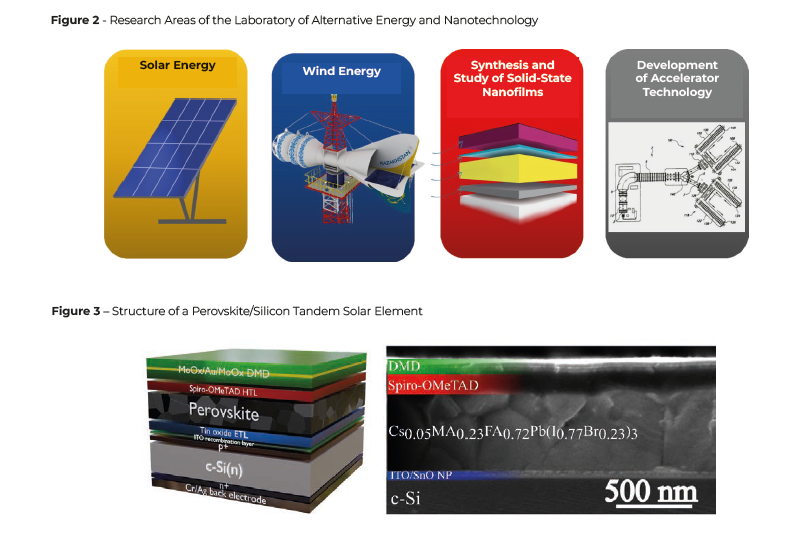
One of the key components of the "learning through research” system is the Laboratory of Alternative Energy and Nanotechnology. The laboratory was established at the Kazakh-British Technical University on May 2, 2011, under the leadership of Professor K. Kh. Nussupov, as a research platform for advancing cutting-edge developments in solar and wind energy, as well as functional nanomaterials. Today, the laboratory serves not only as a scientific hub but also as a true school of engineering practice. Its research spans a wide range of areas from the design of unique wind power systems to the development of multifunctional nanocoatings.
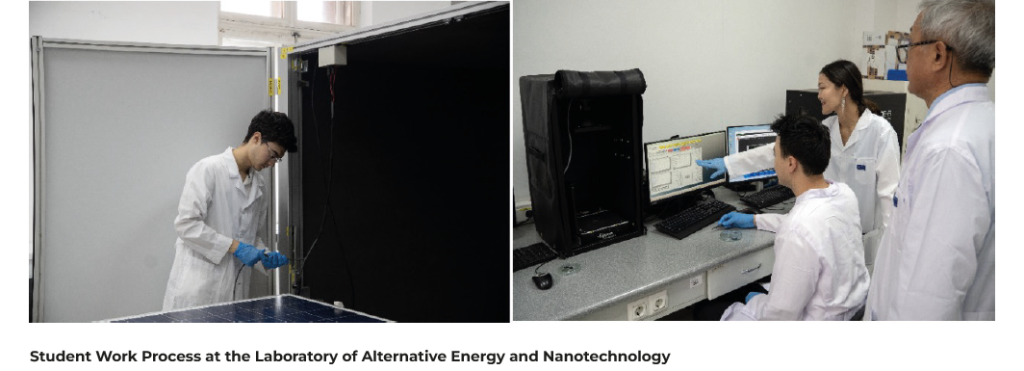
One of the main areas of focus at the laboratory is the development of solar cells with various architectures and their subsequent assembly into solar panels. The laboratory is equipped with a full production cycle for silicon-based solar panels. In recent years, the lab’s researchers, in collaboration with colleagues from Nazarbayev University, have actively been working on the development of perovskite/silicon tandem solar cells, which is one of the most promising directions in modern photovoltaics. This collaboration between KBTU and Nazarbayev University fosters the integration of scientific research with innovative technologies and enhances inter-university cooperation in the field of solar energy development in Kazakhstan.
The operating principle of tandem solar cells is based on the sequential stacking of two photoactive layers, each optimized to absorb a different portion of the solar spectrum. In conventional silicon solar cells, a significant share of high-energy (blue and ultraviolet) photons is lost as heat, since silicon is most efficient in the near-infrared and visible ranges. Perovskites, on the other hand, offer the ability to precisely tune the bandgap, making them highly effective at capturing shorter-wavelength (high-energy) radiation.
In a tandem architecture, the top perovskite layer absorbs high-energy photons, while the bottom crystalline silicon layer captures the lower-energy photons that pass through the upper cell. This design significantly increases quantum efficiency and enables broader utilization of the solar spectrum, achieving a potential conversion efficiency of over 35%, surpassing the theoretical limit of traditional silicon cells (29–30%). These and related challenges are the focus of the PhD dissertation of A.T. Sultanov, the head of the laboratory, as well as several master's theses and undergraduate research projects by young scientists and students.
Thus, faculty members, highly qualified specialists, and students collaborate in the development and advancement of cutting-edge photovoltaic technologies. However, the laboratory’s work is not limited to theoretical and experimental research. One of its priorities is practice-oriented student training, which includes involvement in the operation and monitoring of functioning solar power plants. This hands-on approach allows young specialists not only to reinforce their academic knowledge, but also to gain valuable experience working with real-world energy infrastructure.
The Laboratory of Alternative Energy and Nanotechnology represents a unique scientific and educational environment where innovative developments in renewable energy are seamlessly integrated with the training of a new generation of engineers. Through the close integration of research, practice, and education, the laboratory plays a vital role in advancing sustainable energy technologies and building scientific capacity.
CONCLUSION: ENERGY BEGINS WITH PEOPLE The transition to green energy is not only a matter of infrastructure. It is, above all, a matter of human capital. Universities play a key role in shaping the intellectual foundation of the future economy, laying the scientific and engineering groundwork for sustainable development.
The School of Materials Science and Green Technologies, together with its research laboratories, serves as a vital part of this system at KBTU, where education, science, and innovation converge. In the face of global challenges and climate uncertainty, this is where the engineers of the future are being trained—those who both understand why humanity needs energy and know how to create it for the common good using green technologies.
Israel to build its largest-ever solar power plant in the Negev desert
Solar pensions and wind dividends: how South Korea is turning renewables into a rural development tool
Kyrgyzstan announces tender for land plots for construction of six small hydropower plants
ADB to invest $70 billion in Asia's power grids and digital infrastructure
Kazakhstan and World Bank discuss energy integration in Central Asia
Construction of 500 MW wind power plant begins in Karaganda region
50 MW solar power plant auction winner determined in Kazakhstan's Southern Grid Zone
Rooftop solar panels: Kyrgyzstan prepares rules for households and businesses
Europe’s rising heat: Can renewables provide the solution?
Winner announced for 100 MW solar auction in Kazakhstan
Chinese company ready to invest $1 billion in solar and wind generation in Kyrgyzstan
Meta to invest in space solar energy and ultra-long-duration energy storage
Tokyo pushing plan for world’s biggest floating wind power farm
Kazakhstan cancels 50 MW solar auction due to lack of participants
Tokayev ratifies Green Energy Corridor Agreement with Azerbaijan and Uzbekistan
China raises RES share to 60% of total installed capacity
Batys Kaspiy Energo wins auction for 250 MW wind farm in Atyrau region
Ember: Renewables overtake coal in global power generation for the first time
Kazakhstan continues accepting applications for May RES auctions
Water-energy balance of the region discussed by ministers of four Central Asian countries