

Industry News14.09.2025
From Coal to Sustainability: Modernizing CHP Plants with Kazakh Gas Cleaning Systems



Bolatbek Khusain, Cand. Sc. (Tech.), Professor of the National Academy of Sciences of the Republic of Kazakhstan, Deputy General Director for Innovation at D.V. Sokolsky Institute of Fuel, Catalysis and Electrochemistry JSC
Air pollution caused by the combustion of fossil fuels in industry and transportation remains one of the key drivers of chronic and oncological diseases, often leading to premature death and significant socio-economic losses.
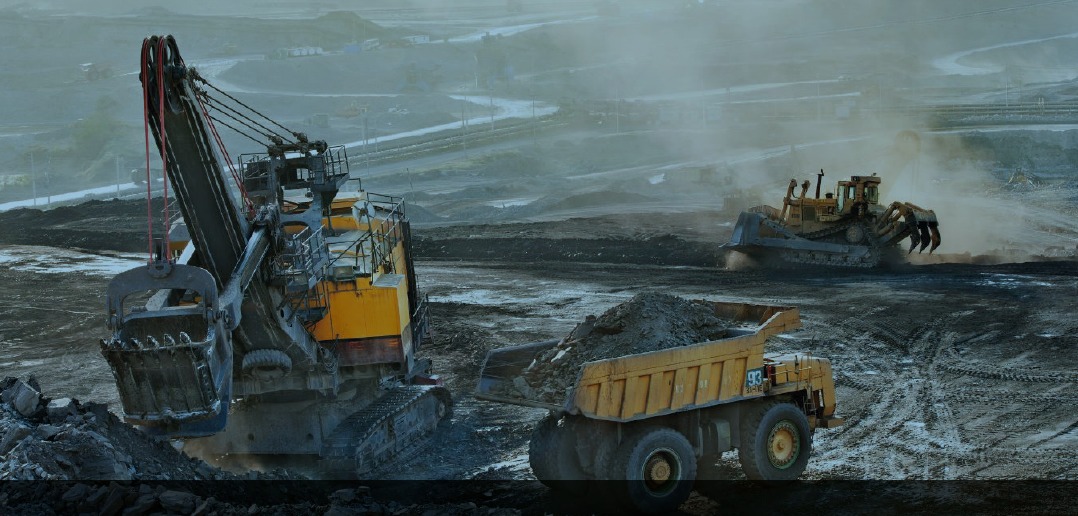
In Kazakhstan, approximately 75% of electricity is generated by burning coal, primarily at 37 combined heat and power (CHP) plants that rely on domestic fuel from the Ekibastuz, Karaganda, and other coal basins. The resulting emissions of SO₂, NOₓ, CO₂, particulate matter, ash, heavy metals, and organic compounds contribute to smog formation, acid rain, and ozone layer depletion. Sulfur dioxide is particularly toxic and has a severe impact on the respiratory system.
At the national level, the government is considering converting CHP plants and industrial facilities to natural gas. While this does reduce emissions, it does not fully resolve the issue. For instance, CHP-2 in Almaty currently emits over 37,000 tons per year, and even after switching to gas, emissions would still remain at around 2,000 tons annually — with conversion costs exceeding 300 billion tenge. Given the lower heating value of gas and rising energy prices, the transition is accompanied by increased tariff pressure on the population.
Thus, phasing out coal will require enormous investment and, in many cases, will be technically and economically challenging due to logistical and infrastructure constraints.
Meanwhile, coal remains the most accessible and strategically important resource: Kazakhstan ranks 8th in the world in proven reserves, with approximately 34 billion tons. This ensures long-term energy security and allows for the continued use of existing infrastructure.
However, as cities expand, CHP plants are increasingly located within urban areas, exacerbating both environmental and social issues. Relocating such facilities requires substantial investment, and increased distances for heat and electricity transmission lead to higher end-user costs.
Under these circumstances, the most rational approach is not to abandon coal altogether, but to implement modern integrated gas cleaning systems capable of reducing emissions to levels comparable to those of green energy. This offers a realistic path toward reducing the harmful impact on public health while preserving the resilience of the national energy system.
And there is a solution. As part of a project for the commercialization of the Results of Scientific and/or Scientific-Technical Activities, co-financed by the Science Fund and Kazakh-British Technical University JSC, a production facility for Integrated Cleaning Systems (hereinafter ICS) has been established at the D.V. Sokolsky Institute of Fuel, Catalysis and Electrochemistry JSC (hereinafter referred to as “the Institute”). These systems are based on domestically produced catalytic converters for neutralizing toxic components of emissions from vehicles and industrial facilities, using a unique, proprietary, and patented technology.
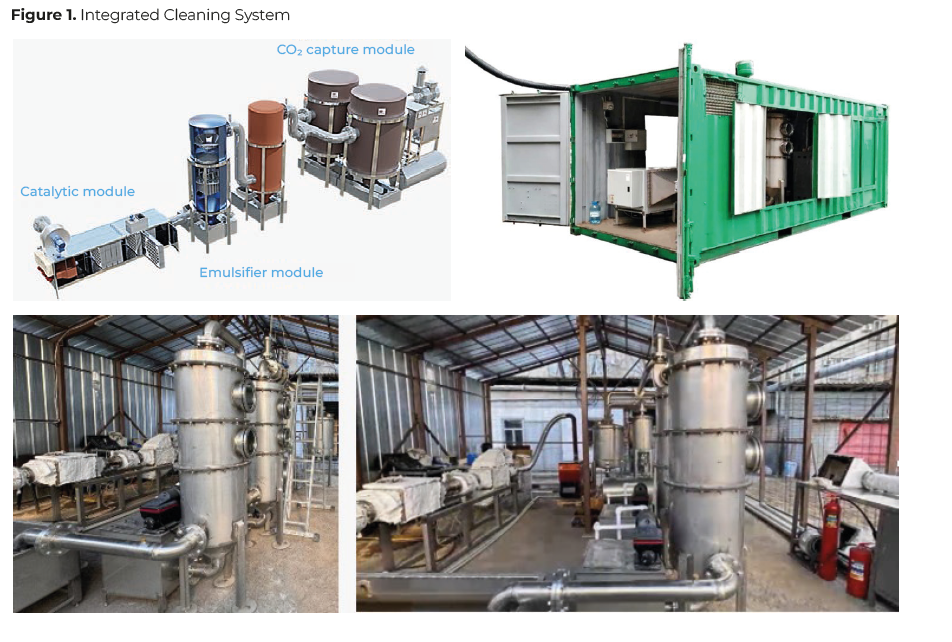
Integrated gas cleaning enables the removal of both particulate matter and harmful gases from flue gases using a variety of methods: liquid absorption (absorption), solid material capture (adsorption), catalysis, and reagent treatment. At coal-fired CHP plants, the best results are achieved through a combination of wet scrubbing with specialized filters and catalysts. Modern battery emulsifiers are particularly effective — compact units with no moving parts that provide efficient mixing of gas and reagent. However, after such treatment, additional processing (e.g., reagent-based) is often required to eliminate residual gases. In addition to cleaning, waste processing is also important. For example, dry ash can be reused in construction, which is not the case with wet ash. In Kazakhstan, existing systems often focus only on dust removal and do not address the full range of pollutants. The modular configuration is seen as the most effective solution, allowing for the use of multiple treatment technologies tailored to particular conditions.
As part of the development of the Integrated Cleaning System (ICS), an extensive set of studies was conducted, including theoretical calculations and experimental testing aimed at improving the efficiency of flue gas treatment. The design of the neutralizers was optimized to reduce gas-dynamic resistance, and catalysts based on platinum and 3d-metals (vanadium, cobalt) were developed, offering high thermal stability and regenerability. Active phases capable of removing up to 90% of NOx were created, and the properties of aerogels were investigated as promising catalyst supports. Modules for absorption, catalysis, and adsorption were designed and calculated, including scrubber-emulsifiers and CO₂ adsorbers with NaX zeolite. The ICS system was implemented using a modular approach, allowing it to be tailored to specific facilities — from large-scale CHP plants to mobile units. Balance and design calculations were carried out for gas flow rates of 500 m³/h, providing a foundation for scaling up and industrial implementation.
Catalytic blocks for neutralizing harmful components in flue gases are installed into industrial exhaust systems using patented universal mounting assemblies, and the designs of the multi-module ICS units are also protected by patents. In parallel a digital twin of the ICS is being developed as a virtual model that visualizes all stages of the purification process based on mathematical calculations. This system not only facilitates real-time monitoring and control but also enables equipment performance forecasting, efficiency optimization, and failure prevention. The use of digital twins in gas purification and CO₂ capture opens up new possibilities for optimizing industrial processes, reducing emissions, and achieving environmental sustainability.
The development of the ICS applied advanced global approaches similar to those used by Mitsubishi Power (Japan), taking into account experience gained during meetings held by our specialists. At the same time, a key principle was the adaptation of the technology using available local materials and engineering solutions.
The products of the country’s only production facility, while matching the quality of foreign analogues, are designed for the purification of gaseous emissions from toxic and harmful components and make it possible to substitute expensive imported equipment.
The ICS consists of several independent stages, each differing in function, design, and operating principle. These stages can be configured based on the specifics of the industrial facility where the system is to be installed, the customer’s requirements, and the desired level of purification, following a modular approach. The ICS can be used with any thermal equipment that generates energy through combustion, including in mobile configurations.
Each stage removes a specific set of harmful components from the emissions.
The full ICS configuration is designed to remove harmful components from gaseous emissions, including particulate matter, CO, NO, NO₂, CₓHᵧ, and SO₂.
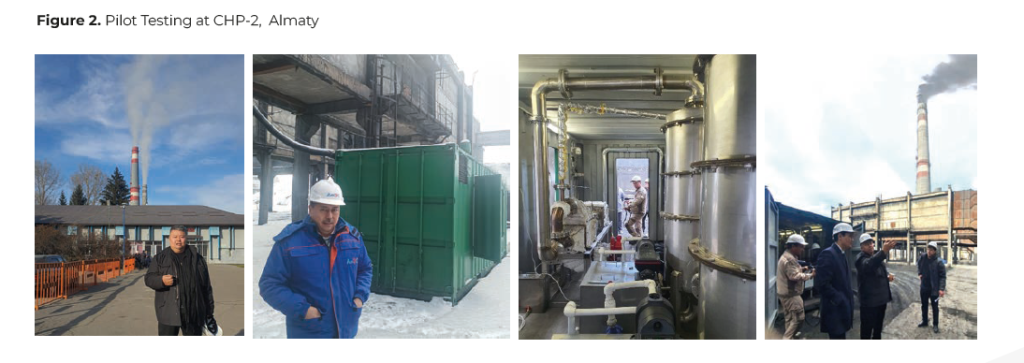
Pilot testing of the ICS conducted at CHP-2 in Almaty demonstrated high efficiency and a high degree of purification.
The integration of a CO₂ capture module, which is currently being developed by Institute scientists using a sorbent produced through a unique, proprietary, patented technology involving ash, creates a unique opportunity to position coal as an environmentally safe resource and potentially redefine it as a “green” energy source. This opens up strategic prospects for the sustainable development of Kazakhstan’s energy sector.
Carbon dioxide can be converted into a wide range of valuable compounds: methanol and dimethyl ether as alternative fuels; sulfonates and carbonates for the chemical industry; polycarbonates and polymers for the production of next-generation plastics; and can also be used in agrotechnologies to stimulate the growth of biomass and microalgae, followed by the production of biofuels and protein concentrates. The disposal of CO₂ through its transformation into valuable materials assigns economic value to emissions, effectively converting a waste stream into a resource. This approach enables not only carbon capture, but also the complete closure of the carbon cycle, integrating decarbonization into a circular economy and supporting the transition toward a carbon-neutral future.
As the domestic exhaust gas cleaning technology is scaled up, it is planned to undergo continuous modernization and automation aimed at further reducing operating costs and improving energy efficiency. This will both enhance the precision and stability of the cleaning process and enable real-time system control, which is especially important under variable operating conditions at industrial facilities.
Widespread implementation of the facility’s products, saving trillions of tenge in public spending, will make it possible to nearly eliminate atmospheric pollution.
The solution to the main environmental problems is clear: the key measure is to ensure the installation of these domestic cleaning systems on ALL pollution sources and to prohibit the operation of equipment with malfunctioning purification systems.
Israel to build its largest-ever solar power plant in the Negev desert
Solar pensions and wind dividends: how South Korea is turning renewables into a rural development tool
Kyrgyzstan announces tender for land plots for construction of six small hydropower plants
ADB to invest $70 billion in Asia's power grids and digital infrastructure
Kazakhstan and World Bank discuss energy integration in Central Asia
Construction of 500 MW wind power plant begins in Karaganda region
50 MW solar power plant auction winner determined in Kazakhstan's Southern Grid Zone
Rooftop solar panels: Kyrgyzstan prepares rules for households and businesses
Europe’s rising heat: Can renewables provide the solution?
Winner announced for 100 MW solar auction in Kazakhstan
Chinese company ready to invest $1 billion in solar and wind generation in Kyrgyzstan
Meta to invest in space solar energy and ultra-long-duration energy storage
Tokyo pushing plan for world’s biggest floating wind power farm
Kazakhstan cancels 50 MW solar auction due to lack of participants
Tokayev ratifies Green Energy Corridor Agreement with Azerbaijan and Uzbekistan
China raises RES share to 60% of total installed capacity
Batys Kaspiy Energo wins auction for 250 MW wind farm in Atyrau region
Ember: Renewables overtake coal in global power generation for the first time
Kazakhstan continues accepting applications for May RES auctions
Water-energy balance of the region discussed by ministers of four Central Asian countries