

International experience14.09.2025
Current Status, Challenges and Opportunities for China-Central Asia Renewable Energy Investment and Financing Cooperation: A Case Study of Kazakhstan and Uzbekistan



Zijun Jiang, Program Officer, Greenovation Hub

Yingjie Chen, Program Manager, Greenovation Hub

Hongyu Guo, Deputy Director, Greenovation Hub
Amid the escalating global climate crisis, accelerating clean energy transition has become a widely shared international priority. Over the past decades, the landscape of global energy investment has shifted dramatically, with clean energy investments continuing to outpace fossil fuels. According to the International Energy Agency (IEA), global energy investment is set to rise to USD 3.3 trillion in 2025, with twice as much investment in clean energy as in fossil fuels. Despite this encouraging trend, two major imbalances persist. First, developing countries remain largely on the margins of global climate finance. In 2023, only 15% of global renewable energy investment flowed to 120 developing countries, with Sub-Saharan Africa receiving less than 1.5%. Second, investment in power grids lags significantly behind the rapid deployment of solar and wind energy, creating critical bottlenecks for integrating renewable energy into energy systems.
Developing countries play a critical role in this transition, yet fully unlocking their renewable energy potential requires strong international support in financing, technology, and capacity building. Kazakhstan and Uzbekistan, two key developing economies in Central Asia, are experiencing rapid urbanization and industrialization while facing significant climate vulnerability. Promoting a green and just energy transition in these countries is essential — not only to curb greenhouse gas emissions and reduce fossil fuel dependence, but also to drive green economic growth and advance more inclusive, sustainable socio-economic development. Nevertheless, both countries face considerable challenges in meeting their low-carbon transition goals. These include high domestic financing costs, aging grid infrastructure, policy and regulatory uncertainties, underdeveloped market mechanisms, and a shortage of skilled professionals.
In recent years, China has deepened green energy cooperation with Kazakhstan and Uzbekistan. Under the framework of the Belt and Road Initiative, China and the two countries have established intergovernmental strategic alignment mechanisms and signed several bilateral agreements covering renewable energy cooperation. Multilateral platforms such as the Shanghai Cooperation Organization (SCO), China-Central Asia Summit, and CAREC have further facilitated policy dialogue, technical exchange, and financial coordination. Meanwhile, Chinese policy banks, commercial lenders, and green tech firms are expanding their presence in Central Asia, boosting investment and technology transfer to support the region’s low-carbon transition.
As demand for renewable energy and green finance continues to grow in both countries, there is an urgent need to refine and adapt China’s investment and financing models to better align with local market dynamics and project realities. Drawing on case studies of Kazakhstan and Uzbekistan, this research examines the key challenges and opportunities in China’s renewable energy engagement and offers targeted policy recommendations to strengthen China-Central Asia cooperation in the sector.

ENERGY STRUCTURE
Energy structure: In Kazakhstan, the primary energy mix relies heavily on fossil fuels, characterized by high carbon intensity and significant export dependence. In 2022, coal accounted for 50.5% of the country's total primary energy supply, while oil and natural gas each contributed approximately 25%, and hydropower made up 1.1%. The energy sector is responsible for roughly 85% of its total carbon emissions, with electricity and heating systems alone contributing over half of the CO₂ output. Kazakhstan’s carbon intensity per unit of GDP is about 70% higher than the global average. Export dependency is also significant — over 54% of energy production is exported, and oil and gas exports contribute around 20% of GDP. In 2023, the final energy consumption mix was led by petroleum products (33.5%), followed by coal (19.4%), natural gas (16.7%), thermal energy (15.3%), and electricity (15.0%), highlighting considerable potential for greater electrification. End-use energy consumption was concentrated in the residential (35.7%), industrial (26.4%), and transport (23.2%) sectors.
POWER STRUCTURE Power structure: Kazakhstan's power sector remains heavily dependent on fossil fuels, with around 70% of its electricity coming from aging coal-fired plants. While the energy mix has historically been dominated by thermal and hydropower, it is now gradually diversifying, with non-hydro renewable energy steadily expanding — though its share remains relatively small. As of early 2024, the country operates 222 power plants with a total installed capacity of approximately 24.6 GW. Thermal power constitutes approximately 78% (19.2 GW), followed by wind power at 5.7% (1.4 GW), solar PV at 4.9% (1.2 GW), and hydropower at 11.4% (2.8 GW).
GRID, ENERGY STORAGE AND RENEWABLE ENERGY EQUIPMENT MANUFACTURING
Grid, energy storage and renewable energy equipment manufacturing: Kazakhstan’s power grid consists of interconnected northern and southern zones linked by three 500 kV transmission lines, along with an isolated western zone. Due to uneven distribution of energy resources and load centers, there is a clear mismatch between regional supply and demand, placing pressure on cross-regional power dispatch. The grid also suffers from high transmission losses (around 8%) and limited peak-shaving flexibility. Energy storage remains in the early stages of development, limited to small-scale pilot and demonstration projects. Large-scale, utility-grade storage systems have yet to be deployed, and the country lacks a mature regulatory framework and technical standards to support their rollout. Kazakhstan’s renewable energy equipment manufacturing industry is still nascent, with an underdeveloped supply chain. Most wind and solar components rely heavily on imported technologies and equipment, reflecting limited domestic production capacity.
NDCS AND RE TARGETS NDCs and RE targets: Kazakhstan has committed to unconditionally reducing greenhouse gas emissions by 15% from the emissions of 1990 by 2030, with a potential reduction of up to 25% contingent on international support. To support its climate ambitions, Kazakhstan aims to increase the share of renewable energy in power generation to 6% by 2025, further raise it to 15% by 2030, and achieve 50% from renewable and alternative energy sources by 2050. The country has already surpassed its 2025 target ahead of schedule, with renewable energy accounting for 6.67% of total power generation in the first nine months of 2024.
Energy structure: Uzbekistan’s primary energy production remains heavily reliant on fossil fuels, with natural gas accounting for 88% of total output in 2022, followed by crude oil (6.8%), coal (3.9%), and hydropower (1.2%). Wind and solar energy have yet to reach large-scale deployment. Fossil fuels continue to serve as a cornerstone of the national economy, with the oil, gas, and related sectors contributing around 16% to GDP in 2020. However, the sector faces growing challenges. Declining production—driven by lagging exploration, aging infrastructure, and depleted reserves—has been compounded by rising domestic energy demand and regional geopolitical pressures. As a result, Uzbekistan has gradually shifted from being a net energy exporter to a net importer, underscoring the urgency of accelerating its energy transition and diversifying its energy mix.
POWER STRUCTURE Power structure: Uzbekistan’s power sector is predominantly fueled by natural gas, which supplied approximately 82% of electricity generation in 2022. Renewable energy accounted for around 10% of the mix, with hydropower contributing more than 90% of that share. Several large-scale solar PV projects are scheduled to come online around 2024, which is expected to significantly increase the share of renewables in the country’s power generation.
Grid and energy storage: Uzbekistan’s power system is highly centralized and suffers from severe infrastructure aging. Over 60% of equipment across transmission lines, distribution networks, substations, and transformers has exceeded its designed operational lifespan. This deterioration contributes to significant technical losses—2.72% in transmission and 12.47% in distribution—undermining grid reliability, operational efficiency, and the system’s ability to accommodate variable renewable energy. To address these challenges and support renewable energy integration, energy storage deployment has emerged as a strategic priority in Uzbekistan’s energy transition. However, the sector remains in its infancy and is largely dependent on imported technologies and equipment.
NDCS AND RE TARGETS
Uzbekistan updated its NDC in 2021, aiming to cut GHG emissions per unit of GDP by 36% from 2010 levels by 2030. To support its climate ambitions, the country aims to increase the total installed capacity of solar and wind power to 8 GW by 2026 and further expand to 27 GW by 2030, with these sources accounting for over 40% of total power generation. As of 2023, Uzbekistan's total installed capacity of renewable energy reached approximately 2.7 GW, representing 15% of the country's total, with hydropower accounting for 91% and solar power 9%.
OVERVIEW OF RENEWABLE ENERGY INVESTMENTS AND FINANCING COOPERATION BETWEEN CHINA AND CENTRAL ASIA
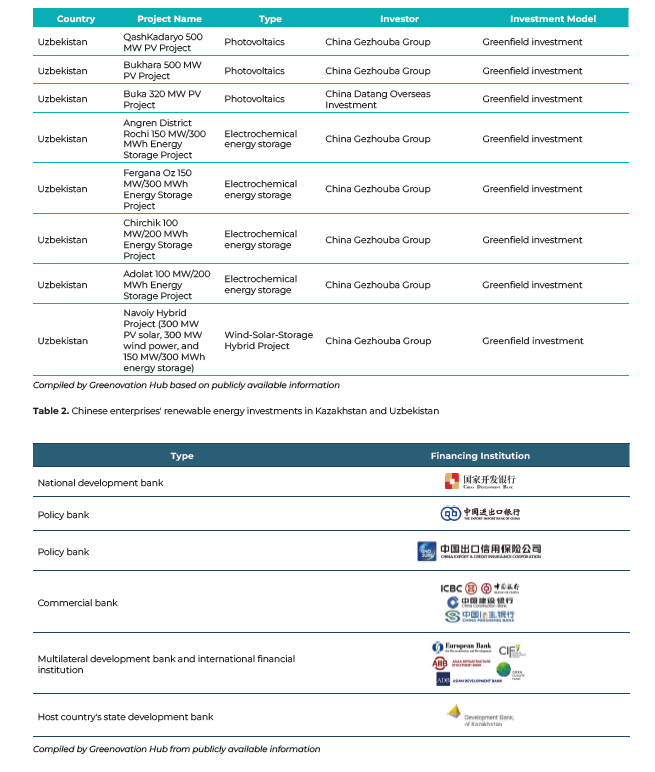
China is one of the largest trading partners and sources of foreign investment in Central Asia. Under the strategic alignment between governments and multilateral cooperation mechanisms, such as the China-Central Asia Summit, the Shanghai Cooperation Organization, and the Central Asia Regional Economic Cooperation (CAREC), countries in the region have identified clear cooperation goals, priorities, and frameworks in the renewable energy sector. Under the framework of the Belt and Road Initiative (BRI), China has upheld the principles of extensive consultation, joint contribution, and shared benefits, actively engaging in the investment and financing of renewable energy projects in Kazakhstan and Uzbekistan. This has led to the formation of a diversified financing ecosystem guided by government cooperation and driven by market-based capital. Chinese companies have evolved from early-stage roles focused on equipment exports and EPC contracting to engaging in greenfield investments and mergers and acquisitions. Financing models have also diversified beyond traditional bank loans, incorporating innovative approaches such as BRI green bonds, non-recourse project financing backed by Sinosure export buyer's credit, commercial bank-led lending with Sinosure credit enhancement, multilateral syndicated loans, and offshore treasury centers of state-owned enterprises. These innovations have helped reduce project risks and capital costs. The range of participating actors has also expanded. In addition to large state-owned power companies, several technologically advanced and operationally agile private firms have become actively involved in solar, wind, energy storage, and smart grid projects, injecting sustained momentum into the region’s green energy transition.
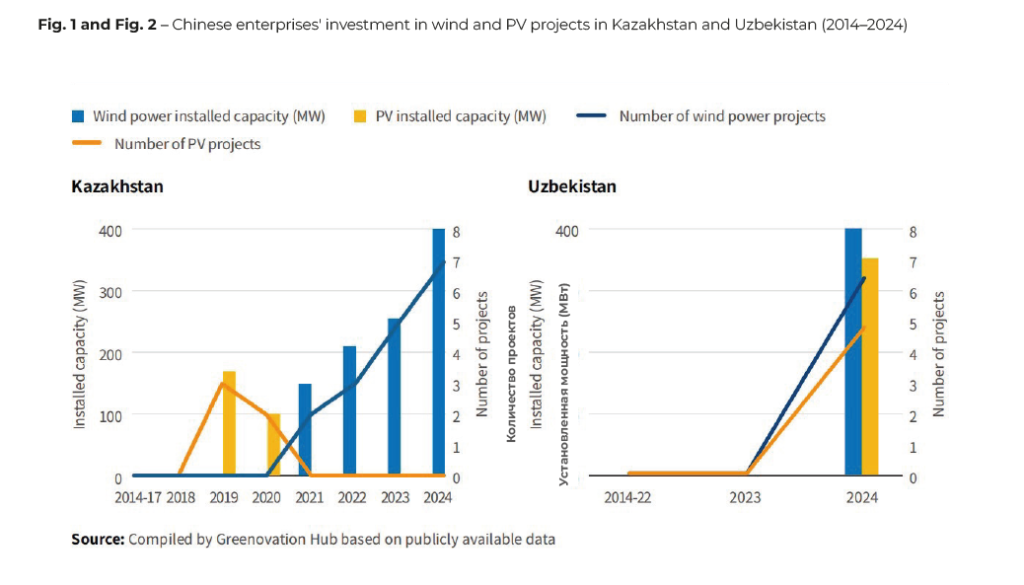
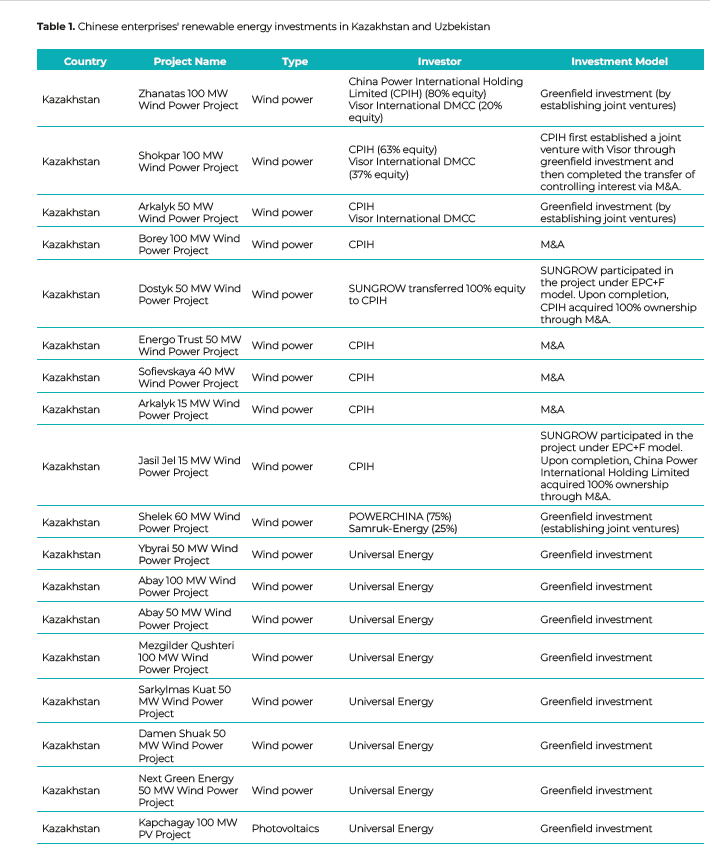
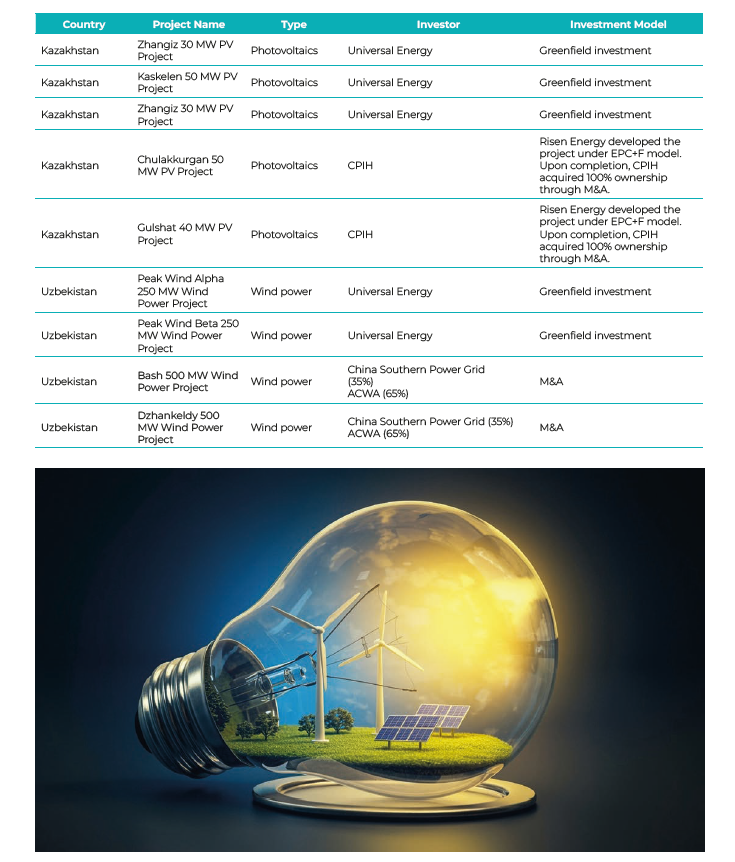
According to Greenovation Hub’s analysis of publicly available data, between 2014 and 2024, Chinese companies participated in 29 solar and wind power projects—either under construction or already in operation—in Kazakhstan and Uzbekistan through greenfield investments and acquisitions, with a total installed capacity of approximately 4,120 MW. In Kazakhstan, private enterprises dominate solar and wind development, while in Uzbekistan, state-owned companies hold a clear lead in both project count and capacity. Geographically, Chinese companies’ total installed and under-construction capacity is estimated at around 1,300 MW in Kazakhstan and 2,820 MW in Uzbekistan.
China raises RES share to 60% of total installed capacity
Batys Kaspiy Energo wins auction for 250 MW wind farm in Atyrau region
Ember: Renewables overtake coal in global power generation for the first time
Kazakhstan continues accepting applications for May RES auctions
Water-energy balance of the region discussed by ministers of four Central Asian countries
Just transition: leaving no one behind in the energy transformation
CAREC and Central Asian universities sign new memoranda on green skills development
Kazakhstan and UNECE discuss energy resilience and low-carbon technologies
100,000 jobs and a skills gap: how Central Asia is preparing for the renewables boom
No transition without transmission: How Central Asia is building its energy future
ADB to invest $5.5bn across 15 projects in Kazakhstan
17 agreements worth over $2.3 billion signed at the opening of RES 2026 EXPO in Astana
World Bank to invest $1bn in Central Asia's energy integration
Kazakhstan and China to launch a 500 MW wind farm in Karaganda region
Kazakhstan and Tajikistan move toward clean power deal over Rogun HPP
Regional Ecological Summit 2026 opens in Astana
Solar pumps and drip irrigation help Kyrgyz farmers cut costs amid rising energy prices
Hormuz closure failed to trigger coal comeback as solar and wind filled the gap
Astana set to launch RES 2026 EXPO and ink key international deals
Central Asian countries to discuss energy transition at RES 2026 in Astana