

International experience14.09.2025
Development of battery energy storage system (BESS): International Experience




Timur Shalabayev, Executive Director of "Qazaq Green" RES Association
BESS are expected to play a key role in ensuring the stability and flexibility of energy systems as the use of renewable energy sources continues to expand. At the COP28 climate summit held in Dubai in 2023, around 200 countries agreed to achieve net-zero emissions in the energy sector by 2050, to transition away from fossil fuels, to triple renewable energy capacity, and to double the rate of improvement in energy efficiency by 2030.
Kazakhstan is part of this global trend. The country has set a goal of achieving carbon neutrality by 2060. According to the approved five-year auction schedule, a total capacity of 6.7 GW has been offered for bidding. As a result of the auctions held, 592 MW are planned to be commissioned by the end of 2027. To support these energy transition goals, an Action Plan for the Development of the Electric Power Industry of the Republic of Kazakhstan until 2035 has been adopted. It is worth noting that the implementation of this document also envisions the commissioning of large-scale “gigawatt-class” renewable energy projects. These are wind power projects of 1 GW each, combined with 300 MW energy storage systems, developed in cooperation with companies such as TotalEnergies, Masdar, ACWA Power, China Power, and Hevel (which is implementing a hybrid wind and solar power plant). As a result, the installed capacity of energy storage systems in Kazakhstan could exceed 1 GW over the next decade. If the Action Plan is successfully implemented, the share of renewables in the country's power system is expected to reach 24.4% by 2035.
BESS plays a critical role in strengthening energy security. Such systems enhance the stability and resilience of power grids and offer backup power solutions for households, businesses, including hospitals and other critical infrastructure. Batteries can also deliver essential services in emergency situations caused by extreme weather or other disruptions.
The global battery market doubled in 2023, reaching over 90 GWh, with the total volume of deployed batteries increasing by more than 190 GWh. The largest growth in battery sales was observed in utility-scale systems, while behind-the-meter batteries accounted for 35% of the annual increase in 2023. Standalone battery systems currently remain at much smaller volumes. BESS of all sizes are well-suited to provide short-term flexibility, shifting energy over the course of seconds, minutes, or a few hours, but they can also deliver a broader range of services to support system operation. These include ancillary and backup services, system adequacy support, and congestion management in transmission and distribution networks. Financial incentives, including tax credits and grants, as well as requirements to pair storage with new solar or wind energy projects, are also driving the deployment of these systems. The economic viability of using batteries depends on specific circumstances and individual cases. The answer may vary from region to region, depending on the characteristics of the power system and the regulatory framework. Combining different market mechanisms by providing multiple services simultaneously can improve the economic attractiveness of BESS, but it also increases the complexity of the business case.
UTILITY-SCALE BATTERY ENERGY STORAGE SYSTEMS (BESS)
The deployment of BESS at utility scale is particularly important in power systems with a high share of renewables. These systems can store energy for 1 to 8 hours and are capable of providing peak power: they can be charged during off-peak periods with low electricity demand—for example, during peak solar photovoltaic (PV) generation in the daytime. They are discharged when electricity demand is high, such as in the evening, when solar PV systems no longer produce power. In competitive electricity markets, battery systems can monetize their potential by participating in energy arbitrage, using the advantage of tariff distribution in wholesale electricity markets through charging at low prices and discharging when prices are higher.
Thanks to their instant response capabilities, batteries are also ideal providers of ancillary services in power grids, such as frequency regulation, voltage support, and reserve management. In addition, their blackstart capability allows them to restore service after system outages.
In many European countries, particularly Germany, Sweden, and the United Kingdom, BESS have already become key providers of frequency and reserve services, supported by reforms that enabled BESS to access the relevant markets for delivering these services. In systems with a growing share of variable renewable energy and declining synchronous generation, driven by the retirement of conventional thermal power plants, there is a rising need for inertial response and short-circuit power, both of which can be provided by batteries equipped with grid-forming inverters. However, it should be noted that not all grid-forming inverters are capable of providing short-circuit current.
Providing ancillary services has emerged in recent years as an important revenue stream for battery storage systems in several markets worldwide, accounting for over 15% of new project deployments annually, especially for batteries with a two-hour storage duration.
Ensuring sufficient capacity to support system adequacy is also becoming an increasingly common application of battery energy storage. Where regulations allow, participation in capacity markets enables BESS owners to secure long-term revenue streams.
In addition, batteries can help relieve grid congestion by storing excess electricity generated from renewable sources during periods of high output. This reduces the costs associated with curtailment and facilitates better integration of renewables into the power system.
When used for load management, batteries minimize the need for transmission upgrades or investments in the distribution network. This is the primary use case for so-called grid boosters in Germany, the utility-scale batteries deployed to eliminate bottlenecks in the transmission system, thereby reducing the need for additional investment to reinforce specific lines.
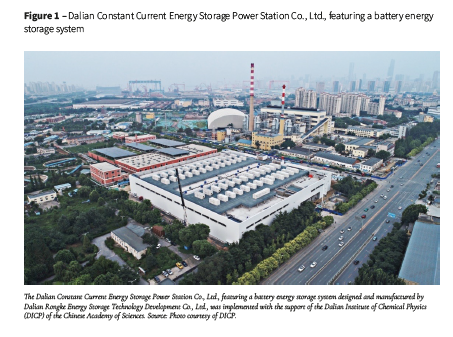
The following are various examples of how BESS are used in power systems.
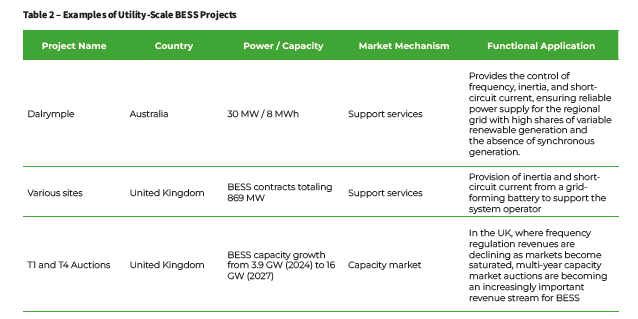
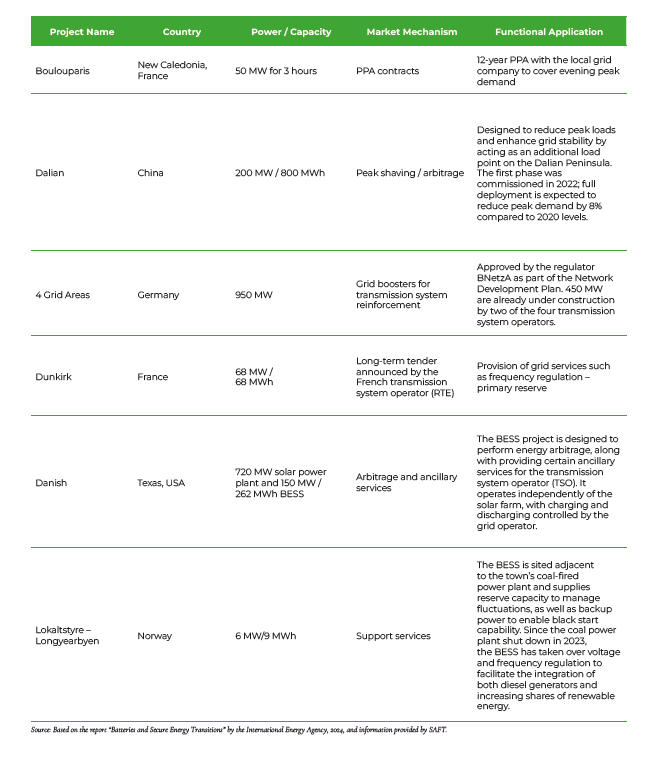
The regulatory environment and the technical specifications of power networks are key factors shaping the use of BESS. In many jurisdictions with market-based electricity systems, including the European Union, legislation imposes strict limitations on the ownership and operation of energy storage systems by transmission and distribution system operators (with the exception of certain pilot projects, such as grid boosters). As a result, any management services must be contracted out to third parties.
In the UK, local flexibility markets for distribution systems have recently been introduced. These markets are built around open public tenders, where the cost and benefits of flexibility services offered by third parties are compared to the cost of reinforcing the grid. In 2022-2023, over 30% of contracts awarded, amounting to nearly 600 MW of storage, went to such solutions. In France, transmission system operators and certain distribution system operators have recently launched local flexibility tenders open to energy storage projects. In California and New York, distribution system operators are increasingly relying on storage systems that are either co-owned or procured through power purchase agreements (PPAs) with third parties to reduce grid loads, thus avoiding or deferring costly investments in network upgrades.
Microgrids are another utility-scale application of BESS. In Australia and several U.S. states, regulatory authorities have introduced dedicated measures and programs to support the development of microgrids, often built around energy storage systems, in order to enhance the resilience of critical infrastructure such as hospitals, large industrial facilities, and services for low-income communities. Microgrids enhance system resilience by allowing operators to disconnect from the main grid through adaptive islanding during major disruptions, maintaining power supply despite the loss of the primary energy source.
Some battery technologies can also be used for multi-day storage, helping to cover extended periods of peak demand or to compensate for episodes of low renewable generation. One such example is a first-of-its-kind 100-hour iron-air long-duration battery project currently under development in California, which is being implemented as part of the state’s resource adequacy program. However, under current market structures, most grid services remain focused on short-duration storage. In the U.S., for instance, existing duration requirements for ancillary services (less than one hour) and capacity (four hours) have shaped the runtime design of most deployed storage systems, which typically operate for four hours or less.
Historically, utility-scale BESS have primarily been used for frequency regulation or shifting electricity demand over time. However, with the growing share of variable renewable energy and the limited size of ancillary services markets, energy shifting has become the dominant application for storage systems. In 2023, this function accounted for around 85% of installed BESS capacity.
In Germany, frequency support was initially the main driver behind utility-scale BESS deployment. But the emergence of new market mechanisms has created additional opportunities for their use, including innovative renewable energy tenders that combine generation with storage, the use of BESS for transmission system optimization (e.g. grid boosters), and optimization of energy consumption at industrial facilities.
If the regulatory framework allows for combining different BESS applications and accessing multiple market mechanisms, this can improve the economic viability of BESS projects and reduce reliance on limited long-term contracts (PPAs). However, achieving this requires more complex energy system management. At the same time, an increase in the number of charge-discharge cycles of BESS also accelerates battery degradation, and not all services are compatible. For instance, if a BESS is optimized for high-frequency, short-duration services, it may not perform effectively when used for longer-duration, non-frequency-based grid support functions.
BEHIND-THE-METER BATTERY ENERGY STORAGE SYSTEMS
Standalone battery energy storage systems are deployed at the distribution level and installed at residential, commercial, and industrial facilities owned by end users. These systems are typically connected directly to on-site or rooftop solar photovoltaic systems, behind the electricity meter, while the building itself remains connected to the grid. They form part of the category of distributed energy resources, which are playing an increasingly important role in the integration of renewable energy sources. These systems can deliver benefits to both consumers and the grid by reducing costs and environmental impact, while enhancing energy security and supporting the electrification of the industrial sector.
Behind-the-meter BESS provide consumers with various opportunities to reduce energy costs. By storing excess solar PV generation during the day, behind-the-meter batteries allow consumers to increase their self-consumption of rooftop solar electricity and reduce reliance on the grid. By charging during periods of low electricity prices, behind-the-meter batteries help consumers lower their electricity bills. BESS can also be used to reduce peak demand, helping consumers save on electricity costs during high-demand periods.
In addition, individual BESS units installed at the household level can be aggregated into so-called virtual power plants (VPPs) and participate in electricity markets. VPPs combine distributed energy resources, including behind-the-meter BESS, distributed renewable generation, and flexible loads, and dispatch them as a single electricity source. To form a virtual power plant, each distributed energy resource must be connected to a centralized control system that optimizes their collective operation and responds to market signals and grid operator instructions. Where market regulations allow, VPPs can sell electricity at wholesale prices, provide ancillary services, and support energy security through capacity services. VPPs also have the ability to respond flexibly to local grid constraints by adjusting the output of individual energy resources within the network. This makes them a potentially valuable tool for relieving congestion in transmission and distribution systems.
In addition to cost-saving benefits, behind-the-meter BESS can enhance the reliability of power supply by providing backup electricity during unplanned outages, an especially critical function for industrial facilities, social infrastructure (such as hospitals), and vulnerable consumers with uninterrupted power needs.
From a system-wide perspective, behind-the-meter BESS can deliver many of the same benefits as utility-scale systems. With the right signals and incentives in place, they can help reduce overall grid demand, alleviate pressure on the network by limiting peak loads, and provide capacity reserves.
However, compared to utility-scale BESS, behind-the-meter storage systems operate at a local level, which can create opportunities to defer distribution network upgrades or expansion. When aggregated into virtual power plants, behind-the-meter BESS can also provide ancillary services such as frequency regulation, voltage support, and reserve capacity. However, the extent to which behind-the-meter systems can benefit from such deployment largely depends on the regulatory framework, particularly on how end-user tariffs are structured and market access rules for aggregators. It is also influenced by the extent to which smart metering systems have been adopted.
Israel to build its largest-ever solar power plant in the Negev desert
Solar pensions and wind dividends: how South Korea is turning renewables into a rural development tool
Kyrgyzstan announces tender for land plots for construction of six small hydropower plants
ADB to invest $70 billion in Asia's power grids and digital infrastructure
Kazakhstan and World Bank discuss energy integration in Central Asia
Construction of 500 MW wind power plant begins in Karaganda region
50 MW solar power plant auction winner determined in Kazakhstan's Southern Grid Zone
Rooftop solar panels: Kyrgyzstan prepares rules for households and businesses
Europe’s rising heat: Can renewables provide the solution?
Winner announced for 100 MW solar auction in Kazakhstan
Chinese company ready to invest $1 billion in solar and wind generation in Kyrgyzstan
Meta to invest in space solar energy and ultra-long-duration energy storage
Tokyo pushing plan for world’s biggest floating wind power farm
Kazakhstan cancels 50 MW solar auction due to lack of participants
Tokayev ratifies Green Energy Corridor Agreement with Azerbaijan and Uzbekistan
China raises RES share to 60% of total installed capacity
Batys Kaspiy Energo wins auction for 250 MW wind farm in Atyrau region
Ember: Renewables overtake coal in global power generation for the first time
Kazakhstan continues accepting applications for May RES auctions
Water-energy balance of the region discussed by ministers of four Central Asian countries