

Industry News01.02.2025
"Green" construction in Kazakhstan: a step towards a sustainable future and achieving the SDGs


Alexander Bely, KazGBC Executive Director

Aiman Shopayeva, KazGBC Technical Director

Zhamya Saimbetova, KazGBC Communications Manager
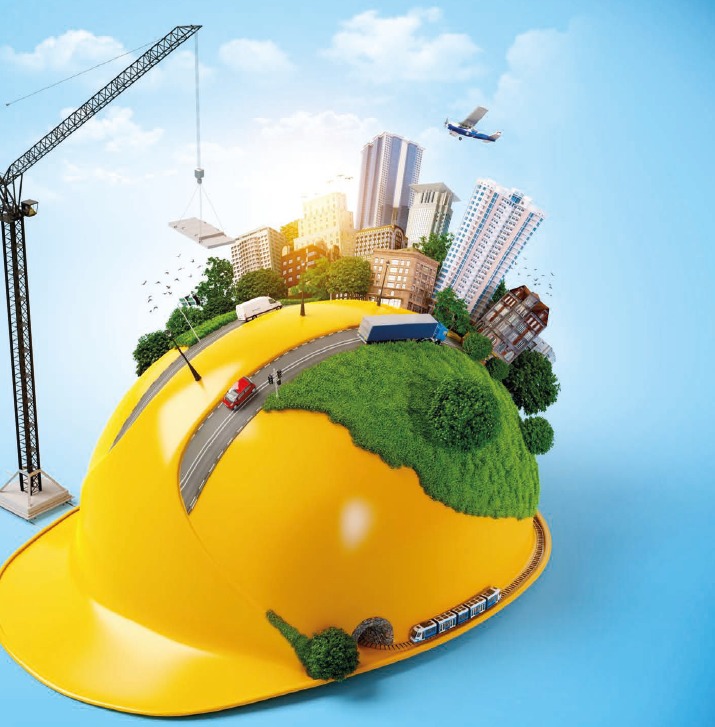
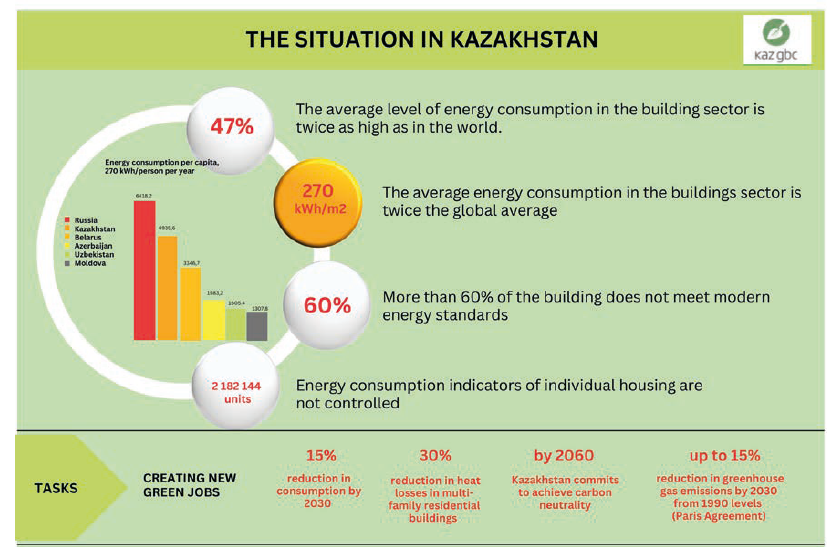
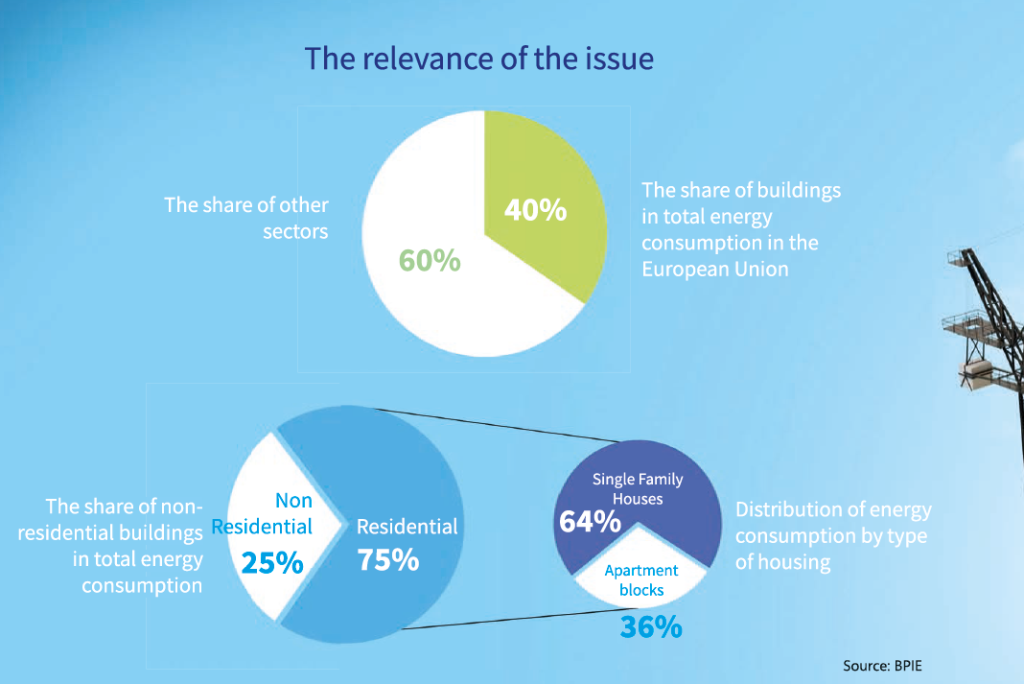
According to the Bureau of National Statistics of the Republic of Kazakhstan, the total area of the housing stock in 2023 amounted to 419 058.1 thousand square meters, which is 13 899.5 thousand square meters more than in 2022. This year, these indicators are also projected to increase due to population growth. Moreover, this applies not only to residential real estate, but also commercial, office, public buildings and infrastructure facilities. The growing level of construction, like any other type of activity, is associated with the impact on the environment and consumption of resources, primarily energy. In Kazakhstan, buildings and their operation consume up to 45% of energy, which leads to a serious burden on the environment and an increase in the carbon footprint. As part of the Paris Climate Agreement, adopted in 2015, Kazakhstan committed to achieve carbon neutrality by 2060. This arises the logical question: what measures should be taken to decarbonize the economy without reducing the pace of construction? One of the solutions may be "green" construction.
The Kazakhstan Green Building Council (KazGBC) has been successfully operating in Kazakhstan for ten years. This non-profit organization operates under the World Green Building Council (WorldGBC) and is designed to promote and implement green building practices and methods in Kazakhstan. The organization is actively working on certification of buildings, development and improvement of the Kazakh standard of "green" construction, as well as training specialists in this field. One of the great successes of the organization was the introduction of the Kazakhstan OMIR building environmental assessment system. This is the Kazakhstan standard of "green" construction, created by professionals and experts of the architectural and construction industry, world-renowned specialists with the support of WorldGBC and UNDP. The OMIR standard has incorporated the best criteria from the world-famous LEED and BREEAM green building standards and has been adapted to the Kazakh market, taking into account the climatic, social and economic characteristics of the country. OMIR has a number of advantages for Kazakhstani users, such as language accessibility, adaptation to the local market and legislation, affordable certification and the availability of more accredited specialists in the country.
"Green" construction is the concept of designing and constructing sustainable and energy-efficient buildings, the methods of which minimize the negative impact on the environment and improve the quality of life of people. Such construction is aimed at creating energy-efficient, environmentally friendly and healthy buildings for living. "The key criteria of "green" building are saving water, energy, heat, prevention and timely prevention of water and heat loss. The maximum use of local materials and their environmental friendliness are also important. The safe radiation background of the building, the correct choice of the construction site, and a high class of energy efficiency are also priority indicators," - explains Alexander Bely, Executive Director of the Kazakhstan Green Building Council KazGBC.
Over the years, OMIR has established itself as an effective, reliable and thoughtful standard for "green" construction, which can also serve as one of the tools fora country to achieve the UN SDGs. OMIR covers key aspects: energy efficiency, waste minimization, resource savings, improvement of the quality of the building's internal environment and much more. These indicators meet 11 of the 17 Sustainable Development Goals. For example, the OMIR standard can contribute to the achievement of goal No. 6 "Ensure availability and management of water and sanitation for a II", the standard focuses on water conservation, and goal No. 7 "Ensuring access to affordable, reliable, sustainable and modern energy sources for all" is reflected in the Energy section. This section provides the maximum number of points to certified facilities, and also includes high points for renewable energy sources, which indicates the commitment of the standard to the principles of decarbonization.
SDG13 "Taking urgent measures to combat climate change and its consequences" should also be noted. June 2024 was the hottest in the history of observations on the planet. "Green" construction can become one of the key tools in the fight against climate change. Green buildings significantly reduce carbon dioxide emissions through energy-efficient technologies, while reducing the carbon footprint of the building. Using natural solutions such as green roofs and vertical gardens helps improve rainwater management and reduces the risk of flooding in cities. In addition, "green" buildings reduce dependence on external energy networks through the integration of renewable energy sources.
The Sustainable Development Goa Is are somehow related to responsible consumption of resources and conservation of ecosystems. The construction sector is a big consumer of materials, so the attitude to building materials in eco-construction is also special. It is a mistake to believe that all natural materials can be immediately classified as "green". "In the world, the environmentaI friend I i ness of buiIding materiaIs means not only the origin, but aIso the amount of energy spent on the extraction of raw materials and the production of this building material. Developed countries are switch) ng to eco-friendly materials, for example, eco-concrete produced using environmentally friendly components and technologies,"- notes Aiman Shopayeva, Technical Director of KazGBC.
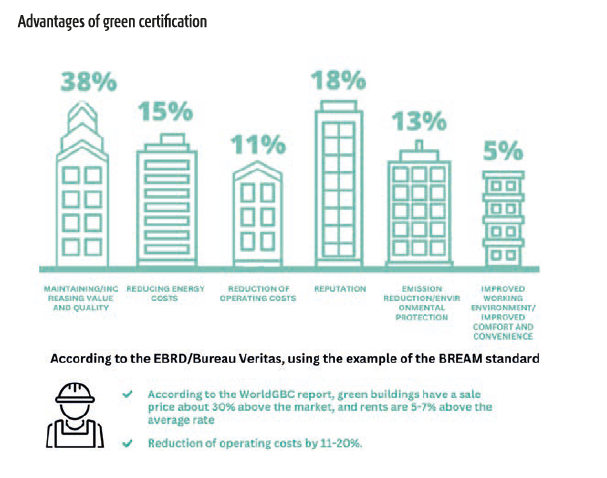
OMIR standard helps to create buildings that not only meet high environmental requirements, but also provide savings on operating costs. This standard also stimulates the growth of the market for qualified specialists and creates new jobs in the field of eco-construction. The next major area of work of the Kazakhstan Green Building Council is the training of specialists and experts in this field. The Council conducts training, then accredits specialists who have successfully passed the ОМ IR standard examination. Over the years, KazGBC has proudly certified 100 professionals and 9 green building experts of "green" construction, who have key skills and knowledge and can be useful in the eco-building industry.
Of course, during this time, Kazakhstan has its own leaders of "green" construction. These are construction and design companies, developers, consulting firms and suppliers of "green" materials, which make a great contribution to the development of "green" construction, actively applying its methods and principles in their area of activity.
For example, the construction company BAZIS-A has certified the largest number of its facilities (18 residential complexes) in Kazakhstan today. Many of the company's facilities have received OMIR gold certificates. The consulting firm Bureau Veritas Kazakhstan with activities closely related to sustainable development services for businesses, is also actively promoting the "green" certification of buildings. It was in cooperation with Bureau Veritas Kazakhstan that the assessment of the largest shopping malls in Kazakhstan was successfully carried out in this October. It is also worth noting the Aruna City residential complex in Astana, which was the first in Kazakhstan to place the "green" marking "OMIR" on its facility. This is a special label about receiving the certificate of compliance with "green" construction. Aruna City has an OMIR gold certificate, and its label is located in the sales office of this residential complex.
In matters of labeling "green to the OMIR system, it is also necessary to highlight the Dostyk Plaza and Shymkent Plaza shopping malls, owned by the TSPG investment fund, which placed OMIR label first among retail facilities, thereby setting an example of the need for "green" certification for commercial facilities as a symbol of commitment to sustainable development and environmental protection. Among the regional companies that are successful in "green" construction, developers Kanfar Building and Ontustik Kurylys Service can be distinguished, which build high-quality and energy-efficient residential buildings in Shymkent, observing the principles of "green" construction. International cooperation plays an important role in the issues of "green" construction. In 2024, KazGBC provided support in preparation of the Azerbaijani standard for "green" construction, which was developed using OMIR approaches, incorporating existing effective tools and methodologies of the Kazakh standard, which indicates its high appreciation and relevance. This work was carried out within the framework of the Agreement on Cooperation in the field of national standards of "green" construction "Central Asia - Caspian - Caucasus".
KazGBC has concluded a number of other international agreements and memoranda, within the framework of which cooperation is conducted in the field of "green" construction. Council also tries to actively work with government agencies, local executive authorities and local communities in Kazakhstan. This activity of KazGBC is in line with SDG 17 "Strengthening the means of implementation and enhancing work within the framework of the Global Partnership for Sustainable Development". OMIR standard contributes to the creation of effective partnerships to achieve sustainable solutions at all levels both within Kazakhstan and abroad.
Thus, the promotion of "green" construction in Kazakhstan opens up opportunities for sustainable and long-term development, reduces costs and improves the quality of life of citizens. After all, "green" buildings are primarily buildings for human health and comfort, not only in the present, but also with great investment for future generations. Kazakh standard of "green" construction OMIR is becoming a real prospect for Kazakhstan and an important tool for achieving a sustainable future.
Winner announced for 100 MW solar auction in Kazakhstan
Chinese company ready to invest $1 billion in solar and wind generation in Kyrgyzstan
Meta to invest in space solar energy and ultra-long-duration energy storage
Tokyo pushing plan for world’s biggest floating wind power farm
Kazakhstan cancels 50 MW solar auction due to lack of participants
Tokayev ratifies Green Energy Corridor Agreement with Azerbaijan and Uzbekistan
China raises RES share to 60% of total installed capacity
Batys Kaspiy Energo wins auction for 250 MW wind farm in Atyrau region
Ember: Renewables overtake coal in global power generation for the first time
Kazakhstan continues accepting applications for May RES auctions
Water-energy balance of the region discussed by ministers of four Central Asian countries
Just transition: leaving no one behind in the energy transformation
CAREC and Central Asian universities sign new memoranda on green skills development
Kazakhstan and UNECE discuss energy resilience and low-carbon technologies
100,000 jobs and a skills gap: how Central Asia is preparing for the renewables boom
No transition without transmission: How Central Asia is building its energy future
ADB to invest $5.5bn across 15 projects in Kazakhstan
17 agreements worth over $2.3 billion signed at the opening of RES 2026 EXPO in Astana
World Bank to invest $1bn in Central Asia's energy integration
Kazakhstan and China to launch a 500 MW wind farm in Karaganda region