

News of Central Asia01.11.2023
C5+1: Central Asian countries discuss joint measures for addressing climate crisis


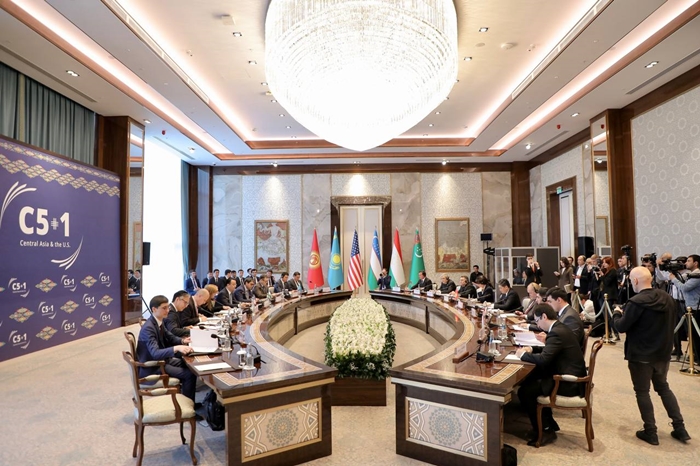
QAZAQ GREEN. On October 24, U.S. Agency for International Development (USAID) Administrator Samantha Power and Ministers from the Republic of Uzbekistan, Republic of Kazakhstan, the Kyrgyz Republic, the Republic of Tajikistan, and Turkmenistan met in Samarkand, Uzbekistan under the auspices of the C5+1 regional diplomatic platform.
During the C5+1 Regional Connectivity Ministerial, co-hosted by USAID and the Government of the Republic of Uzbekistan, Administrator Power emphasized the United States’ commitment to enhance regional cooperation with Central Asia by optimizing trade, strengthening bilateral trade and investment ties, diversifying export-import markets, boosting green energy development and energy efficiency, and driving inclusive and sustainable economic growth. The participants affirmed their commitment to protecting human rights, including the rights of women, children, and persons with disabilities.
The participants expressed their intent to collaborate on issues of regional economic importance such as supporting sustainable green energy, transport sector development, and strengthening customs and border management. The participants underscored the importance of C5+1 collaboration that delivers regional solutions to global challenges.
During the C5+1 Ministerial, participants:
Committed to working together to ensure a prosperous future for Central Asia and discussed how to mitigate the negative consequences of recent international developments, especially in the areas of inflation, reverse migration, debt management, and employment rates;
Recognized that promoting inclusive economic growth and economic resilience in Central Asia is essential for the region's long-term prosperity and stability;
Shared a desire to advance collective and country commitments to address the climate crisis, including through the increased use of renewable energy sources, implementing energy efficient technologies, rapidly reducing methane from fossil energy and other sectors, and developing “green” economies, taking into account the national circumstances and available resources of states;
Commended USAID’s ongoing Power Central Asia initiative, which supports the C5 governments’ national and regional priorities in energy security, clean energy development, and regional integration of energy systems;
Stressed the need to promote cooperation that helps to preserve glaciers, improve the efficient and rational use of water resources, and enhance regional and transboundary management of water resources and understanding of how to leverage existing activities and programs, including the USAID Regional Water and Vulnerable Environment initiative, to advance shared water and agricultural objectives that will improve food security;
Recognized the importance of improving the investment and business enabling environment through regulatory and legal improvements;
Discussed the importance of developing the region’s digital, technological, and innovative economies to spur economic growth and job creation;
Recognized the importance of strengthening intraregional trade, transport, and transit links as well as the importance of increasing transport cooperation, interconnectivity, and transport sustainability in Central Asia by developing relevant joint projects and programs and promoting existing ones;
Noted the need to deepen trade and investment ties with the United States as well as the importance of joint implementation of policies to diversify external economic connections and cultivate new export markets with the assistance of USAID’s Trade Central Asia Activity and additional U.S. government programming;
Highlighted the importance of the Trans-Caspian Trade Route and additional multimodal transport corridors that would foster increased international transit and enhanced cargo transport, and considered actions that will increase investment into such trade routes and transit corridors;
Acknowledged the importance of scaling up women’s economic empowerment efforts across the region and supporting workforce development and employment for women, youth, and persons with disabilities;
Recognized that regional efforts to address accessibility challenges, reduce the digital divide, and promote inclusive design have the potential to significantly improve the lives of persons with disabilities by increasing their access to education, employment, healthcare, and social opportunities;
Highlighted the importance of local organizations in developing community-based solutions, where it is appropriate, that will lead to sustainable economic growth; and,
Underscored that a peaceful and prosperous Central Asia requires a sustained commitment to the independence, sovereignty, and territorial integrity of all countries through upholding the UN Charter and its principles.
Kazakhstan and World Bank discuss energy integration in Central Asia
Construction of 500 MW wind power plant begins in Karaganda region
50 MW solar power plant auction winner determined in Kazakhstan's Southern Grid Zone
Rooftop solar panels: Kyrgyzstan prepares rules for households and businesses
Europe’s rising heat: Can renewables provide the solution?
Winner announced for 100 MW solar auction in Kazakhstan
Chinese company ready to invest $1 billion in solar and wind generation in Kyrgyzstan
Meta to invest in space solar energy and ultra-long-duration energy storage
Tokyo pushing plan for world’s biggest floating wind power farm
Kazakhstan cancels 50 MW solar auction due to lack of participants
Tokayev ratifies Green Energy Corridor Agreement with Azerbaijan and Uzbekistan
China raises RES share to 60% of total installed capacity
Batys Kaspiy Energo wins auction for 250 MW wind farm in Atyrau region
Ember: Renewables overtake coal in global power generation for the first time
Kazakhstan continues accepting applications for May RES auctions
Water-energy balance of the region discussed by ministers of four Central Asian countries
Just transition: leaving no one behind in the energy transformation
CAREC and Central Asian universities sign new memoranda on green skills development
Kazakhstan and UNECE discuss energy resilience and low-carbon technologies
100,000 jobs and a skills gap: how Central Asia is preparing for the renewables boom