

World News11.03.2024
Taiwan has found a way to recycle wind farm blades to solve a key industry


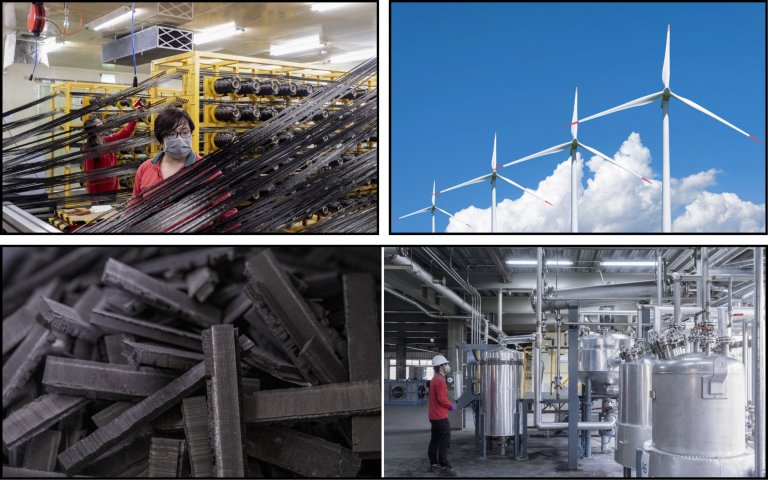
QAZAQ GREEN. By 2044, the volume of spent blades will reach 782,000 metric tons In Taiwan, Swancor Holding Co has developed a new resin, EzCiclo, for the production of wind turbine blades that can be recycled at the end of its service life and allows the reuse of carbon fibers from the blades.
For the wind energy industry, the inability to recycle blades is the most serious problem, which is why it is systematically criticized, Ecopolitic reports citing Bloomberg.
Robert Tsai, the company's director, said that traditional composite resin for blades is difficult to return to liquid form. However, EzCiclo can be dissolved in a heated container with a special liquid, which will also allow the reuse of carbon fibers.
It is noted that traditionally, used blades end up in landfills or are burned in industrial furnaces. Some blades are used in the construction of bridges, but this does not solve the problem of the industry. In addition, wind power capacity is increasing every year, and the size of new installations is constantly growing.
With a service life of approximately 20 years, composite waste from decommissioned blades will increase 20-fold to 782,000 metric tons in 2044, according to BloombergNEF.
Tsai explained that the fibers become shorter and less strong after processing and cannot be reused to make new blades. However, they can be used to make car bumpers, camping tables, etc. In addition, the liquid formed during processing can be used for the production of polyester.
The article highlighted that the wind energy industry produces less composite waste compared to other industries such as construction and electronics, and about 90% of turbines can be recycled.
“Even without recycling the blades, wind energy is still much better for the environment than burning fossil fuels. But the industry is still looking for a solution," said Bloomberg.
It is noted that the global market for recycled carbon fiber will amount to $278 million by 2028. That's a relatively small number compared to the $217 billion invested in wind energy in 2023, according to BNEF. But this solution can save thousands of tons of industrial waste.
Swancor emphasized that the processing of composite carbon fiber produces approximately 2 kg of carbon emissions for every kilogram of fiber. However, in the production of primary material, this indicator reaches 55 kg. Currently, the company is still working on evaluating the life cycle of the new technology and the service life of such blades.
Tsai added that EzCiclo costs about 10 to 15 percent more than traditional resin, but that only partially increases the overall cost of the project.
Kazakhstan and World Bank discuss energy integration in Central Asia
Construction of 500 MW wind power plant begins in Karaganda region
50 MW solar power plant auction winner determined in Kazakhstan's Southern Grid Zone
Rooftop solar panels: Kyrgyzstan prepares rules for households and businesses
Europe’s rising heat: Can renewables provide the solution?
Winner announced for 100 MW solar auction in Kazakhstan
Chinese company ready to invest $1 billion in solar and wind generation in Kyrgyzstan
Meta to invest in space solar energy and ultra-long-duration energy storage
Tokyo pushing plan for world’s biggest floating wind power farm
Kazakhstan cancels 50 MW solar auction due to lack of participants
Tokayev ratifies Green Energy Corridor Agreement with Azerbaijan and Uzbekistan
China raises RES share to 60% of total installed capacity
Batys Kaspiy Energo wins auction for 250 MW wind farm in Atyrau region
Ember: Renewables overtake coal in global power generation for the first time
Kazakhstan continues accepting applications for May RES auctions
Water-energy balance of the region discussed by ministers of four Central Asian countries
Just transition: leaving no one behind in the energy transformation
CAREC and Central Asian universities sign new memoranda on green skills development
Kazakhstan and UNECE discuss energy resilience and low-carbon technologies
100,000 jobs and a skills gap: how Central Asia is preparing for the renewables boom