

World News03.09.2025
German scientists develop facade solar panels with efficiency up to 80%


QAZAQ GREEN. Researchers at Fraunhofer FEP have achieved a breakthrough in solar technology that could revolutionize building design by creating photovoltaic modules that are virtually indistinguishable from conventional facade elements.
The innovation addresses one of the biggest barriers to widespread solar adoption: aesthetics. While building-integrated photovoltaics (BIPV) offer enormous potential for urban energy generation, property owners and architects have long resisted installing solar panels that compromise building appearance.
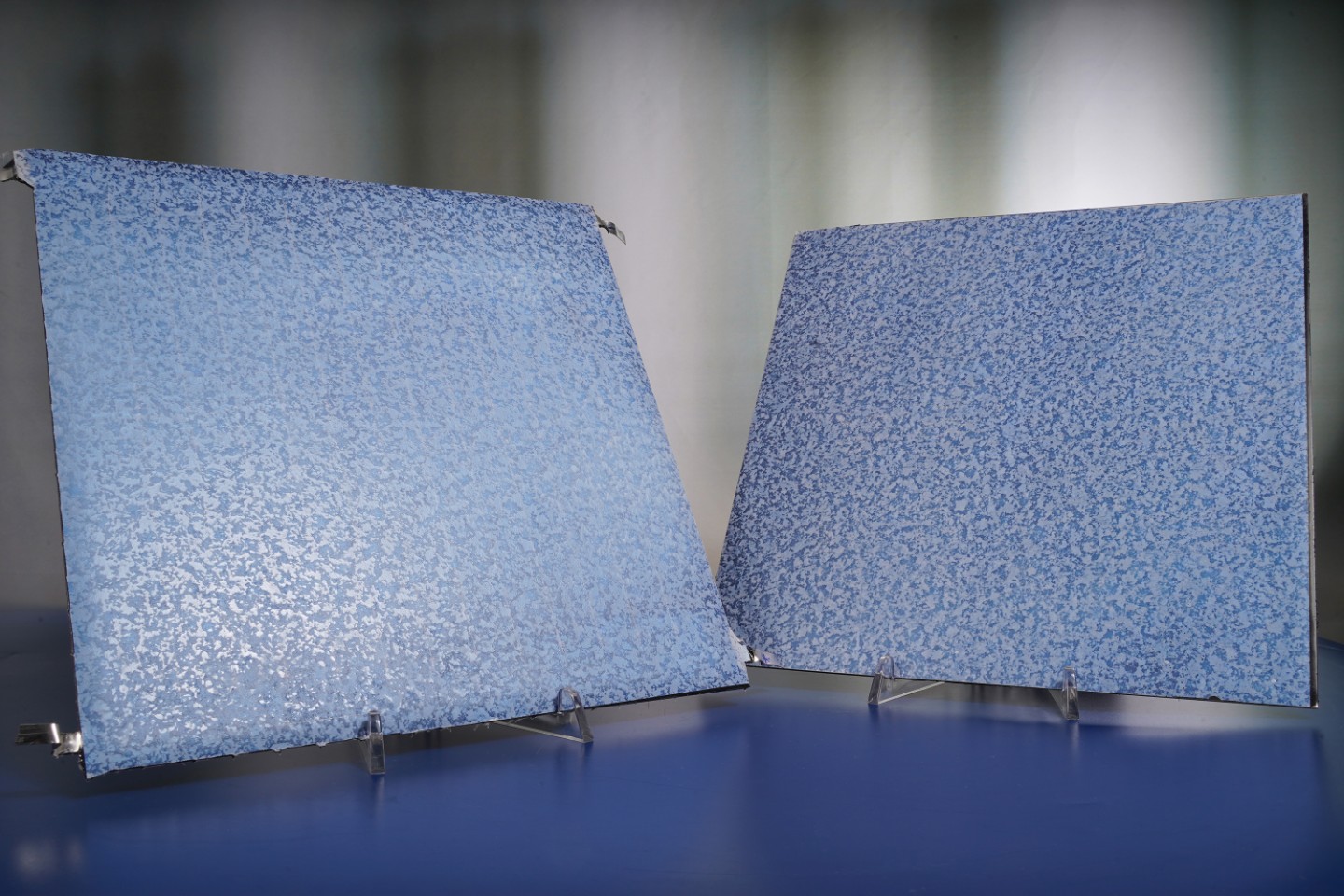
"Tests show that the PV modules with decorative finishes are visually indistinguishable from conventional facade elements and achieve up to 80% of the performance of uncovered comparison modules," said Dr. Steffen Günther, project manager at Fraunhofer FEP.
The technology uses advanced roll-to-roll nanoimprint lithography to apply decorative films to solar modules, allowing them to seamlessly blend with metal facade elements. This manufacturing process can produce uniform designs across entire building facades, making solar installations nearly invisible to observers.
The development is part of the Design-PV project, funded by the German Federal Ministry for Economic Affairs and Energy through 2026. The initiative brings together six partners working to overcome technical challenges in building-integrated solar technology.
One major hurdle the team solved was adhesion. Solar panels typically use ETFE (ethylene tetrafluoroethylene) film, which has excellent weather resistance but poor surface adhesion. Fraunhofer FEP developed a specialized plasma process that creates nanometer-scale roughness on the ETFE surface, dramatically improving how decorative layers bond to the material.
The timing is crucial for Germany's climate goals. The country aims to achieve carbon neutrality by 2045, and building-integrated photovoltaics represent a significant untapped resource for clean energy generation. Traditional rooftop installations often face space constraints, making facade integration an attractive alternative.
Initial testing has validated multiple design options, with researchers successfully applying various decorative finishes that maintain both aesthetic appeal and energy production capability. The modules underwent evaluation by the Institute for Solar Energy Research in Hamelin, confirming their visual integration and performance metrics.
The research team is now conducting comprehensive tests on long-term stability and weather resistance. Additional design options and color variations are also being developed to give architects greater flexibility in solar integration projects.
Dr. Günther will present the findings at the Radtech Europe Conference in Warsaw this October, where industry professionals will get their first detailed look at the manufacturing process and potential applications.
The advancement could significantly accelerate BIPV adoption in commercial and residential construction, potentially transforming how cities generate renewable energy without compromising architectural aesthetics.
Kazakhstan and World Bank discuss energy integration in Central Asia
Construction of 500 MW wind power plant begins in Karaganda region
50 MW solar power plant auction winner determined in Kazakhstan's Southern Grid Zone
Rooftop solar panels: Kyrgyzstan prepares rules for households and businesses
Europe’s rising heat: Can renewables provide the solution?
Winner announced for 100 MW solar auction in Kazakhstan
Chinese company ready to invest $1 billion in solar and wind generation in Kyrgyzstan
Meta to invest in space solar energy and ultra-long-duration energy storage
Tokyo pushing plan for world’s biggest floating wind power farm
Kazakhstan cancels 50 MW solar auction due to lack of participants
Tokayev ratifies Green Energy Corridor Agreement with Azerbaijan and Uzbekistan
China raises RES share to 60% of total installed capacity
Batys Kaspiy Energo wins auction for 250 MW wind farm in Atyrau region
Ember: Renewables overtake coal in global power generation for the first time
Kazakhstan continues accepting applications for May RES auctions
Water-energy balance of the region discussed by ministers of four Central Asian countries
Just transition: leaving no one behind in the energy transformation
CAREC and Central Asian universities sign new memoranda on green skills development
Kazakhstan and UNECE discuss energy resilience and low-carbon technologies
100,000 jobs and a skills gap: how Central Asia is preparing for the renewables boom