

News Kazakhstan03.02.2026
PwC Kazakhstan published ESG Disclosure Rating


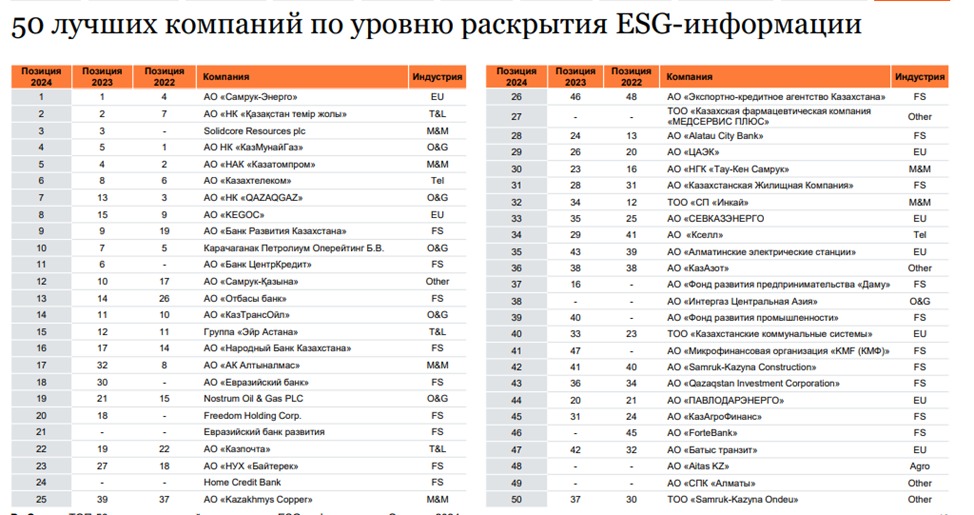
QAZAQ GREEN. PwC Kazakhstan has published the sixth edition of the TOP 50 leading Kazakhstani companies in ESG disclosure for 2024. The study reviewed annual, integrated, ESG, and social reports from 98 companies across a wide range of sectors. Reporting quality was assessed against 165 criteria covering the completeness, quality, and accessibility of ESG disclosures. Based on the results, PwC compiled a ranking of the Top 50 companies with the highest level of ESG information disclosure.
The average score of the top ten reports reached 8.5 out of 10, compared with 8.4 in the previous year and 7.4 in 2022. Samruk-Energy JSC retained its leading position for the second consecutive year, earning an “A+” rating despite stricter assessment criteria. The Top 10 also includes NC Kazakhstan Temir Zholy JSC, Solidcore Resources plc, NC KazMunayGas JSC, NAC Kazatomprom JSC, Kazakhtelecom JSC, QAZAQGAZ JSC, KEGOC JSC, Development Bank of Kazakhstan JSC, and Karachaganak Petroleum Operating B.V. All companies in the top ten received ratings of “A” or higher.
A significant share of the ranking is made up of portfolio companies of the Samruk-Kazyna Fund, reflecting a consistent approach to ESG management and aligning with the Fund’s objective of positioning its major portfolio companies above 70% of global peers in ESG ratings by 2032.
Nearly all companies in the study (98%) described their overall approach to sustainable development. However, only 68% articulated specific ESG targets, up from 54% in 2023, and just 44% of those supported their targets with measurable indicators. This suggests that ESG remains largely declarative for a substantial portion of the market.
Progress is evident in the area of materiality. Some 86% of companies identified key sustainability topics, while 76% disclosed the methodology used to determine them. At the same time, only 18% applied the concepts of double or dynamic materiality, indicating that deeper integration of ESG considerations into corporate strategy remains a key challenge.
Risk management practices are also evolving. The share of companies identifying ESG-related risks increased by 18%, yet only 6% assessed the financial impact of these risks. Key stakeholder groups were identified by 94% of companies, although only 52% reported concrete actions to address stakeholder interests.
Environmental disclosures remain largely climate-focused. Data on direct greenhouse gas emissions are disclosed by 88% of companies, while 78% report emissions related to energy consumption. The share of companies disclosing other indirect emissions across the value chain nearly doubled to 46%. Two-thirds of companies describe climate-related risks and opportunities, and the use of scenario analysis increased from 16% in 2023 to 34%. However, only 28% distinguish between physical and transition risks and present mitigation or adaptation plans.
Attention to water management, waste, and biodiversity continues to lag behind climate issues. Long-term climate targets have been set by 48% of companies, while significantly fewer have defined waste-related targets. Progress tracking remains limited: only 16% monitor progress against climate goals, with even lower monitoring levels in other environmental areas.
In the social dimension, disclosure levels are relatively high, largely due to regulatory requirements. All companies reported having occupational health and safety policies, and 90% conducted related training. However, only 32% disclosed measures to promote equal opportunities, and just 38% reported data on gender pay ratios. Assessments of impact on local communities were conducted by 64% of companies, while 76% disclosed investments in social infrastructure. Only 18 companies in the Top 50 approved formal human rights policies, and 16% published ESG requirements for suppliers.
Within the governance pillar, 72% of companies disclosed information on individuals responsible for sustainability matters, but only 32% integrated non-financial KPIs into executive remuneration. Board independence was disclosed by 84% of companies, while only 54% reported conducting board performance assessments.
Compliance with international reporting frameworks continues to improve. Some 92% of companies reported alignment with GRI, SASB, or the Agency of the Republic of Kazakhstan for Regulation and Development of Financial Market recommendations, compared with 82% in 2023. Only 18% reported alignment with IFRS S1 and S2. The share of companies obtaining external assurance of non-financial information increased to 38%, up from 30% a year earlier, and 71% published reports in the Kazakh language.
For the first time, the study includes a dedicated sectoral analysis. The financial sector is the most represented in the Top 50, accounting for 19 of the 35 companies in the sample. More than half of financial institutions (53%) incorporated ESG considerations into credit and investment decisions, while 40% accounted for financed emissions.
Oil and gas companies disclose non-financial information at above-average levels but remain less prepared to engage in discussions on a just energy transition. The energy sector underperforms the Top 50 average across most indicators, and none of the energy companies disclosed value-chain emissions. Mining companies achieved above-average results, particularly in the social pillar, with all reporting water withdrawal and discharge volumes.
“The market is gradually moving toward a more structured and systematic approach, although the gap between leaders and the rest of the market remains significant. We hope the study will serve as a practical benchmark for companies and support the further development of transparent, long-term value-driven ESG practices in Kazakhstan,” said Natalia Lim, Partner at Strategy& and ESG Practice Leader for Eurasia.
Overall, the findings indicate steady progress in ESG practices among companies in Kazakhstan. At the same time, the integration of sustainability into corporate strategy and financial processes remains the key challenge—and opportunity—for companies seeking to strengthen their leadership positions.
Kazakhstan and World Bank discuss energy integration in Central Asia
Construction of 500 MW wind power plant begins in Karaganda region
50 MW solar power plant auction winner determined in Kazakhstan's Southern Grid Zone
Rooftop solar panels: Kyrgyzstan prepares rules for households and businesses
Europe’s rising heat: Can renewables provide the solution?
Winner announced for 100 MW solar auction in Kazakhstan
Chinese company ready to invest $1 billion in solar and wind generation in Kyrgyzstan
Meta to invest in space solar energy and ultra-long-duration energy storage
Tokyo pushing plan for world’s biggest floating wind power farm
Kazakhstan cancels 50 MW solar auction due to lack of participants
Tokayev ratifies Green Energy Corridor Agreement with Azerbaijan and Uzbekistan
China raises RES share to 60% of total installed capacity
Batys Kaspiy Energo wins auction for 250 MW wind farm in Atyrau region
Ember: Renewables overtake coal in global power generation for the first time
Kazakhstan continues accepting applications for May RES auctions
Water-energy balance of the region discussed by ministers of four Central Asian countries
Just transition: leaving no one behind in the energy transformation
CAREC and Central Asian universities sign new memoranda on green skills development
Kazakhstan and UNECE discuss energy resilience and low-carbon technologies
100,000 jobs and a skills gap: how Central Asia is preparing for the renewables boom