

World News14.06.2023
Norway considers opening Germany-sized area to deep-sea mining


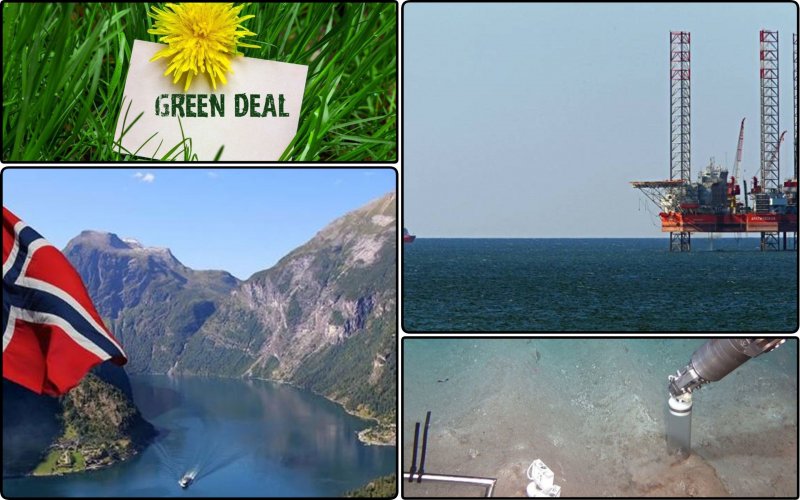
QAZAQ GREEN. Norway’s government is gearing up to establish itself as a frontrunner in deep-sea mining, with plans to open an oceanic area nearly the size of Germany to extract essential battery metals from its sea floor, mining.com reports.
The move comes as companies and nations shift their attention to the mineral-rich ocean floor, a valuable source of materials for smartphones and electric vehicles.
Most minerals are found in potato-sized rocks called polymetallic nodules, which are rich in cobalt, nickel, and other valuable metals.
The International Seabed Authority, an arm of the United Nations, has a deadline of July 9 to put together regulation before deep-sea mining begins following a clause triggered by the Pacific Island of Nauru in 2021.
Norway’s energy ministry aims to submit a proposal to parliament within the next two weeks, allowing exploration and extraction close to Svalbard, the Norwegian archipelago in the Arctic, the Financial Times reported. The plan would then face a parliamentary vote in the fall.
However, Norway is not without challenges in its pursuit of deep-sea mining. Fishing businesses and environmentalists have expressed strong opposition to the proposal.
Moreover, there is the risk of sparking disputes with other nations as the Svalbard Treaty grants Norway mining rights to the area along with Denmark, France, Ireland, Italy, Japan, the Netherlands, Sweden, Russia, the UK, and the US.
Norway argues it commands exclusive mining rights over a larger area of water there than Russia, the UK and the EU contend it does.
The proposed area contains volcanic springs that surge from the Earth’s crust, housing an estimated 38 million tonnes of copper—more than global annual copper production.
Norwegian Prime Minister Jonas Gahr Støre told the national newspaper Bergens Tidende that deep-sea mining can be conducted without harming ocean life. Environmentalists and scientists, however, refute this claim.
In a recent study focusing on the Clarion-Clipperton Zone (CCZ) in the Pacific Ocean, an area targeted for deep-sea mining stretching from Hawaii to Mexico, researchers discovered over 5,000 species, with the vast majority unknown to science.
“It’s critical that we address these data gaps so we actually can understand what species are there if mining happens,” said Muriel Rabone, a biologist and data analyst at the Natural History Museum in London and co-author of the study.
Rabone said the researchers estimate that at least 30% to 40% of CCZ species live on the nodules.
“They are most vulnerable to mining because if the nodules are removed you’re literally taking out their habitat, their house,” she said.
Kazakhstan and World Bank discuss energy integration in Central Asia
Construction of 500 MW wind power plant begins in Karaganda region
50 MW solar power plant auction winner determined in Kazakhstan's Southern Grid Zone
Rooftop solar panels: Kyrgyzstan prepares rules for households and businesses
Europe’s rising heat: Can renewables provide the solution?
Winner announced for 100 MW solar auction in Kazakhstan
Chinese company ready to invest $1 billion in solar and wind generation in Kyrgyzstan
Meta to invest in space solar energy and ultra-long-duration energy storage
Tokyo pushing plan for world’s biggest floating wind power farm
Kazakhstan cancels 50 MW solar auction due to lack of participants
Tokayev ratifies Green Energy Corridor Agreement with Azerbaijan and Uzbekistan
China raises RES share to 60% of total installed capacity
Batys Kaspiy Energo wins auction for 250 MW wind farm in Atyrau region
Ember: Renewables overtake coal in global power generation for the first time
Kazakhstan continues accepting applications for May RES auctions
Water-energy balance of the region discussed by ministers of four Central Asian countries
Just transition: leaving no one behind in the energy transformation
CAREC and Central Asian universities sign new memoranda on green skills development
Kazakhstan and UNECE discuss energy resilience and low-carbon technologies
100,000 jobs and a skills gap: how Central Asia is preparing for the renewables boom