

World News01.11.2023
Meet the world’s first battery-electric heavy-haul locomotive


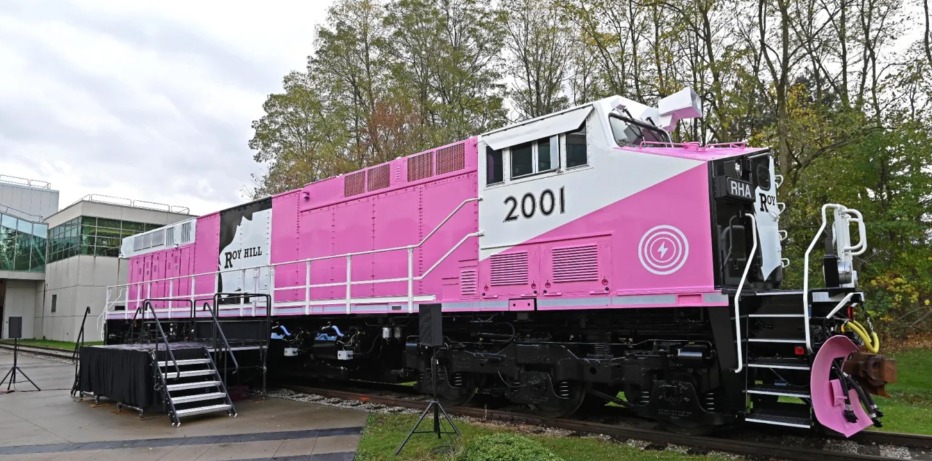
QAZAQ GREEN. Wabtec’s FLXdrive Heavy Haul locomotive, the world’s first 100% battery-electric heavy-haul locomotive for mainline service, is headed to Australia to transport iron ore, Electrek.co reports.
World’s first electric heavy-haul locomotive
Iron ore mining company Roy Hill is piloting the FLXdrive commercially in Western Australia’s Pilbara region. It has a max battery capacity of 7 megawatt hours (MWh). (To put that huge amount of energy output in perspective, just 1 MWh allows an EV to drive 3,600 miles or power an American home for 1.2 months.)
Roy Hill’s locomotive is painted pink because the company supports breast cancer research. Wabtec is finishing up the locomotive’s build now, and then it will be tested further in the first half of 2024. It will be shipped to Australia in the second half of next year.
The FLXdrive has six axles, a CoCo wheel arrangement, one operator cab, and 3.2 MW traction power. (Wabtec’s general specs say it’s able to configure the model with a max battery capacity of 8 MWh.)
But while the FLXdrive is electric, Roy Hill’s train won’t be. The FLXdrive will be paired with a diesel locomotive, making the train’s consist – a set of railroad vehicles that form a train – hybrid. Wabtec says the hybrid configuration will result in a “double-digit percentage reduction in fuel costs and emissions.”
Alan Hamilton, Wabtec’s VP of engineering, said in a video call with me that “the train set in Australia is typically a mile and a half long, and it’s heavy, so at this early period of adoption, we are combining the electric locomotive with a diesel locomotive. It’s the first initial practical step.” Roy Hill’s trains carry more than 33,000 tonnes of iron ore.
What’s interesting about Roy Hill’s FLXdrive model is that it’s going to charge entirely on regenerative braking. That’s possible because the train’s route goes up and down a mountain. Hamilton said that Roy Hill’s FLXdrive locomotive is “not critical for mission distance” because it’s paired with a diesel locomotive.
Gerhard Veldsman, CEO of Hancock Prospecting Group Operations, which owns Roy Hill, said of its FLXdrive model:
By using regenerative braking, it will charge its battery on the 344-kilometer [214-mile] downhill run from our mine to port facility and use that stored energy to return to the mine, starting the cycle all over again. This will not only enable us to realize energy efficiencies but also lower operating costs.
This electric milestone in heavy-haul train transport is something to celebrate.
When I asked Hamilton whether Wabtec had active plans for battery-locomotive-only pilots, Hamilton replied that while he thought it was possible to build and run an all-battery heavy haul train, Wabtec’s strategy is currently “energy flexibility.” He also said that “diesel is going to be around for a while.”
The company’s “road map for sustainability” shows an all-of-the-above approach. The 2030+ plan includes diesel trains that Wabtec says have– a set of railroad vehicles that form a train – a potential CO2 reduction of 8%. It’s also got hybrid (30% CO2 reduction), fully electric (100% CO2 reduction, of course), and hydrogen (100% CO2 reduction) locomotives on its to-do list. There’s a vague mention of biofuels.
Rail is one of the most efficient and least emitting ways of transporting goods. In August, Antônio Merheb, the president of the International Heavy Haul Association, told the International Railway Journal that “the rail sector is recognized as the transport mode that emits the lowest level of polluting gases, which makes it an attractive option to reduce the environmental impact of freight transport.”
So it’s great to see Wabtec come up with a solution to reduce emissions further, but it feels a little like Wabtec is dipping its toe in the water with electrification. We know heavy haul trains are a big challenge to power with batteries; we just hope Wabtec pivots and rises to the challenge in the electric side of its sustainability plan.
Kazakhstan and World Bank discuss energy integration in Central Asia
Construction of 500 MW wind power plant begins in Karaganda region
50 MW solar power plant auction winner determined in Kazakhstan's Southern Grid Zone
Rooftop solar panels: Kyrgyzstan prepares rules for households and businesses
Europe’s rising heat: Can renewables provide the solution?
Winner announced for 100 MW solar auction in Kazakhstan
Chinese company ready to invest $1 billion in solar and wind generation in Kyrgyzstan
Meta to invest in space solar energy and ultra-long-duration energy storage
Tokyo pushing plan for world’s biggest floating wind power farm
Kazakhstan cancels 50 MW solar auction due to lack of participants
Tokayev ratifies Green Energy Corridor Agreement with Azerbaijan and Uzbekistan
China raises RES share to 60% of total installed capacity
Batys Kaspiy Energo wins auction for 250 MW wind farm in Atyrau region
Ember: Renewables overtake coal in global power generation for the first time
Kazakhstan continues accepting applications for May RES auctions
Water-energy balance of the region discussed by ministers of four Central Asian countries
Just transition: leaving no one behind in the energy transformation
CAREC and Central Asian universities sign new memoranda on green skills development
Kazakhstan and UNECE discuss energy resilience and low-carbon technologies
100,000 jobs and a skills gap: how Central Asia is preparing for the renewables boom